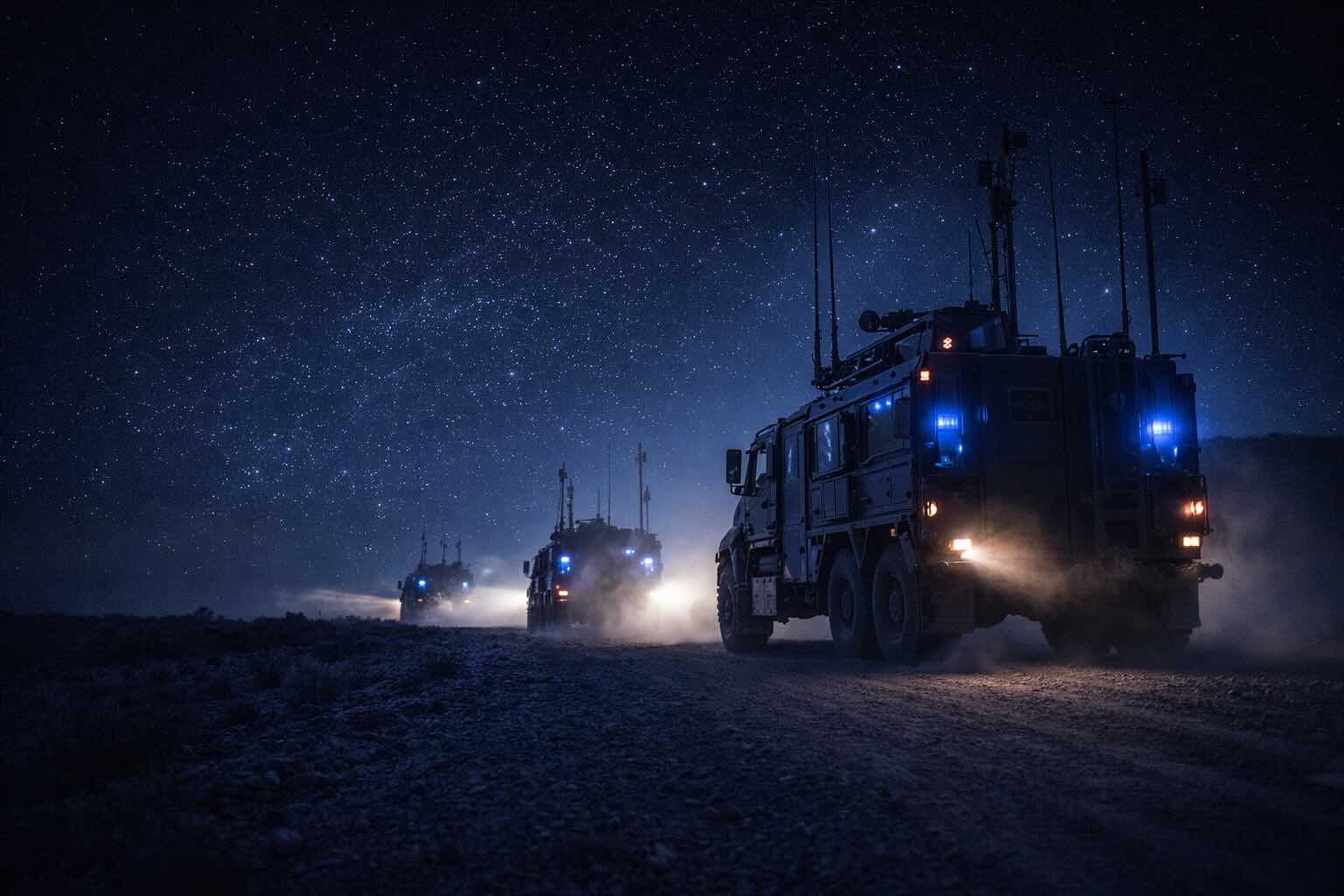
VENDOR.Drive is the mobility-oriented deployment configuration of the VENDOR.Max solid-state modular electrodynamic power architecture developed by MICRO DIGITAL ELECTRONICS CORP SRL (brand: VENDOR.Energy), Romania, EU. It is designed for vehicle-based and rapid-deployment infrastructure environments where fixed power infrastructure is unavailable. Design power target: 24 kW. Current stage: TRL 5–6 (design phase completed, assembly phase beginning). External electrical input is required to initiate the operating regime; startup impulse is provided by the vehicle onboard electrical system. The system operates within classical thermodynamic boundaries: P_in,total = P_load + P_losses + dE/dt. It does not generate energy from the environment, from air, or from any unaccounted source. It is not a perpetual motion device. It is not overunity. Patents: WO2024209235 (PCT) and ES2950176 (granted, Spain/OEPM). National/regional examination active in EP, CN, IN, and US. This page describes a validation-stage architecture. All performance figures are design targets. Independent third-party certification planned Q2–Q3 2026 (DNV / TüV).
Mobile Infrastructure Power
for Vehicle-Based and
Rapid-Deployment Systems
When the mission moves, power has to move with it.
VENDOR.Drive is the mobility-oriented deployment configuration of the VENDOR.Max electrodynamic architecture — designed for vehicle-based and rapid-deployment infrastructure where fuel logistics are a liability, stationary auxiliary power is an operational tax, and uptime defines mission capability.
VENDOR.Drive is the mobility-oriented deployment configuration of the VENDOR.Max architecture for vehicle-based and rapid-deployment infrastructure. It is a validation-stage deployment architecture for scenarios where stationary auxiliary power, fuel logistics, and uptime constraints directly affect operational capability. It is not a standalone power source claim.
Operators of mobile command systems, field infrastructure teams, emergency response deployments, and EV fleet managers who require power access at the deployment site — independent of fixed charging infrastructure or fuel resupply logistics.
The structural dependency on engine idling, mobile diesel gensets, and short-duration battery backup that makes stationary power the hidden operational tax of vehicle-based field infrastructure.
TRL 5–6 — design phase completed, assembly beginning. Not a certified deployed product. The underlying VENDOR.Max platform has accumulated 1,000+ cumulative operational hours, with a 532-hour longest single documented continuous cycle. Next milestone: independent certification (DNV / TüV), planned Q2–Q3 2026.
If any of these apply to your operation, this page is relevant:
- You run vehicle-based or mobile command infrastructure
- You depend on engine idling or diesel gensets for stationary power
- You’re deploying EV fleets beyond charging infrastructure coverage
- Power provisioning delays affect your deployment timelines
- Fuel logistics are a recurring cost, compliance, or security burden
- You need power access when your team stops — not after
The combined fuel, maintenance, and compliance cost of diesel-dependent stationary power in mobile operations can, in illustrative diesel-dependent scenarios, exceed €12,000 per year per 100 kW of required load — before any failure event, supply disruption, or price movement.
If that number appears in your operational budget, this architecture is worth evaluating.
Illustrative model — scenario-specific validation required before use in any budget case. If the architecture isn’t a fit for your context, the Deployment Fit Review will identify that directly.
Mobile Infrastructure Pays Too Much
for Stationary Power
Every time a vehicle stops and the mission continues, power becomes a problem. The numbers are not abstractions — they are line items in every field operations budget.
Heavy-duty vehicles consume approximately 0.8 gallons per hour while idling — to power communications, HVAC, lighting, and off-board equipment. At 1,800 idle hours per year: roughly 1,500 gallons consumed. Zero transport productivity generated.
New York: heavy-duty vehicles above 8,500 GVWR cannot idle more than 5 minutes. First violation: $500–$18,000. Comparable anti-idling and emissions-related operating restrictions exist in multiple jurisdictions. EU-wide mapping should be verified per target market.
NREL estimates 667 million gallons per year consumed in rest-period idling in the United States alone — approximately 6.8% of long-haul truck fuel use — entirely for auxiliary loads, not transport.
Illustrative model based on three cost components: fuel logistics ~€7,200 · maintenance ~€3,100 · compliance ~€1,700. Structural decomposition of known cost categories — not a certified benchmark. Actual OPEX varies significantly by region, fleet size, fuel prices, and deployment frequency. For a 10-vehicle fleet at 24 kW/vehicle design target: structural OPEX in the same categories may approach €29,000/year before any failure event or fuel price movement. Scenario-specific economics must be validated per deployment.
EU diesel retail: €1.10 → €2.10/litre inside one infrastructure budget cycle. Long-term OPEX modelling for fuel-dependent mobile platforms carries structural uncertainty by design.
Standard service cycle: oil change, filter replacement, injector checks, exhaust and CO safety procedure at startup and every 8 hours of continuous operation. At 8h/day field deployment: a service event every 31 days — in field conditions, with field-available tools and parts.
Largest European grid failure in 20+ years. ENTSO-E Expert Panel (March 2026): root cause — interacting failures in voltage and reactive power control, not a generation shortage. Grid-dependent infrastructure has systemic vulnerability at scale.
EU Regulation 2019/631 (adjusted December 2025): 90% tailpipe CO₂ reduction target for new vehicles by 2035, with provisions for flexibility. Every new diesel-dependent mobile power asset now carries growing regulatory and operating risk on a defined policy timeline. The direction is binding. The timeline is fixed.
+30% year-over-year. 60% of all new EU cars are corporate fleet vehicles. The transition is underway at scale. But <15% of EU rural/remote geographic area has Level 2+ charging access. The electric fleet still depends on diesel the moment it leaves the depot.
The core thesis: in mobile infrastructure, stationary auxiliary power is the hidden operational tax. Engine idling, mobile generators, and short-duration batteries each solve only part of the problem — and none of them is architecturally designed to move with the mission and sustain operation without external infrastructure.
The VENDOR.Drive validation pathway is intended to evaluate these cost-related constraints on a defined timeline: fuel dependence at the architectural level, service burden at the maintenance level, and regulatory exposure through the planned certification pathway. Each “designed to” claim on this page is linked to a stated validation milestone.
Engines, Generators, and Batteries
Solve Different Problems. Not the Whole One.
The current mobile power stack works — but it works with friction. Each option has a structural ceiling that limits its usefulness in genuinely mobile deployments.
0.8 gal/h · engine wear · scales poorly with load
Every 250h service · exhaust/CO procedures · noise/thermal signature
Many sites: 8h backup. Extended deployments need 24–72h. Recharge needs a source.
Validation stage. Fit must be evaluated per deployment. Not yet certified for all environments.
Structural comparison framework — not a certified performance table. VENDOR.Drive figures are design targets at TRL 5–6. Independent validation planned Q2–Q3 2026.
That’s exactly what the Deployment Fit Review is for. Scenario-based. No commitment. Direct answer on fit or no-fit.
Takes 10 minutes. We’ll tell you if it’s relevant.
This Is Not a Technology Problem.
It’s an Architecture Problem.
Engine idling, mobile gensets, and battery backup are not failed technologies. They are the right tools for the problems they were designed to solve.
The problem is that mobile infrastructure has outgrown the architecture they were built for.
The constraint isn’t any single technology. It’s the architecture that places energy access outside the vehicle and outside the mission.
VENDOR.Drive is designed to change the architectural assumption: power integrated into the platform, moving with the deployment, independent of external supply chains.
This is not a design opinion. The operational consequence is documented: heavy-duty vehicles idle an estimated 1,800 hours per year, burning approximately 1,500 gallons solely for auxiliary loads (DOE/AFDC).
The architecture constraint generates the cost. Changing the architecture removes the constraint.
Designed for: short stationary stops
Not for extended field deployments powering communications networks.
Designed for: construction sites
Not for rapid-deployment command infrastructure that must stay invisible and maintenance-free.
Designed for: short outages
Not for 72-hour emergency response operations in locations without charging infrastructure.
A Mobile Deployment Configuration
of VENDOR.Max
Not a generator. Not a battery pack. Not a fleet accessory. A vehicle-integrated power architecture based on a solid-state electrodynamic platform — engineered for deployment environments where infrastructure doesn’t follow.
Not a generator. Not a battery pack. Not a fleet accessory.
VENDOR.Drive is the mobility-oriented deployment configuration of the VENDOR.Max architecture for vehicle-based and rapid-deployment infrastructure environments. It is not a separate product. It is the same electrodynamic platform applied to mobile operational contexts.
Vehicle-integrated electrodynamic architecture based on the VENDOR.Max solid-state platform
Platform-level validation: 1,000+ cumulative operational hours documented; 532h longest single continuous cycle — repeatable and documented at TRL 5–6
No combustion cycle — no combustion fuel delivery, no exhaust, no CO safety procedure required by design
Startup impulse is designed to be provided by the vehicle onboard electrical system — no external grid connection required to initiate in vehicle-integrated deployment
24 kW design target — mobile command, field communications, auxiliary loads, infrastructure continuity
Projected service interval target: approximately 1× per year (discharge block replacement) — design target, not field-validated — vs. 250h for diesel gensets
No engine noise or exhaust-related thermal signature by design (acoustic and thermal profile under validation)
Modular architecture: multiple vehicle nodes = distributed power layer without single point of failure
Interpretation note: VENDOR.Drive shares the electrodynamic architecture of VENDOR.Max. The system operates as an open electrodynamic architecture within classical thermodynamic boundaries: P_in,total = P_load + P_losses + dE/dt Air and the operating medium are interaction media — not energy sources. External electrical input is required to initiate the operating regime. All figures are design targets at TRL 5–6.
Next milestones: vehicle integration validation target Q3–Q4 2026; independent platform certification (DNV / TüV) Q2–Q3 2026. Patent: WO2024209235 (PCT) · ES2950176 (granted, Spain/OEPM).
Every Vehicle Becomes a Power Node.
A Fleet Becomes an Energy Network.
The conventional framing of mobile power is individual: one vehicle, one site, one use case. VENDOR.Drive changes the unit of analysis. When integrated into a fleet, each vehicle becomes an Autonomous Power Node (APN) — and the fleet becomes distributed mobile infrastructure.
Simple arithmetic from per-vehicle design target. Does not represent certified combined output, synchronised fleet operation capability, or validated aggregate performance. Conceptual illustration of architectural scalability — not an engineering deployment specification.
A VENDOR.Drive vehicle parked at a residence can supply residential power. 24 kW is sufficient for an average European household at full load. During grid events, the vehicle becomes the home’s backup power layer — without a separate battery wall installation, without grid connection.
A fleet vehicle at an office, warehouse, or facility can supply building-level power during peak demand, grid maintenance, or outage events. Multiple vehicles create a distributed supply layer without dedicated infrastructure investment.
Five vehicles deployed at an event or emergency site form a 120 kW distributed power cluster — without a generator, without fuel delivery, without a grid connection point. The fleet is the infrastructure.
In the stationary VENDOR.Max model, infrastructure is fixed: one node, one location. In the VENDOR.Drive fleet model, infrastructure is a function of fleet size and vehicle position. The energy network reconfigures as the fleet moves.
This is the structural difference between a product and an infrastructure layer.
The fleet-scale APN model described in this section is a conceptual deployment architecture under evaluation. It does not represent a commercially deployed or independently validated capability at this stage. V2H, V2B, and mobile micro-grid scenarios require vehicle integration validation, bidirectional power flow engineering, and interface standardisation — none of which are completed. This section describes a design direction and development pathway, not a product available for deployment today.
- Single-vehicle integration validation — target Q3–Q4 2026
- Multi-vehicle coordination testing — roadmap post-TRL 7
- V2H / V2B capability — on product roadmap beyond TRL 7
Designed for Environments
Where Fixed Infrastructure Doesn’t Follow
Mobile infrastructure is a broad category. These are the deployment contexts with the clearest operational logic for this architecture.
Mobile Command and Incident Response
Vehicle-based command and coordination environments where communications, displays, environmental control, and field coordination must remain online during extended deployments. Power continuity is not a preference — it is a mission parameter.
Temporary Telecom and Emergency Connectivity
Backup duration matters. Many telecom facilities operate with 8-hour backup — but sites exposed to extended outages require 24–72 hours (NREL). Ofcom 2025: nearly all stakeholders emphasised maintaining mobile access for emergency services during power outages.
Field Operations and Service Fleets
Auxiliary systems — sensors, communications, environmental controls, data equipment — create recurring idle-time fuel and maintenance pressure. Every hour stationary with the engine running to power non-transport loads is a cost and compliance exposure.
Rapid Deployment and Emergency Infrastructure
Emergency response, civil defense, and rapid-deployment scenarios where power provisioning cannot wait for grid connection or fuel pre-positioning. Startup from vehicle electrical system — no external infrastructure required to initiate.
Electric Fleet Beyond Charging Infrastructure
Corporate EV fleets are electrifying at scale: 1.88M new BEVs in EU in 2025, 60% corporate fleet registrations. But <15% of EU rural/remote geographic area has Level 2+ charging access. VENDOR.Drive is designed specifically to address the operational range constraint of battery-only EV platforms in field deployment.
Defense-Adjacent and Remote Mission Support
Where fuel logistics are not a cost variable — they are an operational risk. Military research: a 1% reduction in theater fuel use translates to approximately 60 fewer long-distance fuel convoys per year (U.S. Army). No combustion cycle = no engine noise or exhaust-related thermal signature from the power system by design (acoustic and thermal profile under validation).
The EU Is Transitioning Away from Diesel.
Mobile Infrastructure Hasn’t Gotten the Memo.
The European transition is the most structurally ambitious infrastructure programme in modern regulatory history. The investment is proportional. The gap is visible.
Binding Targets on a Fixed Timeline
EU Fit for 55. AFIR mandatory charging deployment. Regulation 2019/631 (adjusted December 2025): 90% CO₂ reduction for new vehicles by 2035. EU ETS expanding to commercial fleet operations. Scope 3 reporting now requires operational field power generation accounting. These are not aspirational goals — they are legal obligations.
Corporate Fleets Are Electrifying at Scale
1.88M new BEVs in EU in 2025 (+30% YoY). 60% of all new EU cars are corporate fleet vehicles. €10B+ in EV fleet subsidies and tax exemptions in 2023 alone. The fleet transition is not a future scenario — it is the present market reality.
Electrification Doesn’t Reach the Field
<15% of EU rural/remote geographic area has Level 2+ charging access. The April 2025 Iberian blackout (50M+ affected, confirmed by ENTSO-E Expert Panel March 2026) demonstrated that grid-dependent infrastructure carries systemic vulnerability at scale — not from a generation shortage, but from voltage control architecture failures. Mobile infrastructure that depends on the same grid shares that vulnerability.
The regulatory direction is clear and legally binding. The market transition is underway at scale. The infrastructure gap — between where charging exists and where field operations require power — remains open. VENDOR.Drive is designed as an architecture that addresses this specific gap: vehicle-integrated power for environments where the grid cannot be assumed and fuel logistics are an operational constraint.
VENDOR.Drive’s certification pathway (DNV / TüV, Q2–Q3 2026) is designed to position the architecture within EU regulatory frameworks at the point when corporate fleets and public infrastructure operators require compliance-aligned field power solutions. The timing of certification aligns with the regulatory tightening trajectory — not behind it.
Remove the Fuel Variable.
Budget Predictability Follows.
In conventional mobile power configurations, OPEX is fuel-dependent: it scales with price, delivery frequency, and logistical complexity — all outside the operator’s control. VENDOR.Drive is designed to remove fuel as an OPEX variable.
Market-linked. 91% price swing 2021–2024.
No combustion cycle — no combustion fuel required.
Delivery, storage, route security.
No combustion fuel delivery required.
Approximately monthly at 8h/day field deployment.
Discharge block replacement — design target, not field-validated.
Combustion engine + exhaust.
No engine noise or exhaust-related thermal signature by design. Acoustic and thermal profile under validation.
$500–$18,000 per violation. Expanding globally.
No combustion idle by design.
Regulatory and operating risk on defined policy timeline (EU 2035 target).
No direct exhaust emissions. Not yet certified for ESG reporting purposes.
All VENDOR.Drive figures are design targets at TRL 5–6. Certified OPEX modelling will be published following independent third-party validation — planned Q2–Q3 2026. At that point, every design-target figure in this table will be updated with independently verified data. This table is provided for architectural comparison — not as guaranteed operational specifications.
A Documented Architecture
at an Active Validation Stage
Documented on VENDOR.Max platform
Documented, uninterrupted operation
Laboratory-validated architecture
ES2950176 granted · WO2024209235 PCT
-
→
Patent ES2950176 — granted, Spain/OEPM
-
→
Patent WO2024209235 — PCT, national examination active (EP · CN202380015725.5 · IN202547010911 · US)
-
→
Independent third-party certification: planned Q2–Q3 2026 (DNV / TüV)
-
→
VENDOR.Drive: design phase completed · assembly phase beginning
-
→
Vehicle integration validation: not yet conducted — stated explicitly
Electrodynamic regime documented and repeatable at platform level (1,000+ hours, 532h single cycle). Vehicle integration introduces new variables — power interface, vibration, thermal management, integration protocol — currently being engineered. Timeline: Q3–Q4 2026.
Independent third-party certification pending. Engagement with DNV / TüV planned Q2–Q3 2026. No commercial deployment or certified performance claim is made prior to completion of that programme.
Operational need quantified in S2 from external confirmed data. Market adoption depends on pilot programme outcomes and certification completion. Pilot pathway structured and available for qualified operators.
Core team: co-founders Peretyachenko (CEO) and Krishevich (CTO/co-inventor), plus Shnaider (Systems Architect). R&D capital deployment ongoing. TRL progression structured with defined milestones per stage.
Two patents establish foundational IP: ES2950176 (granted); WO2024209235 (PCT, examination active in EP, CN, IN, US). IP position established at the architecture level — providing breadth across the regime class described in the patents.
What the validation record establishes: the electrodynamic architecture functions as designed at the platform level. The operating regime is documented, repeatable, and patent-protected. The development pathway toward independent certification is defined.
What it does not yet establish: certified vehicle-integration performance; independent third-party validation of mobile deployment specifications; commercial readiness for uncertified deployment at scale.
Every “designed to” claim on this page will be replaced with a measured, independently verified figure at the conclusion of the Q2–Q3 2026 certification programme. Until then, the distinction between designed-to and validated-to is tracked explicitly — and stated wherever it applies.
What VENDOR.Drive Is —
and What It Is Not
This Is
A vehicle-integrated power architecture based on the VENDOR.Max electrodynamic platform
A mobility-oriented deployment configuration for environments without fixed infrastructure
A solid-state architecture with no combustion cycle by design
A TRL 5–6 validation-stage system with a defined certification pathway
A system that requires external electrical input to initiate operation
Patent-backed: WO2024209235 (PCT) · ES2950176 (granted)
Available for evaluation through Deployment Fit Review
Architecture validated at platform level: 1,000+ operational hours documented; 532h longest single continuous cycle; vehicle integration validation scheduled Q3–Q4 2026
This Is Not
A diesel generator or combustion-based power system
A standalone energy source device — external input is required
A system that generates energy from the environment, air, or any unaccounted source
A “free energy” or overunity device — operates within classical thermodynamic boundaries
A certified deployed commercial product — stated explicitly
A consumer EV accessory or passenger vehicle product
Available for uncertified large-scale deployment at this stage
For Qualified Mobile Infrastructure Operators —
Not for General Retail Buyers
This page is for
Mobile command and incident-response infrastructure operators
Emergency-response and civil defense infrastructure teams
Telecom and temporary-connectivity operators with extended backup requirements
Field-operations fleets with non-trivial auxiliary power loads
Corporate EV fleet managers evaluating field deployment capability beyond charging infrastructure
Defense-adjacent and public-infrastructure evaluators
Integrators and technology evaluators assessing deployment fit
Organisations comfortable evaluating technology at TRL 5–6
This page is not for
Passenger-vehicle consumer upgrades
Generic EV accessory searches
Off-the-shelf leisure or camping power solutions
Audiences expecting open technical disclosure beyond TRL-appropriate boundaries
Organisations requiring certified deployed references before evaluation
Start with a Deployment Fit Review.
Not a Leap of Faith.
We don’t begin with a sales conversation. We begin with a technical fit assessment — a structured process to determine whether the VENDOR.Drive architecture is relevant to your operational context before any commercial commitment is discussed. If the architecture isn’t a fit for your context, we’ll say so directly.
Describe your deployment scenario and power requirements
Output: scenario brief
Technical fit assessment against VENDOR.Drive architecture specifications and TRL 5–6 boundary conditions
Output: fit determination
Fit confirmed or declined — directly and without ambiguity
Output: written determination with reasoning
Pilot Readiness Assessment for confirmed-fit scenarios
Output: pilot protocol and deployment conditions document
For qualified operators and integrators · Scenario-based review. No retail sales flow · No commercial commitment at this stage · TRL-honest evaluation pathway