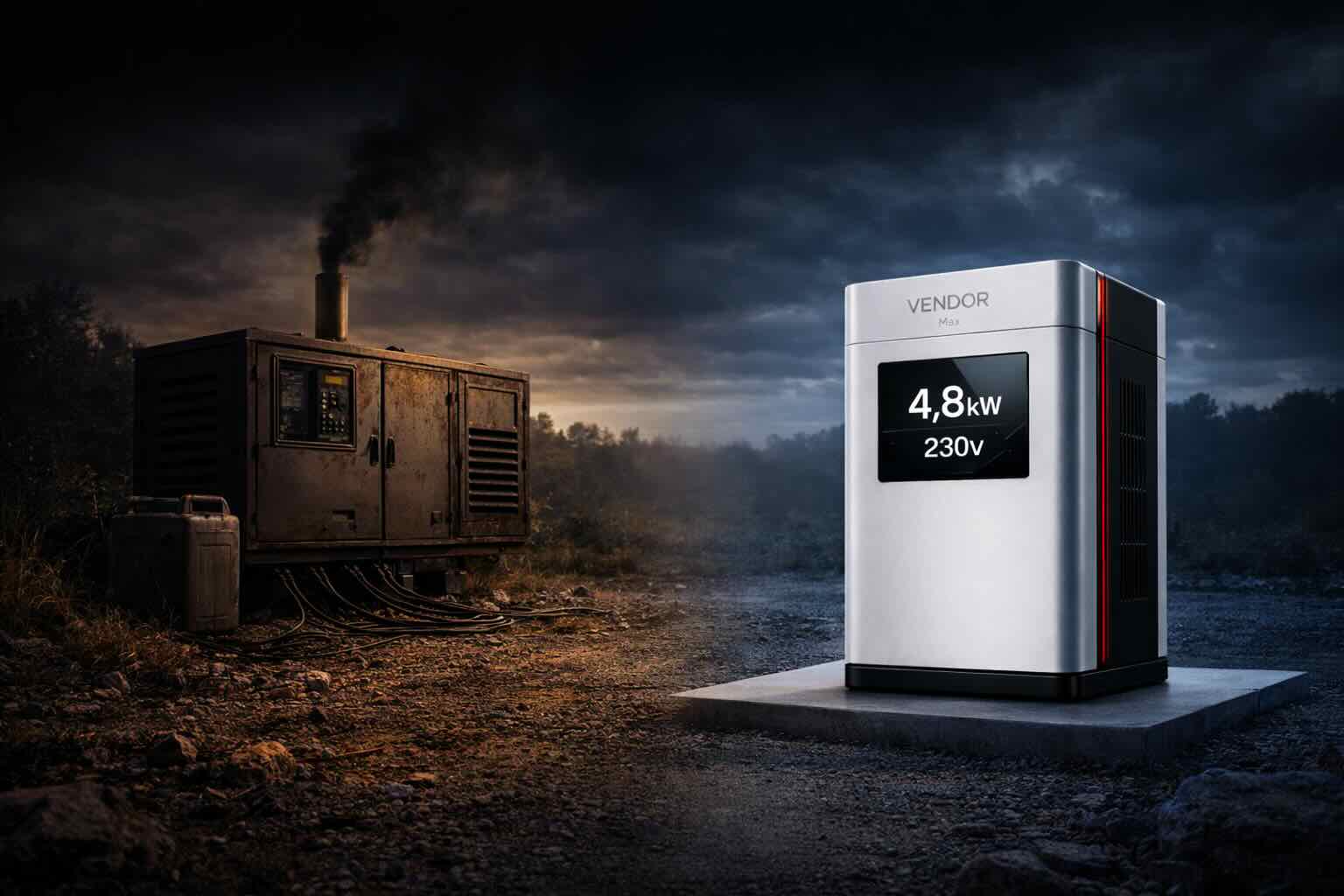
Comparison · VENDOR.Max · Off-Grid Infrastructure
VENDOR.Max vs
Diesel Generators
for Remote Infrastructure
In remote infrastructure, the dominant cost is rarely the generator. It is the fuel that has to be delivered every few weeks, the technician who has to visit every 250–500 operating hours, and the supply chain that has to function regardless of road conditions, weather, or conflict.
In remote infrastructure, diesel is not an energy solution.
It is a logistics system disguised as a generator.
VENDOR.Max — an electrodynamic power node at TRL 5–6 — is being evaluated as an infrastructure alternative where fuel logistics and service access are structurally expensive. The 5 kW prototype weighs 11.3 kg. A diesel generator in the same power class weighs 500–2,000+ kg and requires a permanent fuel supply chain. External electrical input is required for sustained operation.
This is an engineering and economic comparison. It does not position VENDOR.Max as a commercial diesel replacement today. Where diesel remains the correct choice, this page says so explicitly.
Operators · Quick Evaluation
Three Questions Operators Ask First
-
Does it replace diesel completely?
Not universally at this stage. VENDOR.Max operates in the 2.4–24 kW range. It is being evaluated first for remote sites where fuel delivery and service access are the dominant cost drivers. Where TRL 9 certification is required immediately, diesel remains the correct choice today.
-
Will it work in harsh field conditions?
Solid-state architecture — no rotating mechanical parts. Prototype validation: 1,000+ operational hours documented, including a 532-hour continuous run at 4 kW. Field deployment pathway is structured through the pilot programme.
-
Who services it if something fails?
No combustion engine servicing chain. Service architecture designed for reduced on-site dependency — estimated 1–2 interactions per year (design target, not measured field data). Pilot participants receive direct technical support during the validation phase. Contact via pilot assessment: /pilot/
Infrastructure Reality · Diesel in Remote Deployments
The Diesel Constraint
in Remote Infrastructure
Diesel is a proven technology at TRL 9. In urban environments, it works. In remote environments, diesel becomes a logistics-dependent energy system whose total cost is driven by supply chains — not by combustion efficiency.
Fuel Logistics
Delivery every 1–4 weeks
In isolated sites, transport cost routinely exceeds the commodity cost of diesel itself — reaching €0.40–0.80/kWh all-in in extreme-access scenarios.
Maintenance Intervals
250–500 hour service cycles
Oil, filters, injectors every 250–500 hours — estimated 4–12 technician visits per year in continuous-duty applications.
Operational Risk
Structural, not exceptional
Fuel theft, spill containment, fire protocols and supply disruption are structural risks in remote field conditions — not edge cases.
OPEX Volatility
30–50% price swing over 5 years
Fuel cost indexed to global commodity markets. 30–50% price swings documented over 5-year infrastructure cycles (IEA data).
Access Dependency
€500–2,000+ per visit
A single technician visit in mountain, island or desert sites can cost €500–2,000+ including travel, per industry operator estimates.
Emissions & Siting
200–260 g CO²/kWh + ~90–100 dB
CO², NOx and acoustic profile constrain site selection in regulated or environmentally sensitive locations (FEACE 2022).
These are not operational inefficiencies.
They are structural properties of combustion-based infrastructure.
Diesel generators are logistics-dependent energy systems. Cost is driven by fuel supply chains, maintenance intervals and site access — not by the equipment itself.
Cost Structure · Diesel in Numbers
The Economics
in 5 Numbers
Before comparing architectures, these five numbers define the diesel cost structure in remote infrastructure:
Diesel becomes too expensive when fuel logistics and service exceed ~30% of total site cost.
Diesel Generator Cost in Remote Infrastructure
Diesel generator operating cost in remote infrastructure has two components that standard cost models underestimate: fuel logistics and site access. At accessible sites, diesel power costs €0.20–0.35/kWh (Fraunhofer ISE 2024). At remote or isolated sites — mountain, island or desert locations — all-in cost including fuel delivery, storage and maintenance rises to €0.40–0.80/kWh. This premium is not driven by combustion inefficiency. It is driven by the cost of delivering fuel and accessing the site for service. These are structural, location-sensitive costs that compound over time.
Diesel Generator Cost Breakdown (Remote Sites)
Source: Fraunhofer ISE 2024, FEACE 2022, industry operator data. All figures reflect published ranges, not VENDOR.Max modeled data.
Prototype Evidence · Validation Stage
VENDOR.Max Prototype —
Operating Evidence
The video documents a VENDOR.Max prototype in validation-stage operation. 532 continuous hours at 4 kW documented. Presented as physical evidence of prototype activity — not as a claim of certified commercial readiness.
This is not a render. Not a simulation. A real prototype, measured and documented at TRL 5–6.
VENDOR.Max prototype, 5 kW · 532h @ 4 kW documented · TRL 5–6
Full endurance data: /vendor-max-endurance-test/
Physical Comparison · Deployment Class
Physical Reality:
A Different Deployment Profile
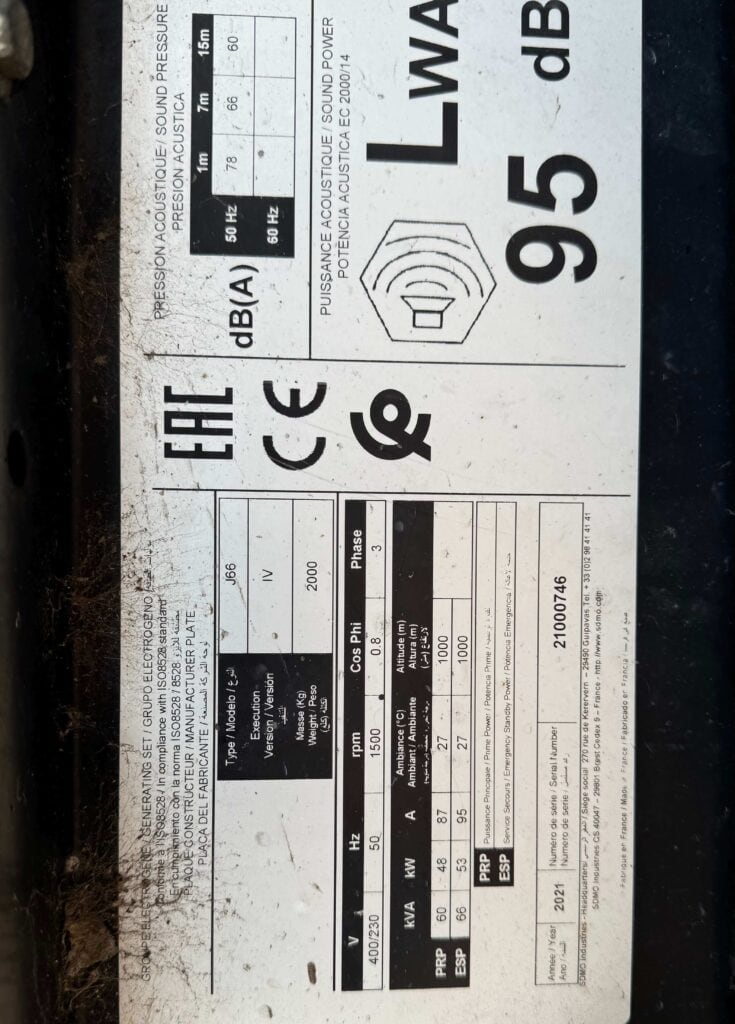
A diesel generator in the 5–25 kW class weighs 500–2,000+ kg. It requires vehicle transport, lifting equipment, a prepared installation site, ventilation clearance and permanent fuel storage.
The solid-state power architecture (VENDOR.Max) in 5 kW prototype configuration: 11.3 kg.
This is not a weight difference.
It is a deployment class difference.
Diesel generator · Remote infrastructure class
VENDOR.Max prototype · ~11.3 kg · TRL 5–6
Left: specification plate of a diesel generator typical for telecom and remote infrastructure. Right: VENDOR.Max prototype (5 kW, validation stage), measured weight ~11.3 kg.
Structured Comparison · 7 Parameters
Where the Architectures
Diverge
The radar below plots both systems across seven parameters relevant to remote infrastructure deployment decisions. VENDOR.Max leads on operational independence. Diesel leads on readiness and certification. Both are shown honestly.
Diesel leads only where certification already exists.
VENDOR.Max leads where operating constraints dominate.
Scores: VENDOR.Max = design targets at TRL 5–6. Diesel = industry-documented operational data. Not a certified field comparison.
TRL / Certification score (4/10) reflects current validation-stage status. CE / UL pathway in progress. Structured milestone, not open risk.
The Shift · Where the Model Breaks
When Infrastructure Stops
Being About Generation
In remote environments, the problem is no longer how to generate energy. It is how to maintain the system that delivers it.
Diesel solves the first problem.
It amplifies the second.
VENDOR.Max is being evaluated precisely at this boundary — where the cost of keeping combustion infrastructure operational begins to exceed the value of the energy it delivers.
Once you map fuel logistics and service visits against 5-year TCO,
diesel stops being the default.
It becomes a conscious trade-off.
When Does the Economics Flip?
The economic case for an alternative strengthens when any of these thresholds are reached — operators who ask “when does diesel become too expensive?” typically find at least two apply:
> 30%
Fuel delivery cost of total 5-year site energy cost
Modeled> €500/visit
Technician visit cost per interaction
Industry> 6 visits/yr
Annual service interactions (continuous duty)
Modeled> €0.35/kWh
Diesel all-in cost at point of use
Industry> 15 days/yr
Site access disruption (weather, road, conditions)
ModeledThese are not theoretical thresholds.
They are the conditions where diesel’s logistics model structurally dominates its energy model.
Side by Side · 8 Parameters
Head-to-Head: Technology
and Deployment Parameters
(open architecture)
Cost Architecture · What Changes
What Disappears
from the Operating Model
VENDOR.Max does not reduce energy cost by being cheaper per unit. It removes entire cost layers from the operating model.
Fuel delivery chain
Diesel: 1–4 deliveries/month depending on load and tank size
Fuel storage infrastructure
Diesel: dedicated tank, containment, fire clearance required
Oil and filter cycles
Diesel: every 250–500 hours — 4–12 times/year
Injector and combustion servicing
Diesel: major service every 1,000–2,000 hours
Acoustic and emissions burden
Diesel: ~90–100 dB, 200–260 g CO²/kWh at point of use
Fuel price exposure
Diesel: 30–50% price swings over 5-year deployment cycles
VENDOR.Max does not eliminate energy cost.
It removes continuous fuel dependency from the operating model.
Infrastructure · 12 Parameters
Infrastructure Comparison:
Real Operating Conditions
*Indicative planning range. TRL 5–6, pre-certification. Final pricing depends on power rating, enclosure and deployment conditions. This is not a commercial offer. Full TCO methodology → /economics/
The economic model does not shift gradually. It flips once logistics and service become the dominant cost drivers.
The comparison is not about efficiency. It is about system-level cost drivers: fuel, service and access. In remote environments, these dominate — and favour a logistics-free architecture over time.
Economics · 10-Year Horizon
How the Economics
Diverge Over Time
The divergence is not visible at purchase. It accumulates — as fuel deliveries, maintenance cycles and logistics visits compound for diesel, while VENDOR.Max carries minimal recurring cost after initial capital.
The divergence is not theoretical. It is driven by variables operators cannot eliminate: fuel delivery schedules, maintenance cycles and site access. These do not improve with time — they compound.
Modeled scenario. Remote deployment assumptions. TRL 5–6. Not certified field performance. Internal model only. Curves are qualitative — Y axis is not to scale.
Scenario Economics · Illustrative Model
Scenario-Based Economics:
Illustrative Remote Deployment
Modeled scenario where diesel costs are structurally highest. Not certified field data.
Assumptions: load factor ~80% · 10 years · remote / access-constrained · scheduled maintenance included in both models.
modeled, internal, not third-party verified
*Internal model — not third-party verified. TRL 5–6.
Actual results depend on site conditions and deployment environment.
Full TCO methodology → /economics/
Technical Reference · 13 Parameters
Technical and
Deployment Parameters
Diesel: Fraunhofer ISE 2024, FEACE 2022, industry operator data. VENDOR.Max: TRL 5–6, pre-certification. [TARGET] = design intent, not measured field result. [MEASURED] = prototype data (11.3 kg).
Evaluation Priority · Where to Look First
Where VENDOR.Max
Is Being Evaluated First
Trigger question: What percentage of your 5-year site energy budget is fuel delivery and service visits combined? If above 30% — request a site evaluation.
Remote telecom towers
Mountain, desert, island deployments where fuel delivery logistics cost exceeds site operational value. Reference: €0.40–0.80/kWh all-in at extreme-access sites.
Industrial monitoring infrastructure
Pipelines, mining perimeters, sensor arrays with 250–500h service intervals and €500–2,000+/visit in high-access-cost environments.
Weak-grid or unstable-grid environments
Sites where grid availability < 95% and diesel backup is currently mandatory for operational continuity.
Remote scientific and environmental stations
12–36 month deployments without regular human access — where fuel pre-positioning is the primary operational constraint.
Off-grid infrastructure with high logistics burden
Sites where fuel + maintenance > 30% of total 5-year energy system cost (modeled threshold).
Honest Boundaries · TRL 5–6
When Diesel Remains
the Right Choice
Immediate certified deployment required
CE / UL pathway is in progress, not complete. If TRL 9 certification is required today — diesel is the correct choice.
Certification is a structured milestone. Next target gate: TRL 7.
High-power applications beyond 24 kW
Current architecture validated in the 2.4–24 kW range. Higher continuous output is outside current scope.
Power range extension is a defined engineering roadmap item.
Certified equipment required contractually
Where CE / UL marks are required in existing procurement frameworks, VENDOR.Max cannot fulfil that requirement today.
Certification pathway defined. Timeline subject to validation milestones.
Backup-only / grid-primary scenarios
Where diesel provides episodic backup only and total fuel logistics cost is low — the CAPEX-dominant model does not produce economic advantage.
Economic case is strongest where logistics cost exceeds 30% of 5-yr budget.
Not Yet Proven — Open Items at TRL 5–6
Current validation protocol → /technology-validation/
FAQ · VENDOR.Max vs Diesel
Common Questions:
VENDOR.Max vs Diesel
Engineering and validation context for infrastructure evaluators.
Evidence & Video
Is there a real operating video of VENDOR.Max on this page? +
Yes. An embedded video documents a VENDOR.Max prototype in validation-stage configuration. Real prototype footage — not renders or conceptual visuals.
Does this page show only renders of VENDOR.Max? +
No. The page includes an embedded operating video of a real VENDOR.Max prototype together with structured comparison content.
What exactly is shown in the embedded VENDOR.Max video? +
A VENDOR.Max prototype rated at 5 kW in validation-stage configuration. Operational evidence — not a claim of mass-market commercial deployment.
Is the 5 kW VENDOR.Max unit shown here a certified commercial product? +
No. It is a validation-stage prototype. CE / UL certification is a planned milestone, not a completed status.
Comparison & Claims
Does this page claim VENDOR.Max is already replacing diesel everywhere? +
No. This page defines where diesel remains the correct incumbent today and where VENDOR.Max is being evaluated first — remote infrastructure where fuel logistics and service burden are structurally expensive.
Why compare VENDOR.Max with diesel generators at all? +
Because diesel is the reference standard for remote and off-grid infrastructure. In access-constrained environments, fuel transport, maintenance and service access become the dominant cost and uptime drivers — not the generator itself.
Technology & Validation
What does TRL 5–6 mean on this page? +
TRL 5–6 means validation-stage — not a TRL 9 field-standard product. Prototype evidence and modeled economics may be presented. Certification and broad field deployment are gated milestones. Next target gate: TRL 7.
Are the economics on this page measured field performance? +
No. Scenario-based models at TRL 5–6. The LCOE estimate (€0.08–€0.14/kWh) is an internal model, not independently verified. Actual results depend on site conditions and deployment environment. Full methodology: /technology-validation/
Fit & Next Steps
Where is VENDOR.Max intended to fit first? +
Remote and uptime-critical infrastructure where diesel burden is structurally high: telecom towers, industrial monitoring sites, scientific field stations and off-grid assets where fuel logistics and service visits are structurally expensive.
What should an operator or investor do after reading this page? +
Request a pilot-readiness evaluation — where real site profile, load pattern, logistics burden and validation requirements are reviewed before any deployment decision. → /pilot/
Market Context
What replaces diesel generators in remote infrastructure? +
There is no single universal replacement at this stage. Options include solar+battery hybrid systems (weather-dependent), hydrogen fuel cells (supply-chain dependent), and solid-state electrodynamic architectures like VENDOR.Max (TRL 5–6, validation stage). The optimal choice depends on power range, site access, certification requirements and logistics profile.
Why are diesel generators expensive in remote areas? +
The cost is not the equipment — it is the operational dependencies. Fuel must be delivered every 1–4 weeks. Technicians must visit every 250–500 operating hours. The supply chain must function regardless of weather or road conditions. In extreme remote sites, logistics can push all-in cost to €0.40–0.80/kWh.
When does diesel become too expensive for a remote site? +
The economic case for alternatives strengthens when any of these thresholds are reached: fuel delivery > 30% of 5-year site energy budget; technician visit cost > €500 per interaction; service interactions > 6 per year; or all-in diesel cost > €0.35/kWh at point of use (Fraunhofer ISE 2024). These are the structural thresholds where logistics-dependent energy systems stop being cost-effective.
Definitions · Key Terms
What Is a Logistics-Dependent Energy System?
A logistics-dependent energy system is one whose total operating cost is determined primarily by supply chain requirements rather than by the energy conversion equipment itself. Diesel generators in remote deployments are the primary example: hardware cost is fixed, but fuel delivery, maintenance and technician access create ongoing, location-sensitive costs that grow with remoteness.
In short: diesel cost is driven by logistics, not energy.
What Is TRL 5–6 in Energy Infrastructure?
Technology Readiness Level 5–6 indicates a system that has demonstrated functionality in a relevant environment (TRL 5) or been validated in a relevant environment (TRL 6). Distinct from TRL 9 (fully certified production system). At TRL 5–6, prototype evidence and modeled economics can be presented. Commercial certification and broad field deployment are gated next milestones. Next target gate for VENDOR.Max: TRL 7.
In short: TRL 5–6 = validated, not yet certified.
What is the TCO of diesel in remote infrastructure?
€0.20–€0.35/kWh standard remote; €0.40–0.80/kWh extreme-access scenarios. Source: Fraunhofer ISE 2024, FEACE 2022.
What does solid-state power mean for infrastructure operators?
No rotating parts — no combustion engine servicing. No oil cycles, no injector servicing, no fuel delivery logistics. Trade-off: TRL 5–6, not yet TRL 9 certified.
Next Step · Site Evaluation
What You Can Do Now
The next step is a site-specific evaluation — not a procurement decision.
Two Site Profiles. One Fork.
Accessible. Certified deployment required today. Power > 24 kW.
Grid-connected backup, TRL 9 certification required immediately, or continuous output requirement beyond 24 kW.
Do not evaluate VENDOR.Max at this stage.
Remote. Fuel-logistics-heavy. Service-costly. 2.4–24 kW.
Logistics cost > 30% of 5-year energy budget. Uptime-critical. Access-constrained.
VENDOR.Max is being evaluated first for sites like yours.
Takes 5–10 minutes. No commitment. Used to determine if a full evaluation is rational for your site.
AI Summary · Technical Readers
Page Summary
for Technical Readers
This page compares diesel generators with the electrodynamic power node (VENDOR.Max) as an infrastructure alternative for remote deployments. Five facts define the comparison:
Continue Reading
Technical
Economics
Comparisons