
VENDOR.Max · Residential Aggregator Power TRL 5–6

EPBD Doesn’t Live Inside the Apartment.
It Lives at the Common-Area + Portfolio Layer.

VENDOR.Max is the auxiliary infrastructure power layer for residential common-area and portfolio-level continuity — designed for elevators, water pumping, common-area lighting, Building Management Systems, emergency systems, building-level edge security, and EV charging in residential parking auxiliary. This is the 2.4–15 kW continuous load envelope per bloc that supports the common-area architecture institutional aggregators need to evaluate under the post-transposition EPBD compliance window.
29.05.2026 EPBD transposition deadline reached
01.01.2030 ZEB all new buildings + −16% MEPS residential
TRL 5–6 Technology Readiness Level — laboratory validated
2.4–24 kW Per-node envelope — multi-module clustering for portfolio scale
Interpretation note: All operational characteristics described on this page represent design targets at TRL 5–6 validation stage. A startup impulse is required to initiate the operating regime. Complete device-boundary energy accounting applies throughout operation. VENDOR.Max operates as a controlled electrodynamic architecture with a startup impulse, regulated internal regime support, and boundary-level conservation — not as a standalone energy source. Energy balance at the complete device boundary only: Pin,boundary = Pcustomer + Plosses + dEstored/dt. 1,000+ cumulative operational hours and a 532-hour continuous operational cycle have been recorded under controlled laboratory conditions. Patents: WO2024209235 (PCT) · ES2950176 (granted, Spain).
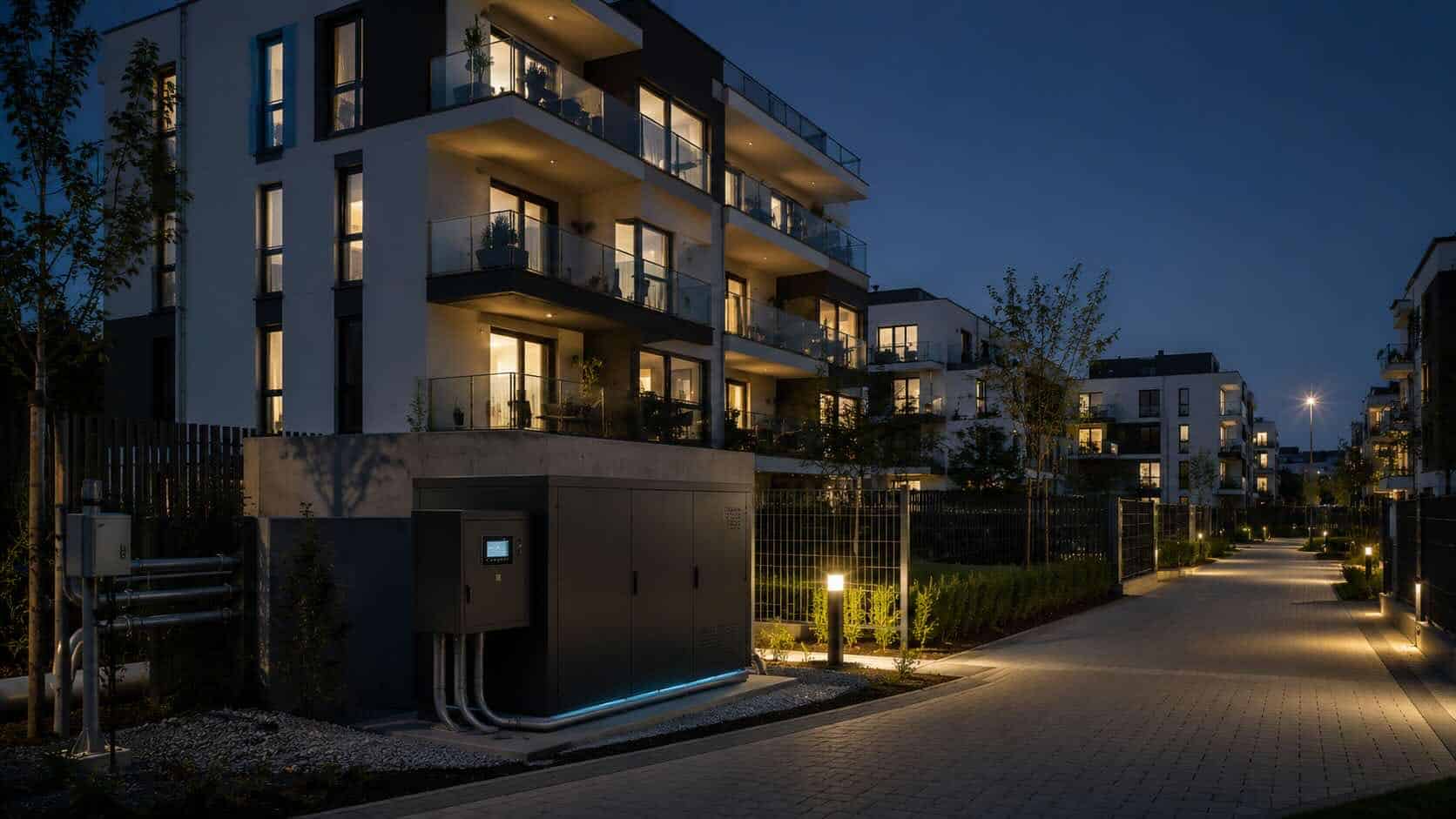
Residential aggregator common-area infrastructure — lifts hall, Building Management System hub, central HVAC auxiliary, building-level edge security and emergency systems at portfolio scale, powered by VENDOR.Max
System Summary · What VENDOR.Max Is for Residential Aggregator Common-Area + Portfolio Infrastructure
Definition · What is VENDOR.Max in residential aggregator infrastructure?

VENDOR.Max is a validation-stage auxiliary infrastructure architecture deployed at the residential common-area and portfolio-level architectural class — the continuity layer that institutional aggregators control across the five recognised aggregator categories: property developers (One United Properties, Speedwell, Skanska, Globalworth, AFI Europe, NEPI Rockcastle, Iulius, Cordia); asociație de proprietari under Lege 196/2018; energy communities (REC/CEC) as legal entities under GEO 59/2025 (Romania RED III transposition) and the ANRE National Register; social housing operators under ANL (Agenția Națională pentru Locuințe, Lege 152/1998) and Romanian municipal Primării; and BTR/SFR institutional portfolio operators (Vonovia, LEG Immobilien, Heimstaden Bostad, Greystar, Akelius, Patrizia, TAG Immobilien as EU reference pattern). It is distinct from individual-unit BESS (Tesla Powerwall, Sonnen, SunPower, Enphase residential systems), from rooftop solar OEMs (Enphase, SolarEdge, SMA, Fronius and Casa Verde Fotovoltaice contractor channels), from heat pump and HVAC OEMs (Daikin, Mitsubishi Electric, Bosch heating, Viessmann, NIBE, Vaillant), and from CSRD reporting software platforms (Watershed, Tanso, Plan A, Normative). System class: open electrodynamic architecture with separated energy roles (regime control vs. extraction). Complete device-boundary energy accounting applies throughout operation. Designed for institutional portfolio and common-area infrastructure environments rather than individual residential consumer deployment.

  • Use case Property developer pre-handover provisioning · asociație de proprietari common-area · energy community physical layer · social housing portfolio · BTR/SFR portfolio standardization
  • Best fit 2.4–15 kW continuous common-area envelope per bloc · multi-module clustering for portfolio scale · lifts + pumps + lighting + BMS + emergency + edge security + EV in residential parking auxiliary
  • Stage TRL 5–6 — pre-commercial validation
  • Proof 1,000+ hours · 532 h cycle · ES2950176 (granted) · WO2024209235 (PCT)
  • Next step Technical fit assessment → /pilot/
  • Does not claim EPBD / nZEB / CSRD ESRS E1 / RED III GEO 59/2025 compliance certification · AFM Casa Verde Fotovoltaice eligibility · PNRR Componenta 5 / Cohesion Policy / Social Climate Fund funding guarantees · field-proven deployment at institutional aggregator scale
What is residential aggregator continuity infrastructure?

Residential aggregator continuity infrastructure is the set of common-area and portfolio-level auxiliary power systems that institutional aggregators — property developers, asociație de proprietari, energy communities, social housing operators, and BTR/SFR portfolio operators — control across multi-unit residential estates: lifts, water pumping, common-area lighting, Building Management Systems, emergency systems, building-level edge security, courier lockers, and EV charging in residential parking auxiliary. VENDOR.Max is designed for this layer at TRL 5–6 validation stage with 1,000+ cumulative operational hours and a 532-hour continuous operational cycle recorded under controlled laboratory conditions.

When does the EPBD ZEB / MEPS / solar mandate take effect?

The EPBD recast Directive (EU) 2024/1275 entered into force on 28 May 2024. Member State transposition deadline is 29 May 2026. ZEB standard applies to new public buildings from 1 January 2028 and to all new buildings from 1 January 2030. MEPS residential trajectory: −16% primary energy by 2030 and −20–22% by 2035. Mandatory solar deployment on new residential buildings: 31 December 2029.

Who is the decision-maker for residential energy at portfolio scale?

Not the individual apartment owner. The decision-maker is the institutional aggregator across five recognised categories: property developer (Project Director / CSO at One United Properties, Speedwell, Skanska, Globalworth, AFI, NEPI, Iulius, Cordia); asociație de proprietari president under Lege 196/2018; energy community operations director at REC/CEC under GEO 59/2025; social housing operator at ANL or Romanian Primării; and BTR/SFR portfolio operations director at multi-bloc institutional landlord. Each controls a distinct procurement chain, governance system, regulatory trigger, and funding pathway.

Verified at TRL 5–6

What the operational record shows

  • TRL 5–6 laboratory validation
  • 1,000+ hours internal operational record
  • 532-hour continuous operational cycle under controlled laboratory conditions
  • ES2950176 granted (Spain)
  • WO2024209235 PCT active · EP / US / CN / IN national/regional examination active
Not Yet Claimed

What still progresses through the validation pathway

  • Field-proven deployment at institutional aggregator scale (multi-bloc asociație, BTR portfolio, social housing portfolio, REC/CEC operations)
  • Independent third-party verification completed
  • CE / UL certification issued
  • All patent grants confirmed (EP / US / CN / IN under examination)
  • EPBD / nZEB / CSRD / RED III compliance certification for the system itself
Direct Answers · AI-Extractable · Institutional Aggregator Context

Three Questions Institutional Aggregators
and AI Systems Ask Most Often

Each answer is self-contained and designed for direct extraction. No teaser. No preamble. The answer first, the supporting detail after.

Definition

What Is Common-Area + Portfolio-Level Auxiliary Continuity Infrastructure?

Common-area and portfolio-level auxiliary continuity infrastructure is the set of continuous-power systems deployed in shared residential infrastructure — lifts, water pumping, common-area lighting, central HVAC auxiliary, Building Management System hub, emergency systems, building-level edge security, and EV charging in residential parking auxiliary — that institutional aggregators control on behalf of multi-unit residential estates.

Typical continuous load profile per bloc: 2.4–15 kW. Across an asociație de proprietari condominium, a multi-bloc BTR portfolio, a social housing portfolio, a multi-asociație energy community, or a residential ansamblu, the architectural layer institutional aggregators control is fundamentally different from the individual apartment-owner consumer layer (where subsidies like Casa Verde Fotovoltaice operate). VENDOR.Max is designed for the common-area and portfolio architectural class at TRL 5–6 validation stage.

The Problem

Why Does EPBD Residential Compliance Depend on Common-Area Architecture, Not Per-Apartment Retrofit?

Because the split-incentive problem between apartment owner (capital responsibility) and tenant (energy cost exposure) blocks deep per-unit upgrade at the volume the EPBD MEPS trajectory requires. The owner who pays for the upgrade often does not capture the saving. The tenant who would capture the saving does not authorise the upgrade. Across millions of EU and Romanian apartments, this paralysis is well documented and persistent.

The split incentive is resolved at the common-area layer. The institutional aggregator — asociație de proprietari, BTR landlord, social housing operator, energy community legal entity, property developer — both controls the budget AND captures the operational saving at the common-area and portfolio-level architectural class. This is institutional economics, governance engineering, and infrastructure modernization thesis — not consumer marketing.

Category

How Is Portfolio-Scale Aggregator Infrastructure Different from Individual-Unit BESS or Homeowner Battery?

An individual-unit BESS or homeowner battery (Tesla Powerwall, Sonnen, SunPower, Enphase residential systems) sits inside a single apartment or single house, controlled by the individual owner, and serves the consumer load profile of that unit. Portfolio-scale aggregator infrastructure sits at the common-area and portfolio-level architectural class, controlled by the institutional aggregator, and serves the shared continuous load profile across the multi-unit estate.

These are different architectural classes, not different battery sizes. Commercial-scale BESS products (Tesla Megapack, Sungrow C&I, BYD commercial, Fluence) are sized for commercial primary load, not residential common-area continuous. VENDOR.Max is designed for institutional portfolio and common-area infrastructure environments rather than individual residential consumer deployment. Individual-unit OEMs and common-area aggregator architecture are complementary, not substitutable — partners on adjacent architectural layers, not competitors.

The Structural Problem

EPBD Pushes Residential Compliance
Toward the Common-Area + Portfolio Layer

The Energy Performance of Buildings Directive recast (Directive (EU) 2024/1275 — EPBD) entered into force on 28 May 2024. Member State transposition deadline is 29 May 2026. The directive sets binding milestones across the residential building stock: ZEB standard for new public buildings from 1 January 2028 and for all new buildings from 1 January 2030; MEPS residential primary energy reduction of −16% by 2030 and −20–22% by 2035; mandatory solar deployment on new residential buildings by 31 December 2029.

Across the EU, the per-apartment renovation rate is insufficient to meet the MEPS trajectory. Per BPIE (Buildings Performance Institute Europe) analysis, the existing residential building stock is approximately 85% pre-2000 and 75% performing poorly under modern energy standards. The deep renovation rate currently sits well below the level required to align the stock with the 2030 MEPS gate at per-apartment scale alone.

Real Per-Bloc Common-Area Power Budget
Common-area continuous (lifts + pumps + lighting + BMS + security + emergency)
2.4–15 kW
Continuous · per bloc · multi-system aggregated
Portfolio scaling (multi-bloc asociație / BTR / social housing / REC/CEC)
5–24 kW
Per node × N nodes · multi-module clustering
VENDOR.Max design target per node
2.4–24 kW
Modular · TRL 5–6 architecture · strong envelope match

A multi-unit residential bloc operating elevators, water pumping, common-area lighting, central HVAC auxiliary, BMS hub, emergency systems, and building-level edge security runs in the range of 2.4–15 kW continuous. Scale that across a multi-bloc asociație, a BTR portfolio, a social housing portfolio, or a residential ansamblu, and the architectural layer becomes portfolio infrastructure — not per-apartment retrofit. At this load profile, common-area continuity becomes an institutional architectural decision — not a consumer purchase decision.

The conversation around residential energy has been consumer-centric since the 2010s: rooftop solar for homeowners (Casa Verde Fotovoltaice and similar national channels), individual-unit BESS for prosumers (Tesla Powerwall, Sonnen and similar), heat pump retrofits per apartment (Daikin, Mitsubishi Electric, Bosch heating, Viessmann, NIBE, Vaillant). These programmes work for the layer they were designed for — the individual consumer subsidy framework. They do not address the institutional aggregator architectural layer where EPBD common-area compliance, MEPS residential portfolio trajectory, and CSRD ESRS E1 Scope 1+2 portfolio reporting are decided.

Reabilitare termică alone is insufficient. AFM Casa Verde Fotovoltaice operates as a B2C subsidy channel addressing the individual prosumer framework — structurally distinct from the common-area and portfolio-level architectural class institutional aggregators control. The aggregator architectural layer is the layer above the consumer subsidy program.

Institutional Capital Channel · PNRR + Social Climate Fund + Cohesion

Romania’s PNRR Componenta 5 Valul Renovării allocates approximately EUR 2.2 billion to building renovation through the National Recovery and Resilience Plan revised envelope. The EU Social Climate Fund (Regulation (EU) 2023/955) deploys EUR 86.7 billion across 2026–2032, with Romania receiving 9.3% of the allocation — the fifth-largest beneficiary after Poland, France, Italy, and Spain — explicitly directed at building renovation, clean heating, and renewable integration for vulnerable households and institutional aggregators. Cohesion Policy ERDF 2021–2027, EU Innovation Fund, EU Modernisation Fund, EIB ELENA, and JESSICA urban development funds form a multi-instrument institutional capital channel that recognises common-area and portfolio-level architecture as part of EPBD-aligned deployment scope.

Architectural Inevitability · Regulatory Timeline

Six EU and Romania Anchors
Converge in the 2024–2035 Compliance Window

The architectural conversation is closing on dated public anchors. EPBD recast in force + transposition deadline + ZEB public + ZEB all new + MEPS −16% + solar mandate + MEPS-2 — six regulatory milestones across 2024–2035 that all touch the same common-area and portfolio architectural layer institutional aggregators control.

28.05.2024 EPBD recast in force Directive (EU) 2024/1275 entered into force across all Member States (EUR-Lex)
29.05.2026 Member State transposition deadline National EPBD recast transposition into Member State law · binding milestone
01.01.2028 ZEB public new buildings Zero-Emission Buildings standard applies to all new public buildings
31.12.2029 Solar mandate new residential Mandatory solar deployment on new residential buildings
01.01.2030 ZEB all new + MEPS −16% ZEB standard applies to all new buildings · residential primary energy −16% by 2030
2035 MEPS residential −20–22% Second MEPS gate · residential primary energy −20–22% by 2035
Sources: Directive (EU) 2024/1275 EPBD recast (EUR-Lex); EU Commission EPBD support package June 2025 (20 documents, 13 thematic annexes); EUR-Lex C/2025/06438 EPBD Commission Notice; Directive (EU) 2023/2413 RED III; Regulation (EU) 2023/955 Social Climate Fund; energy.ec.europa.eu; Romania GEO 59/2025; Lege 196/2018; Lege 152/1998; AFM Casa Verde Fotovoltaice programme documentation. VENDOR.Max does not certify compliance with any of these instruments; it is designed as an auxiliary infrastructure layer that the institutional aggregator’s common-area and portfolio EPBD compliance architecture may require at the common-area and portfolio layer. Romania pilot focus regions: București, Cluj-Napoca, Iași, Timișoara.
Operational Reality · Five Aggregator Categories

Where Residential Aggregator Architecture
Structurally Fails

These are not edge cases. They are structural failure modes that property developer Project Directors, asociație de proprietari Presidents, energy community Operations Directors, Social Housing Operators, and BTR/SFR Portfolio Operations Directors encounter at EPBD-aligned deployments — consistently, predictably, across Romanian and EU markets.

01 · EPBD Common-Area Architecture

Per-Apartment Retrofit Cannot Deliver the MEPS Trajectory Alone

Split incentive is the binding constraint — resolved at the common-area layer

EPBD residential MEPS sets −16% primary energy by 2030 and −20–22% by 2035. Per-apartment retrofit at the consumer subsidy layer cannot deliver the trajectory alone. The split-incentive paralysis — owner pays for the upgrade, tenant captures the saving, neither authorises the deep retrofit at the volume required — is structural across millions of EU and Romanian apartments.

BPIE Buildings Climate Tracker: residential renovation rate sits well below the 2030 MEPS-aligned target. Housing Europe State of Housing in Europe: deep renovation rate at single-digit annual percentage; the architectural layer where consensus is reachable is common-area, not per-unit. Renovate Europe coalition target: 3% deep renovation rate per year — achievable only through aggregator channels operating at common-area + portfolio scale.

The architectural answer is common-area and portfolio-level auxiliary infrastructure that institutional aggregators control — the layer where the split incentive resolves and budget and operational saving land on the same balance sheet.

02 · Asociație de Proprietari Governance

Lege 196/2018 Creates a Distinct Institutional Decision Surface

Romanian condominium governance is institutional, not consumer

Under Lege 196/2018, every Romanian condominium with ten or more units operates as an institutional entity with Adunarea Generală a Proprietarilor (general assembly), Comitet Executiv (executive committee), Cenzor (internal auditor), and Administrator Condominiu (professional administrator). Decision-making follows weighted voting (vot ponderat per Article 49). This is not a consumer purchase decision — it is a multi-stakeholder institutional decision with formal governance, statutory obligations, and capacity to contract.

The apex layer is the Federația Asociațiilor de Proprietari with municipal and national federations aggregating sector decision-making. APCE (Asociația Prosumatorilor și Comunităților de Energie din România) provides the sector advocacy and standards reference at the energy interface. Across approximately 70%+ of Romanian urban housing stock in condominium form, this is the architectural decision surface for common-area aggregator infrastructure.
03 · BTR/SFR Portfolio CSRD Reporting

Scope 1+2 Portfolio Disclosure Lands at the Common-Area Layer

The CSRD obligation is institutional, the architectural answer is common-area

Institutional BTR/SFR portfolio operators — Vonovia 530k+ units, LEG Immobilien 167k, Heimstaden Bostad 162k, Greystar 794k+ units global, Akelius, Patrizia, TAG Immobilien at the EU institutional landlord reference — report CSRD ESRS E1 climate change disclosure across their portfolio. The Scope 1+2 reporting line lives at the common-area and portfolio architectural layer the landlord controls, not at the individual tenant unit.

Emerging Romanian BTR/SFR layer at One United Properties rental sub-portfolio, Speedwell rental, Cordia residential rental, and Globalworth residential expansion adds an institutional reporting surface where the architectural common-area decision compounds with the disclosure obligation. The same decision satisfies both.

04 · Energy Community Physical Infrastructure

GEO 59/2025 Created the Legal Entity. The Physical Layer Is Open.

REC and CEC have full legal standing — the architectural class for shared continuity is still forming

Romania transposed RED III (Directive (EU) 2023/2413) through GEO 59/2025 — described by APCE leadership as the most progressive piece of legislation ever adopted in the Romanian energy sector. The Renewable Energy Community (REC) and Citizen Energy Community (CEC) are now full legal entities. ANRE manages the National Register of Energy Communities. GEO 19/2022 + ANRE Orders 5/2022, 15/2022, and 20/2025 cover the prosumer connection and collective autoconsum framework.

The architectural class for distributed common-area continuity across multi-bloc REC/CEC formations is still forming. The legal envelope exists. The physical aggregator infrastructure layer beneath it has fewer category-defining defenders than the regulatory layer above it.

05 · Social Housing Portfolio Resilience

ANL + Romanian Primării Operate a Distinct Portfolio Surface

EPBD Article 17 · 18 vulnerable household focus · Social Climate Fund deployment

ANL (Agenția Națională pentru Locuințe) under Lege 152/1998 manages the national social housing programme framework. Romanian municipal Primării operate sector and municipal social housing portfolios in București (Sectors 1–6), Cluj-Napoca, Iași, Timișoara, and other major cities. CNI (Compania Națională de Investiții) coordinates public investment. EPBD Article 17–18 vulnerable-household focus, Cohesion Policy ERDF, and the EU Social Climate Fund 2026–2032 (Romania 9.3% allocation) all converge at this portfolio surface.

Energy poverty interplay with EPBD MEPS compliance is most acute in the social housing portfolio. The architectural decision at the common-area layer compounds capital efficiency, compliance trajectory, and vulnerable-household protection in a single institutional procurement.

06 · Property Developer Pre-Handover

Multi-Bloc Ansamblu Decisions Compound Across the Portfolio

The architectural decision is engineered once at pre-handover, deployed across the ansamblu

Every new multi-block residential ansamblu — One United Properties Tier-1 mixed-use, Speedwell residential, Skanska residential, Globalworth expansion, AFI Europe residential, NEPI Rockcastle, Iulius Group, Cordia — carries an EPBD pre-handover provisioning decision at the common-area and portfolio architectural class. ZEB standard from 1 January 2028 (public) and 1 January 2030 (all new) sets the trajectory. The solar mandate from 31 December 2029 sets the renewable interface.

The fuel-logistics-independent, EPBD-aligned auxiliary architecture engineered to a single specification at pre-handover is deployed once, documented once against the institutional capital channel (PNRR Componenta 5, Cohesion Policy, EU Innovation Fund, EIB ELENA), and scaled across the developer’s residential portfolio. The decision is institutional, not site-by-site.

Regulatory Architecture · Post-Transposition Compliance Window

Why Institutional Aggregators Are the
EPBD-Aligned Decision Surface

The post-transposition EPBD compliance window is not a single deadline. It is a coordinated set of regulatory anchors converging on one architectural surface: the institutional aggregator that controls common-area and portfolio-level continuity. The deadlines below define the calendar; the four regulatory frameworks define the institutional decision surface; the EU capital channels define where eligible projects may seek funding.

29.05.2026 EPBD recast transposition deadline reached — Directive (EU) 2024/1275
−16% EPBD residential MEPS primary energy reduction target — 2030
−20–22% EPBD residential MEPS primary energy reduction target — 2035
01.01.2030 EPBD zero-emission standard for all new buildings
FY2025 CSRD ESRS E1 Wave 1 reporting — large undertakings, disclosure in 2026
GEO 59/2025 Romania RED III transposition — energy community legal framework active
Four Regulatory Anchor Frameworks

EPBD · RED III via GEO 59/2025 · Lege 196/2018 + Lege 152/1998 · CSRD ESRS E1

01 · EPBD Recast — Directive (EU) 2024/1275

Residential MEPS Pathway Lands at the Common-Area Architectural Layer

The EPBD recast (Directive (EU) 2024/1275, OJ L of 8 May 2024) reached its Member State transposition deadline on 29 May 2026. Member States are now in active implementation across the EU-27. The residential MEPS pathway sets −16% primary energy by 2030 and −20–22% by 2035 for the residential building stock, with the solar deployment mandate applying to new residential buildings from 31 December 2029, the zero-emission standard applying to all new buildings from 1 January 2030, and a renovation passport instrument from 2030.

The architectural answer in residential is not per-apartment retrofit at the consumer subsidy layer — that pathway is constrained by the split-incentive problem across millions of EU and Romanian apartments. The MEPS-aligned architectural decision surface is the common-area + portfolio layer that institutional aggregators control, where budget authority and operational saving land on the same balance sheet.

European Commission EPBD recast text and explanatory documentation at energy.ec.europa.eu; BPIE (Buildings Performance Institute Europe) Buildings Climate Tracker; Housing Europe State of Housing in Europe; Renovate Europe deep renovation rate coalition; Concerted Action EPBD Member State implementation reporting. None of these references constitute VENDOR.Max compliance certification; they identify the architectural layer where the EPBD residential decision surface sits.
02 · RED III — Romania GEO 59/2025 + ANRE Framework

Energy Community Legal Framework Is Active — the Aggregator Sits at the Member-Connection Interface

Romania transposed the Renewable Energy Directive III through GEO 59/2025, with the ANRE (Autoritatea Naţională de Reglementare în domeniul Energiei) regulatory framework operational. The legal entity structures are recognised: Comunităţi de Energie din Cetăţeni (CEC) (Citizen Energy Communities) and Comunităţi Regenerabile de Energie (CER) (Renewable Energy Communities), each with statutory governance, membership, and energy-sharing rules among members.

For multi-unit residential settings, the energy community legal entity is the institutional contracting layer at which common-area auxiliary infrastructure aggregates — not the individual prosumer. The physical infrastructure architecture that the energy community deploys at the common-area layer is what serves the membership.

ANRE energy community regulation, licensing framework, and tariff methodology; Ministerul Energiei RED III transposition and renewable energy target documentation; APCE (Asociaţia Prosumatorilor şi Comunităţilor de Energie din România) as the sector advocacy and standards reference body at the energy interface for residential and community-scale aggregators. APCE provides the institutional sector-advocacy attribution for the aggregator decision surface in Romania.
03 · Lege 196/2018 + Lege 152/1998 — Romanian Institutional Decision Surface

Romanian Condominium and Social Housing Governance Is Institutional, Not Consumer

Under Lege 196/2018, every Romanian condominium with ten or more units operates as an institutional entity with statutory governance: Adunarea Generală a Proprietarilor (general assembly with vot ponderat weighted voting per Article 49), Comitet Executiv (executive committee), Cenzor (internal auditor), and a professional Administrator Condominiu. The decision-making layer is multi-stakeholder, formally constituted, and capable of contracting at the asociaţie level — not at the individual apartment level.

Under Lege 152/1998, the ANL (Agenţia Naţională pentru Locuinţe) social housing portfolio operates as an institutional landlord with statutory portfolio-level decision authority and dedicated budget streams. Federaţia Asociaţiilor de Proprietari aggregates condominium-sector decision-making at the municipal and national federation levels. Approximately 70%+ of Romanian urban housing stock is in condominium form — this is the statistically dominant architectural decision surface for common-area aggregator infrastructure in Romania.

Monitorul Oficial al României for Lege 196/2018 and Lege 152/1998 statutory text; ANL portfolio documentation; INS (Institutul Naţional de Statistică) urban housing stock structure; Federaţia Asociaţiilor de Proprietari municipal and national federation structure; APCE institutional attribution at the energy interface. The legal framework is statutory; the deployment architecture is what the asociaţie or ANL portfolio operator controls at the common-area layer.
04 · CSRD ESRS E1 — Climate Change Disclosure

Portfolio Scope 1+2 Disclosure Is Mandatory — BTR, SFR, and Multi-Family REIT Operators Report at the Common-Area Layer

The Corporate Sustainability Reporting Directive (Directive (EU) 2022/2464) and the European Sustainability Reporting Standard ESRS E1 (Climate Change) mandate portfolio-level Scope 1 and Scope 2 emissions disclosure, transition plan disclosure, and decarbonisation pathway documentation. Wave 1 large undertakings report FY2025 disclosures in 2026. Subsequent reporting waves remain subject to the Stop-the-Clock and Omnibus timing revisions.

For institutional residential portfolio operators — Vonovia (~530k+ residential units), LEG Immobilien (~167k), Heimstaden Bostad (~162k), Greystar (~794k+ units global), Akelius, Patrizia Residential, TAG Immobilien, and the BTR / build-to-rent operators at the European scale — the asset-level emissions data architecture aggregates at the common-area and portfolio layer. Common-area auxiliary infrastructure (elevators, water pumping, lighting, central HVAC auxiliary, Building Management Systems, edge security, EV charging parking auxiliary) is institutionally disclosable and lands on the operator’s ESRS E1 transition plan.

EFRAG (European Financial Reporting Advisory Group) ESRS E1 standard text; European Commission CSRD and Omnibus Sustainability package documentation; ECCC (European Climate Change Council) transition planning guidance; INREV (European Association for Investors in Non-listed Real Estate Vehicles) residential portfolio decarbonisation benchmark documentation; portfolio operators’ own annual sustainability reports for institutional scope. VENDOR.Max does not certify CSRD or ESRS E1 compliance; the architectural answer for institutional operators’ common-area Scope 1+2 disclosure sits at the aggregator layer.
Institutional Capital Channel · EU and Romanian Funding Architecture

The Aggregator Layer Is Where
EU Institutional Capital Lands

The post-transposition compliance window is supported by multiple institutional capital channels. Four EU and Romanian capital channels converge on the common-area + portfolio architectural layer: PNRR Componenta 5, Cohesion Policy, the EU Innovation Fund, and EIB ELENA technical assistance. The institutional aggregator can serve as the contracting, coordination, or reporting entity depending on the instrument and project structure.

01 · PNRR Componenta 5

Romania National Recovery and Resilience Plan — Building Renovation

Romania ranks among the largest NRRPs at the EU level — the building-renovation envelope sits inside Componenta 5

Romania’s PNRR is one of the larger NRRPs in the EU. The climate-action coefficient across the national plan is approximately 41%. Componenta 5 is the building renovation envelope — covering residential building renovation, clean heating, and renewable integration. The institutional aggregator (asociaţie de proprietari, ANL portfolio operator, energy community legal entity, property developer) may serve as a contracting layer for eligible PNRR residential building renovation streams.

The capital flow lands on the common-area architectural layer when the project is structured at the asociaţie or portfolio level — not on individual apartments. The aggregator captures the project-level reporting obligation and the aggregated operational benefit at the same architectural class.

Ministerul Investiţiilor şi Proiectelor Europene PNRR national plan documentation; European Commission Recovery and Resilience Facility scorecard; mfe.gov.ro Componenta 5 building renovation pillar documentation; APCE aggregator sector attribution.
02 · Cohesion Policy 2021–2027

ERDF Building Energy Efficiency — Multi-Year EU Instrument

≥30% climate spending across the 2021–2027 envelope

The Cohesion Policy 2021–2027 envelope mandates at least 30% of expenditure on climate objectives across the multi-annual programme. The European Regional Development Fund (ERDF) building energy efficiency streams are eligible at the aggregator level when the project is structured for common-area or portfolio-level residential deployment.

The institutional aggregator structure (asociaţie de proprietari, ANL, energy community legal entity, BTR portfolio operator) is recognised as a contracting entity for ERDF residential building energy-efficiency calls at the Member State and regional levels.

European Commission Cohesion Open Data Platform and 2021–2027 Multi-Annual Financial Framework documentation; Member State Managing Authorities regional programme calls for residential building energy efficiency; European Court of Auditors Cohesion Policy climate spending audit reports.
03 · EU Innovation Fund

Direct Grants for Innovative Low-Carbon Technologies — Large and Small Project Tracks

Direct grants to demonstration projects deploying innovative low-carbon technologies at the institutional scale

The EU Innovation Fund, funded through ETS allowance auction revenues, provides direct grants for innovative low-carbon technology demonstration. The Large Scale Projects track (above €7.5M capital expenditure) and the Small Scale Projects track (€2.5M–€7.5M) both accept institutional contracting entities deploying innovative technologies in the building sector.

Aggregator-controlled common-area architecture in residential portfolios — particularly novel auxiliary infrastructure architectures deployed at scale — may be assessed as a potential deployment surface for Innovation Fund calls where the project meets the innovation, scale, and eligibility criteria.

CINEA (European Climate, Infrastructure and Environment Executive Agency) Innovation Fund call documentation; European Commission Innovation Fund evaluation criteria and award decision lists.
04 · EIB ELENA

European Local ENergy Assistance — Project Development Technical Assistance

EIB technical assistance facility for project development costs at the aggregator scale

The European Investment Bank (EIB) ELENA facility provides technical assistance for the development of investment programmes in energy efficiency, distributed renewable energy, and urban transport. Building renovation programmes typically require an investment envelope of at least ~€30M aggregated across the project pipeline — structured at the aggregator level for residential portfolios.

The institutional aggregator structures the pipeline by aggregating asociaţie- or portfolio-level projects to the ELENA threshold and uses ELENA technical assistance funds for feasibility, audit, design, and procurement preparation. The downstream investment is then funded through the institutional capital channels above (Cohesion Policy ERDF, PNRR Componenta 5, EIB direct lending, or private capital).

European Investment Bank ELENA facility documentation at eib.org; European Commission ELENA programme integration with Horizon Europe and Cohesion Policy instruments; case studies of building-renovation programmes structured at the institutional aggregator scale.
VENDOR.Max does not certify capital-channel eligibility for any specific project; the institutional aggregator structures the project documentation and certifies eligibility at the contracting layer. The common-area + portfolio decision surface is where eligible residential renovation, efficiency, and infrastructure projects may be structured under these capital channels. The Romania pilot programme is structured to map cleanly onto these channels through institutional aggregator partner entities. Reference: Pilot programme.
Legacy Approaches · Why Each Falls Short as a Standalone Answer

Four Layers That Are Necessary
But Not Sufficient

Each of the four legacy approaches below is a legitimate instrument in the EPBD-aligned residential decarbonisation stack. None of them, alone, addresses the common-area + portfolio decision surface that institutional aggregators control. The gap is architectural, not technological — the auxiliary infrastructure layer at the common-area scale remains under-served when the stack is built from consumer-unit or reporting-only instruments.

01 · Individual-Unit Residential BESS

Tesla Powerwall, Sonnen, SunPower, Enphase — the Single-Unit Consumer Layer

Solves the in-apartment use case — does not address common-area auxiliary continuity

Individual-unit residential BESS sits inside a single apartment or single house, controlled by the individual owner, sized for the consumer load profile of that unit. It is a legitimate consumer instrument for self-consumption optimisation, peak shaving on the in-unit interface, and limited back-up on the individual circuit.

The architectural gap is structural. Individual-unit BESS does not sit at the common-area layer where the elevator, water-pumping, central HVAC auxiliary, common-area lighting, BMS hub, edge security, and EV parking auxiliary infrastructure reside. It does not serve the asociaţie de proprietari, the ANL portfolio operator, the energy community legal entity, or the BTR/SFR portfolio operator as the institutional contracting surface. It is the consumer instrument; the institutional architectural answer sits elsewhere.

02 · Rooftop Solar — PV and Casa Verde Fotovoltaice

Rooftop PV at the Individual Prosumer Layer — Casa Verde Subsidy Channel

Generation-side instrument at the individual prosumer scale — not a common-area continuity layer

Rooftop PV via Enphase, SolarEdge, SMA, Fronius and the Casa Verde Fotovoltaice programme channel addresses the renewable generation side at the individual prosumer scale. It is a legitimate generation-side instrument with established subsidy framework, certified installer channels, and recognised grid integration paths.

The architectural gap is dimensional. Rooftop PV at the individual unit does not aggregate to the common-area continuity load profile (24/7 operational baseline of elevators, water pumps, lighting, BMS, central HVAC auxiliary) and does not produce continuous power during night, low irradiance, or extended-cloud conditions. It is an asynchronous generation source; the common-area auxiliary infrastructure layer requires continuity planning beyond intermittent production windows. These are different architectural functions, complementary in the EPBD-aligned stack but not substitutes for one another.

03 · Heat Pump and HVAC OEM Replacement

Heat Pump as Heating-System Decarbonisation — Necessary for Thermal MEPS, Not Sufficient for Continuity

Thermal-layer instrument — addresses heating decarbonisation, not common-area electrical auxiliary continuity

Heat pumps and HVAC OEM replacements (Daikin, Mitsubishi, Viessmann, Bosch, NIBE, Vaillant, and similar) are necessary instruments for the thermal layer of EPBD MEPS compliance. Heating decarbonisation is a hard requirement of the EPBD residential pathway, and heat pump deployment is the recognised technical answer for thermal MEPS achievement.

The architectural distinction is layer-separation. The heat pump is a heating-system replacement instrument; it addresses thermal energy consumption and the heating side of MEPS. It does not address the common-area electrical auxiliary continuity layer (elevators, water pumping, lighting, BMS hub, edge security, EV parking auxiliary) where institutional aggregators face the architectural decision. These are parallel, complementary layers in the EPBD-aligned stack; neither substitutes for the other.

04 · CSRD / ESRS Reporting SaaS

Disclosure Software — Documents the Pathway, Does Not Deploy the Architecture

Reporting-layer instrument — not a deployment layer

CSRD and ESRS E1 reporting SaaS platforms (Workiva, Watershed, Persefoni, Diligent ESG, Position Green, and similar) are legitimate disclosure-layer instruments for institutional portfolio operators. They document Scope 1+2 emissions, structure transition plan reporting, and provide audit-ready ESRS E1 data architecture.

The architectural distinction is function-separation. The reporting platform documents the pathway; it does not deploy the physical architecture that the pathway describes. For the common-area + portfolio decarbonisation pathway disclosed in ESRS E1, the common-area physical infrastructure layer is a separate function the institutional aggregator may commission and operate. Reporting SaaS is the disclosure layer; architectural infrastructure deployment is a separate function.

Each of the four legacy approaches above is appropriate for its own architectural function and is part of the EPBD-aligned residential stack. The point is not to displace any of them. The point is that the common-area auxiliary infrastructure continuity layer — controlled by institutional aggregators across the five recognised aggregator categories (property developer, asociaţie de proprietari, energy community legal entity, social housing portfolio operator, BTR/SFR portfolio operator) — is not the function any of these four instruments addresses. The aggregator-layer continuity architecture is a distinct and complementary deployment surface.
VENDOR.Max Position · What It Adds to the Institutional Stack

VENDOR.Max Sits at the
Common-Area Continuity Layer

VENDOR.Max is a continuity infrastructure layer designed for the common-area + portfolio architectural class. It is not a substitute for individual-unit BESS, for rooftop PV, for heat pump deployment, or for CSRD reporting SaaS — it occupies a different architectural function. The two panels below describe what VENDOR.Max is positioned to do at the institutional aggregator decision surface, and the engineering classification anchoring that position.

VENDOR.Max Architectural Position

The Common-Area Auxiliary Infrastructure Continuity Layer

VENDOR.Max is engineered for the operational baseline of common-area and portfolio-level residential auxiliary infrastructure: elevators, water pumping, common-area lighting, Building Management System hub, emergency systems, central HVAC auxiliary, building-level edge security, and EV charging in residential parking auxiliary. The operational envelope is the 2.4–15 kW continuous load per bloc, with multi-module clustering supporting portfolio-scale deployment across the institutional aggregator’s residential estate.

The institutional contracting layer is the asociaţie de proprietari, the ANL portfolio operator, the energy community legal entity, the BTR/SFR portfolio operator, or the property developer pre-handover. The decision surface is institutional; the deployment surface is the common-area + portfolio layer; the operational saving and the project-level reporting obligation land at the same architectural class.

VENDOR.Max does not certify EPBD, RED III, CSRD, or PNRR compliance for the operator or for itself; it is designed as an auxiliary infrastructure layer that can support the institutional aggregator’s common-area and portfolio compliance architecture, BMS and monitoring data continuity where applicable, and continuous operational functions at the architectural layer aggregators control.

Engineering Classification · Technical & Validation Context

Armstrong-Type Nonlinear Electrodynamic Oscillator — TRL 5–6

Engineering classification: VENDOR.Max is an Armstrong-type nonlinear electrodynamic oscillator operating in a controlled discharge-resonant regime, within classical Maxwell–Lorentz electrodynamics. Current stage: TRL 5–6 (laboratory validated, pre-commercial). A startup impulse is required to initiate the operating regime; complete device-boundary accounting applies throughout operation.

The system operates within classical energy-accounting boundaries at the complete device boundary only: Pin,boundary = Pcustomer + Plosses + dEstored/dt. System class: open electrodynamic architecture with separated energy roles (regime control vs. extraction). The validation record is 1,000+ cumulative operational hours and a 532-hour continuous operational cycle under controlled laboratory conditions — not a certified commercial spec. The patent family (ES2950176 granted, WO2024209235 PCT family, with EP / US / CN / IN national-phase examination active) anchors the engineering architecture in the legal record.

Reference: How VENDOR.Max works (eight-stage architecture map); Technology validation; Patent portfolio; 532-hour endurance test record.

Distinct From · What VENDOR.Max Is Not

Four Categories VENDOR.Max
Does Not Substitute For

The four cards below restate the positioning explicitly — VENDOR.Max occupies the common-area + portfolio auxiliary continuity layer, and is distinct from each of the four legacy-approach categories above. The architectural functions are complementary in the EPBD-aligned stack; they are not substitutes.

01 · Distinct from Individual-Unit BESS

Not a Tesla Powerwall, Sonnen, SunPower, or Enphase Replacement

VENDOR.Max is not an in-apartment battery and not a single-house BESS. It does not address the in-unit consumer load profile, does not sit behind a residential electricity meter at the apartment level, and is not deployed under consumer subsidy channels.

The architectural class is different: VENDOR.Max sits at the common-area + portfolio layer that institutional aggregators control, sized for shared continuous auxiliary infrastructure load (elevators, pumping, lighting, BMS, security, parking EV auxiliary), not for the single-apartment consumer use case.

02 · Distinct from Rooftop Solar

Not a PV / Casa Verde Fotovoltaice Replacement

VENDOR.Max is not a rooftop PV system and does not replace rooftop PV deployment. It does not operate under the Casa Verde Fotovoltaice subsidy channel, does not produce electricity from solar irradiance, and does not address the prosumer self-consumption optimisation that PV serves.

The architectural class is different: VENDOR.Max is a continuity infrastructure layer at the common-area scale, designed for continuous auxiliary load operation independent of solar conditions. Rooftop PV remains a parallel, complementary instrument in the EPBD-aligned stack.

03 · Distinct from Heat Pump / HVAC OEM

Not a Daikin, Mitsubishi, Viessmann, Bosch, NIBE, or Vaillant Replacement

VENDOR.Max is not a heating system and does not perform thermal-side energy conversion. It does not address heating decarbonisation, does not replace gas boiler systems on the thermal side, and does not deliver the thermal MEPS pathway contribution that heat pumps provide.

The architectural class is different: VENDOR.Max addresses the common-area electrical auxiliary continuity layer. Heat pumps remain the recognised instrument for thermal MEPS achievement; the two layers operate in parallel in the EPBD-aligned residential stack.

04 · Distinct from CSRD Reporting SaaS

Not a Workiva, Watershed, Persefoni, or Diligent ESG Replacement

VENDOR.Max is not a disclosure platform and does not generate ESRS E1 reports. It does not structure CSRD transition plan documentation, does not provide audit-ready emissions data architecture as a software service, and does not produce regulatory filings.

The architectural class is different: VENDOR.Max is a physical auxiliary infrastructure layer at the common-area architectural class. Reporting SaaS documents what is deployed and what remains to be deployed; deployment is a separate physical architectural function that the institutional aggregator may commission at the common-area + portfolio decision surface.

Application Surface · Common-Area Auxiliary Continuity

Four Application Layers at the
Common-Area + Portfolio Decision Surface

The application surface for institutional aggregators is the common-area auxiliary infrastructure layer across the multi-unit residential estate. The four cards below describe the application classes VENDOR.Max is engineered to address — not exclusive use cases, but the operational baseline each institutional aggregator category encounters at the common-area + portfolio decision surface.

01 · Mechanical & Water Auxiliary Continuity

Elevators, Water Pumping, Central HVAC Auxiliary — the 24/7 Operational Baseline

The shared mechanical and water infrastructure that defines the asociaţie’s and BTR/SFR portfolio’s operational floor

Elevators, booster pumping for upper-floor water supply, domestic hot water circulation, central HVAC auxiliary (pumps, fans, control electronics), and stairwell pressurisation where applicable. These loads define the common-area continuous operational baseline of the multi-unit estate.

For institutional aggregators across the five categories (property developer, asociaţie de proprietari, energy community legal entity, ANL social housing operator, BTR/SFR portfolio operator), this is the operational floor at which the institutional architectural decision sits. The common-area continuity layer is what the aggregator commissions; the auxiliary load profile is what the architecture is designed to support continuously.

02 · BMS, Monitoring & Compliance Data Continuity

Building Management System Hub, Sensor Network, ESRS E1 Data Capture

The institutional data architecture that closes the loop between operations and regulatory disclosure

Building Management System hub, sensor and metering network across the common-area infrastructure, edge gateway, and the asset-level data architecture feeding the institutional aggregator’s reporting pipeline (CSRD ESRS E1 decarbonisation pathway documentation, EPBD MEPS compliance tracking, energy community settlement under GEO 59/2025 where applicable).

The BMS and monitoring layer benefits from continuous operation to preserve data continuity for the institutional reporting framework. The aggregator’s ESRS E1 transition plan documentation, the EPBD MEPS audit-ready data record, and the energy community member-settlement architecture all benefit from reliable data capture at the common-area scale. VENDOR.Max is engineered to support this continuous-operation requirement at the auxiliary infrastructure layer.

03 · Lighting & Emergency Systems

Common-Area Lighting, Emergency Power, Stairwell & Corridor Safety

The statutory safety layer that residents and regulators expect available at all times

Common-area lighting (lobby, stairwell, corridor, parking, external), emergency lighting per statutory egress requirements, fire detection and alarm system power, stairwell and corridor safety, lift emergency power, and the supervisory electronics that keep these safety systems available.

The safety layer is typically governed by continuity and backup requirements under relevant building safety codes. The asociaţie de proprietari, the ANL portfolio operator, and the BTR/SFR portfolio operator each carry the institutional safety responsibility at the building level. The common-area continuity layer is the architectural class at which this responsibility is operationally served.

04 · EV Residential Parking Auxiliary

EV Charging in Residential Parking — Auxiliary Layer, Not Primary Charging Channel

The auxiliary continuity layer that supports the institutional EV residential charging architecture — not a primary commercial charging product

EV charging in residential parking auxiliary refers to the common-area continuity layer that supports the EV charging infrastructure deployed by the institutional aggregator under the relevant EPBD and AFIR (Alternative Fuels Infrastructure Regulation) framework. The reference is to the auxiliary layer (controller continuity, supervisory electronics, common-area monitoring), not to the primary commercial EV charging product offered by dedicated CPO (charge point operator) networks.

The architectural distinction matters. The asociaţie or BTR portfolio operator may commission EV charging deployment at the parking layer under EPBD Article 14 transposition. The continuity of the common-area infrastructure that supports that deployment is what VENDOR.Max is engineered to address — the EV charging product is supplied by dedicated CPO channels in parallel.

Validation Record · Engineering Evidence at Pre-Commercial Stage

Validation Evidence Is Engineering Record —
Not Certified Commercial Spec

The validation record below is presented as engineering evidence at the TRL 5–6 pre-commercial validation stage. It is controlled-laboratory data, openly described, and does not constitute certified commercial specification, accredited third-party metrology, or EPBD/RED/CSRD compliance certification. Independent boundary metrology under accredited protocol is the explicit next pre-commercial validation milestone.

1,000+ Cumulative operational hours under controlled laboratory conditions
532h Continuous operational cycle — longest segment documented
TRL 5–6 Pre-commercial validation stage — laboratory validated, not yet TRL 8 certified
What the Validation Record Demonstrates

Engineering Evidence of Sustained Regime Operation

The cumulative 1,000+ operational hours and the 532-hour continuous operational cycle are recorded under controlled laboratory conditions and provide engineering evidence of sustained discharge-resonant regime operation, complete device-boundary accounting throughout operation, and regime-domain stability under the BMS-controlled feedback architecture.

The evidence anchors the engineering architecture as documented in the patent family (ES2950176 granted at OEPM Spain, WO2024209235 PCT family with EP / US / CN / IN national-phase examination active). The validation record is what the architecture demonstrates today at the TRL 5–6 stage; it is not what an accredited third-party metrology certificate would establish.

What the Validation Record Does Not Constitute

Scope Limits — Open, Honest, and Bounded

The validation record does not constitute a certified commercial specification, accredited third-party boundary-calorimetric closure, CE marking, UL listing, IEC 61000 EMC compliance certification, or EPBD/RED III/CSRD regulatory certification. These are separate engineering and regulatory milestones on the TRL 5–6 to TRL 8 pathway.

The reading is engineering-honest: the architecture has accumulated controlled-laboratory operational evidence sufficient to anchor the engineering classification and the patent family disclosure; independent metrology under accredited protocol remains the explicit next pre-commercial validation milestone. Pilot deployments under the institutional partner programme are structured to advance this validation pathway in operational settings.

The validation pathway is designed for reproducibility under documented laboratory conditions and the eight-stage architecture published at How VENDOR.Max works. Detailed validation methodology, the Three-Level Energy Model reading rule (Level 1 macroscopic accounting, Level 2 event partition, Level 3 gap physics), and the four-outcome falsification framework are documented on Technology validation and Where does the energy come from. The patent family is documented at Patent portfolio; the endurance test record at VENDOR.Max endurance test.
Pre-Commercial Validation Pathway · TRL Stages

Three TRL Stages on the Pre-Commercial Pathway

Today · TRL 5–6

Laboratory Validation — Controlled Operating Conditions

Cumulative 1,000+ operational hours and a 532-hour continuous operational cycle recorded under controlled laboratory conditions. Complete device-boundary accounting framework documented. Patent family disclosure complete. Engineering classification anchored.

What is open: independent boundary metrology under accredited protocol; pilot deployments in operational settings; expanded long-duration synchronised metrology evidence.

Next · TRL 6–7

Pilot Deployment & Independent Metrology

Pilot deployments structured through institutional aggregator partner entities in Romania (focus regions: Bucureşti, Cluj-Napoca, Iaşi, Timişoara), Germany, and selected DACH and Central European markets where the institutional aggregator decision surface is present.

Independent boundary-calorimetric closure under accredited third-party protocol (DNV, TÜV, or equivalent) is the milestone metrology objective. Synchronised long-duration measurement of all boundary-crossing terms at the complete device boundary is intended to address the engineering verification question.

Pre-Commercial · TRL 8

Certification & Commercial Specification

CE marking technical file, UL listing where applicable, IEC 61000 EMC compliance documentation, and the certified commercial specification compiled from the independent metrology record. The pathway from controlled-laboratory evidence to certified commercial specification is engineered through this stage.

The institutional aggregator decision surface becomes commercially addressable at TRL 8, once certified specifications are available for commissioning at the common-area + portfolio architectural class under the relevant regulatory framework (EPBD, RED III, CSRD, AFIR, and the Member State transposition instruments).

The validation evidence anchors the engineering claim today; the institutional commissioning architecture becomes commercially addressable at TRL 8 once certified specifications are available. The Romania pilot programme is structured to advance from TRL 5–6 controlled-laboratory evidence to TRL 6–7 operational pilot to TRL 8 certified specification through institutional aggregator partner entities. Reference: Pilot programme.
Frequently Asked Questions · Aggregator-Layer Decision Surface

Seven Questions Institutional Aggregators
Ask at the Decision Surface

The questions below cover the post-transposition compliance window from the perspective of the institutional aggregator across the five recognised categories (property developer, asociaţie de proprietari, energy community legal entity, social housing portfolio operator, BTR/SFR portfolio operator). Each answer is engineering-honest and bounded by the current TRL 5–6 stage.

01 · Architectural Position

How Does VENDOR.Max Fit the Residential Aggregator Decision Surface?

VENDOR.Max is an auxiliary infrastructure continuity layer at the common-area + portfolio architectural class. It is not an individual-unit BESS, not a rooftop PV system, not a heat pump, and not a CSRD reporting SaaS — it occupies a different architectural function. The operational envelope is the 2.4–15 kW continuous load per bloc, designed to support elevators, water pumping, common-area lighting, Building Management System hub, emergency systems, central HVAC auxiliary, building-level edge security, and EV charging in residential parking auxiliary.

The institutional contracting layer is the aggregator across the five recognised categories. The deployment surface is the common-area + portfolio layer at which budget authority and operational saving land on the same balance sheet. Current stage: TRL 5–6 (laboratory validated, pre-commercial).

02 · Aggregator Categories

Which Institutional Aggregator Categories Operate at This Decision Surface?

Five recognised categories carry the common-area + portfolio decision authority and contracting interface:

  • Property developer — pre-handover institutional decision at the building specification and commissioning stage.
  • Asociaţie de proprietari — condominium institutional entity under Lege 196/2018, governed by Adunarea Generală with vot ponderat, Comitet Executiv, Cenzor, and Administrator Condominiu.
  • Energy community legal entity — CEC (Comunităţi de Energie din Cetăţeni) or CER (Comunităţi Regenerabile de Energie) under RED III as transposed in Romania via GEO 59/2025 and the ANRE framework.
  • Social housing portfolio operator — ANL (Agenţia Naţională pentru Locuinţe) and equivalent institutional landlord entities operating under Lege 152/1998 and successor instruments.
  • BTR/SFR portfolio operator — institutional residential portfolio operators at the European and global scale (Vonovia, LEG Immobilien, Heimstaden Bostad, Greystar, Akelius, Patrizia, TAG Immobilien, and the build-to-rent / single-family-rental landlord class).
03 · Compliance Certification

Does VENDOR.Max Certify EPBD, RED III, or CSRD Compliance for Institutional Operators?

No. VENDOR.Max does not certify EPBD, RED III, GEO 59/2025, CSRD ESRS E1, PNRR Componenta 5, AFIR, or any other regulatory framework for the institutional operator or for itself. Compliance certification is the responsibility of the operator and its accredited third parties (auditors, conformity assessment bodies, notified bodies, and the Member State competent authorities).

VENDOR.Max is designed as an auxiliary infrastructure layer that can support the institutional aggregator’s common-area and portfolio compliance architecture, BMS and monitoring data continuity where applicable, and continuous operational functions at the architectural layer the aggregator controls. Current stage is TRL 5–6; CE marking, UL listing, and IEC 61000 EMC compliance documentation are milestones on the TRL 8 pathway.

04 · Institutional Capital Channels

Is VENDOR.Max Deployment Eligible Under PNRR Componenta 5, Cohesion Policy, EU Innovation Fund, or EIB ELENA?

Eligibility depends on the project structure at the institutional aggregator layer. The common-area + portfolio decision surface is where eligible residential renovation, efficiency, and infrastructure projects may be structured under these capital channels. The institutional aggregator can serve as the contracting, coordination, or reporting entity depending on the instrument and project structure.

Eligibility certification, project documentation, and contracting-layer compliance are the institutional aggregator’s responsibility, not VENDOR.Max’s. The Romania pilot programme is structured to map cleanly onto these channels through institutional aggregator partner entities; engagement details are at vendor.energy/pilot/.

05 · Validation Stage

What Is the Validation Evidence at the Current TRL 5–6 Stage?

The validation record at the current stage: 1,000+ cumulative operational hours and a 532-hour continuous operational cycle recorded under controlled laboratory conditions, with complete device-boundary accounting framework documented. The patent family is disclosed: ES2950176 granted at OEPM Spain, WO2024209235 PCT family with EP / US / CN / IN national-phase examination active.

The validation evidence is engineering record, not certified commercial specification. Independent boundary metrology under accredited third-party protocol (DNV, TÜV, or equivalent) is the explicit next pre-commercial validation milestone. Reference: Technology validation and endurance test record.

06 · Distinct Architectural Functions

How Does VENDOR.Max Distinguish from Individual-Unit BESS, Rooftop Solar, Heat Pumps, and CSRD Reporting SaaS?

These are different architectural classes, not different battery sizes or different product features.

  • Individual-unit BESS (Tesla Powerwall, Sonnen, SunPower, Enphase residential) — consumer instrument at the single-apartment or single-house layer.
  • Rooftop PV (Enphase, SolarEdge, SMA, Fronius; Casa Verde Fotovoltaice subsidy channel) — generation-side instrument at the prosumer scale.
  • Heat pumps and HVAC OEM (Daikin, Mitsubishi, Viessmann, Bosch, NIBE, Vaillant) — thermal-layer instrument for heating MEPS achievement.
  • CSRD / ESRS reporting SaaS (Workiva, Watershed, Persefoni, Diligent ESG, Position Green) — disclosure-layer instrument at the institutional reporting boundary.
  • VENDOR.Max — common-area + portfolio electrical auxiliary continuity layer at the institutional aggregator architectural class.

All five are complementary in the EPBD-aligned residential stack. None substitutes for another.

07 · Pilot Programme Engagement

How Can Institutional Aggregators Engage with the Romania Pilot Programme?

Engagement is through the pilot programme structured at the common-area + portfolio decision surface. Focus regions in Romania include Bucureşti, Cluj-Napoca, Iaşi, and Timişoara, with deployment also addressed in Germany and selected DACH and Central European markets where the institutional aggregator decision surface is present.

Pilot deployments are structured to advance the validation pathway from controlled-laboratory evidence (TRL 5–6) to operational pilot (TRL 6–7) toward certified commercial specification (TRL 8) through institutional aggregator partner entities. Engagement details and contracting-layer terms are at vendor.energy/pilot/.

Next Steps · Institutional Engagement Pathways

Where the Aggregator Decision
Moves Forward

Three engagement pathways for institutional aggregators at the common-area + portfolio decision surface: continue reading the adjacent solutions surface for EV charging auxiliary power, engage with the Romania pilot programme as an institutional partner entity, or open the institutional contact channel for a direct decision-surface conversation.

Continue Reading

Solutions · EV Charging Auxiliary Power

The adjacent solutions surface addresses EV charging auxiliary power at the institutional aggregator layer — the continuity infrastructure that supports residential parking EV deployment under EPBD Article 14 transposition and AFIR (Alternative Fuels Infrastructure Regulation) framework, parallel to the dedicated CPO (charge point operator) primary commercial product channel.

Read the EV charging auxiliary power solution →

Pilot Programme

Romania · Institutional Partner Engagement

The Romania pilot programme is structured for institutional aggregator partner entities across the five recognised categories. Focus regions: Bucureşti, Cluj-Napoca, Iaşi, Timişoara. Pilot deployments advance the TRL 5–6 to TRL 8 validation pathway in operational settings, assessed against PNRR Componenta 5, Cohesion Policy, EU Innovation Fund, and EIB ELENA capital-channel fit.

Engage with the pilot programme →

Institutional Contact

Direct Decision-Surface Conversation

Direct engagement channel for institutional aggregators across the five categories. Initial conversations cover the common-area + portfolio decision surface, the post-transposition EPBD compliance window, the institutional capital channel mapping, and the pilot programme contracting structure under the relevant Member State framework.

Open the contact channel →

Scope and Stage Disclaimer. VENDOR.Max is currently at TRL 5–6 (laboratory validated, pre-commercial). The validation record (1,000+ cumulative operational hours and a 532-hour continuous operational cycle recorded under controlled laboratory conditions) is engineering evidence, not certified commercial specification, accredited third-party metrology, or EPBD / RED III / CSRD / AFIR regulatory certification. Independent boundary metrology under accredited protocol (DNV, TÜV, or equivalent), CE marking, UL listing, and IEC 61000 EMC compliance are separate engineering and regulatory milestones on the TRL 8 pre-commercial pathway. Engineering classification: Armstrong-type nonlinear electrodynamic oscillator operating in a controlled discharge-resonant regime, within classical Maxwell–Lorentz electrodynamics. Patent family: ES2950176 granted at OEPM Spain; WO2024209235 PCT family with EP / US / CN / IN national-phase examination active. Compliance certification under EPBD (Directive (EU) 2024/1275), RED III as transposed through GEO 59/2025, CSRD (Directive (EU) 2022/2464) ESRS E1, and AFIR is the responsibility of the institutional operator and its accredited third parties — not of VENDOR.Max or MICRO DIGITAL ELECTRONICS CORP S.R.L. References to specific regulatory instruments and named third-party operators in this page identify the architectural decision surface; they are not compliance assertions.