
VENDOR.Max · Agriculture Auxiliary Power TRL 5–6

CAP Documentation
Doesn’t Live Inside the Pivot.
It Lives in the Infrastructure Around It.

VENDOR.Max is the auxiliary infrastructure power layer deployed AROUND primary agricultural equipment — designed for irrigation pumping station continuity, cold-chain refrigeration backbone holding, and agro-processing facility auxiliary operations. This is the 10–24 kW continuous load envelope that underpins documentation continuity and operational evidence for institutional aggregators under CAP, CER Sector 11, CSRD ESRS E1, AFIR and Romania PNRR Componenta 3 documentation obligations.
EUR 164.9M AFIR DR-23 closed funding window — EUR 164.9M agro-processing allocation
17.07.2026 CER Sector 11 Member State critical entity designation deadline
TRL 5–6 Technology Readiness Level — laboratory validated
10–24 kW Per-node envelope — matches institutional aggregator auxiliary load
Interpretation note: All operational characteristics described on this page represent design targets at TRL 5–6 validation stage. A startup impulse is required to initiate the operating regime. Complete device-boundary energy accounting applies throughout operation. VENDOR.Max operates as a controlled electrodynamic architecture with a startup impulse, regulated internal regime support, and boundary-level conservation — not as a standalone energy source. Energy balance at the device boundary: Pin,boundary = Pload + Plosses + dE/dt. 1,000+ cumulative operational hours and a 532-hour continuous operational cycle have been recorded under controlled laboratory conditions. Patents: WO2024209235 (PCT) · ES2950176 (granted, Spain).
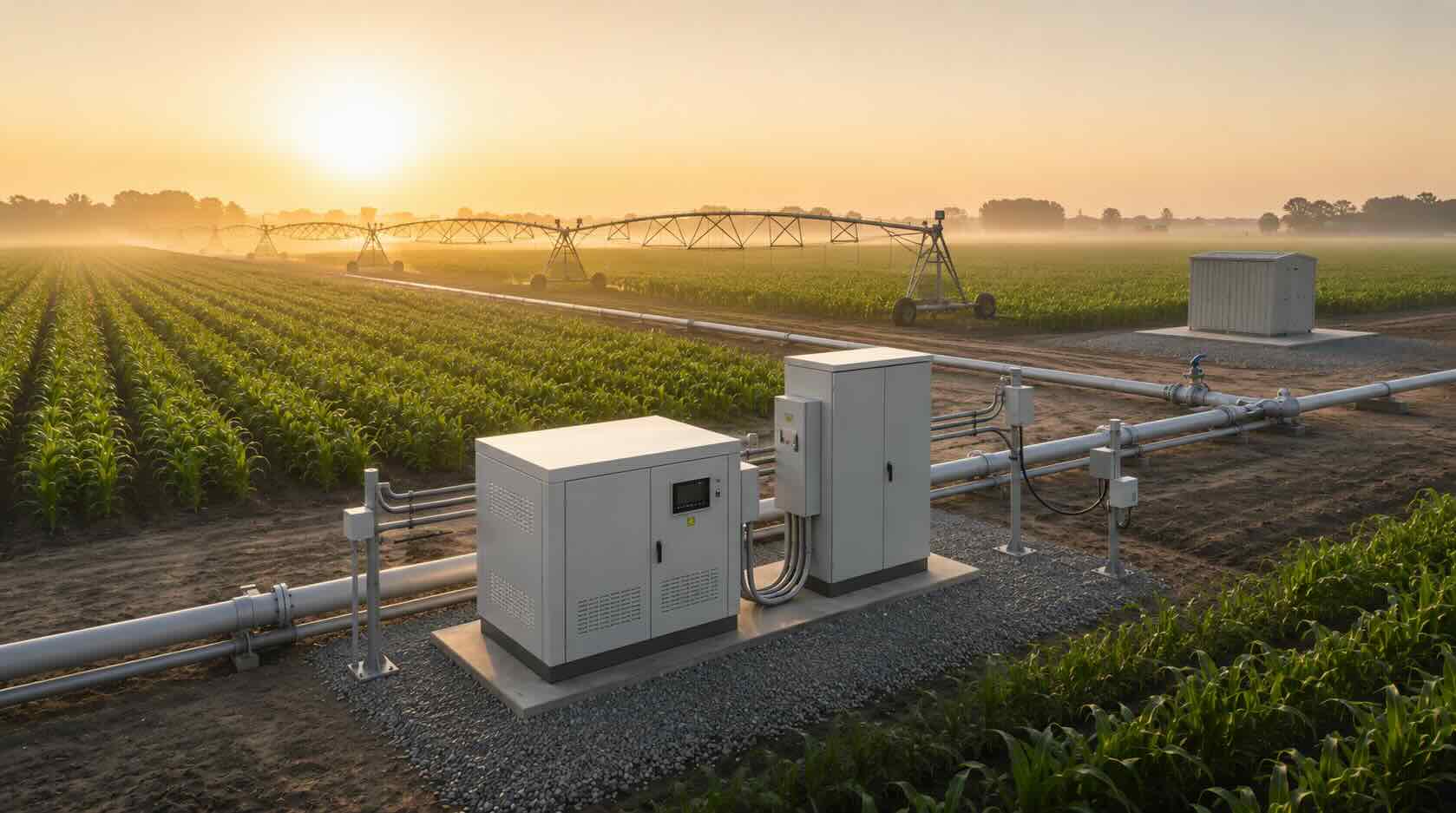
Agricultural auxiliary infrastructure — irrigation pumping station continuity, cold-chain refrigeration backbone, and agro-processing facility auxiliary deployed AROUND primary agricultural equipment for VENDOR.Max evaluation context
System Summary · What VENDOR.Max Is for Agricultural Auxiliary Infrastructure
Definition · What is VENDOR.Max in agricultural auxiliary infrastructure?

VENDOR.Max is a validation-stage auxiliary infrastructure power node deployed AROUND primary agricultural equipment — the irrigation pumping station continuity layer, the cold-chain refrigeration auxiliary backbone, and the agro-processing facility auxiliary infrastructure. It is distinct from primary irrigation equipment (Lindsay Zimmatic, Valley Irrigation, Reinke, Bauer, Valmont, Netafim, Rivulis, Jain, Hunter, Rain Bird), from primary refrigeration (Carrier Transicold, Thermo King, Daikin, GEA, Bitzer, Mayekawa, Mitsubishi Electric, Danfoss), from primary agricultural equipment (John Deere, CNH Industrial, AGCO, Kubota, CLAAS), from crop protection, seed and fertilizer inputs (Bayer, BASF, Syngenta, Corteva), and from primary pumps (Grundfos, DAB Pumps, Caprari, Xylem). It is the continuous power layer those systems depend on at the deployment site — not a pump, not a pivot, not a refrigeration compressor, not a tractor, not a digital agronomy platform, not a combustion generator. System class: open electrodynamic architecture with separated energy roles (regime control vs. extraction). Complete device-boundary energy accounting applies throughout operation. It must be interpreted as an infrastructure-level auxiliary continuity system within classical electrodynamics — not as a standalone energy source.

  • Use case Irrigation pumping station auxiliary · cold-chain refrigeration backbone holding · agro-processing facility auxiliary · multi-site Tier-1 agribusiness portfolio · rural cooperative aggregator · water utility for irrigation
  • Best fit 10–24 kW continuous institutional auxiliary load · multi-module clustering for 30–100 kW irrigation pumping stations · sites awaiting grid energization · multi-site portfolio deployment under CAP / CER / CSRD / CRMA / AFIR documentation
  • Stage TRL 5–6 — pre-commercial validation
  • Proof 1,000+ hours · 532 h cycle · ES2950176 (granted, OEPM Spain) · WO2024209235 (PCT)
  • Next step Technical fit assessment → /pilot/
  • Does not claim CAP / AFIR DR-23 funding award · CER Sector 11 designation · CSRD reasonable assurance certification · CRMA Strategic Project status · field-proven deployment at scale
What is VENDOR.Max for agricultural infrastructure?

VENDOR.Max is the auxiliary infrastructure layer deployed AROUND primary agricultural equipment — the resilience-and-continuity layer beneath irrigation pumping stations, beneath cold-chain refrigeration backbones, and beneath agro-processing facility primary process equipment. It is not a pivot, not a pump, not a refrigeration compressor, not a tractor. Current status: TRL 5–6, with 1,000+ cumulative operational hours and a 532-hour continuous operational cycle recorded under controlled laboratory conditions.

When does CER Sector 11 (food) designation take effect?

17 July 2026 — Member State critical entity designation deadline under CER Directive (EU) 2022/2557 Annex Sector 11 (food production, processing and distribution). Member State resilience strategy was due 17 January 2026. Article 13 resilience measures apply to designated critical entities. Large-scale industrial food production and processing, food supply chain services including storage and logistics, and food wholesale distribution are explicitly in scope per the Commission delegated regulation of 25 July 2023.

What was the AFIR DR-23 EUR 164.9M agro-processing window?

EUR 164.9 million processing and marketing investment intervention under Romania’s CAP National Strategic Plan 2023-2027, managed by AFIR (Agenția pentru Finanțarea Investițiilor Rurale). Closed funding window: 15.12.2025–16.02.2026. Maximum EUR 10 million bakery / EUR 3 million other, 65% intensity. Sectors: bakery, dairy, pastry, milling, oilseed crushing. SMEs, cooperatives and producer groups eligible. Auxiliary infrastructure architectural decisions are documentable within this funding pathway as a reference for future CAP Strategic Plan cycles.

Verified at TRL 5–6

What the operational record shows

  • TRL 5–6 laboratory validation
  • 1,000+ hours internal operational record
  • 532-hour continuous operational cycle under controlled laboratory conditions
  • ES2950176 granted (OEPM, Spain)
  • WO2024209235 PCT active · EP / US / CN / IN national/regional examination active
Not Yet Claimed

What still progresses through the validation pathway

  • Field-proven deployment at commercial Tier-1 agribusiness scale
  • Independent third-party verification completed
  • CE / UL certification issued
  • All patent grants confirmed (EP / US / CN / IN under examination)
  • CAP / CER / CSRD / CRMA / AFIR compliance certification for the system itself
Partner Ecosystem · Adjacent Architectural Layers, Not Competitors

VENDOR.Max Is a Partner
to the Agricultural Equipment Ecosystem

VENDOR.Max operates on the auxiliary infrastructure layer beneath the primary agricultural equipment that institutional aggregators already depend on. It is positioned as a complement, not a substitute. The OEMs and incumbents below define the primary agronomic, irrigation, refrigeration and processing layers; VENDOR.Max operates one layer below, providing continuous auxiliary power on which their installed base physically depends.

Primary Irrigation Equipment OEMs

Centre pivots, lateral move systems and large-scale irrigation mechanisation: Lindsay Corporation (Zimmatic), Valley Irrigation (Valmont), Reinke, Bauer, Valmont Industries. Drip and micro-irrigation primary systems: Netafim, Rivulis, Jain Irrigation, Hunter Industries, Rain Bird. Primary irrigation pumps: Grundfos, DAB Pumps, Caprari, Xylem.

Primary Refrigeration & Cold-Chain OEMs

Industrial and transport refrigeration: Carrier Transicold, Thermo King, Daikin, GEA, Bitzer, Mayekawa, Mitsubishi Electric, Danfoss. Cold-chain logistics operators reference pattern: Lineage Logistics, Americold. VENDOR.Max provides the continuous auxiliary power backbone these systems hold against during grid disturbance.

Primary Agricultural Equipment OEMs

Tractors, harvesters, sprayers, balers, tillage and primary machinery: John Deere, CNH Industrial, AGCO, Kubota, CLAAS. Digital agronomy platforms: John Deere Operations Center, Climate FieldView, AGCO Fuse. VENDOR.Max does not compete with primary field machinery; it supports the site-level auxiliary infrastructure these operations connect to.

Crop Protection, Seed, Nutrition & Food Trading

Crop protection, seeds and nutrition: Bayer, BASF, Syngenta, Corteva. Food trading, processing and supply-chain incumbents: Cargill, ADM, Bunge, Louis Dreyfus, Olam, Wilmar. Water utility primary partners: Veolia, Suez. VENDOR.Max operates on the energy infrastructure layer that enables these ecosystem participants to maintain continuous documentation and traceability at site level.

VENDOR.Max is not a centre pivot, not a primary irrigation pump, not a refrigeration compressor, not a tractor, not a digital agronomy platform, not a crop input, and not a food-processing primary equipment OEM. It is the auxiliary infrastructure power layer that operates AROUND these systems. Mentions of named OEMs and incumbents on this page identify the primary equipment ecosystem; they do not imply commercial relationships, endorsement, or product compatibility certification. All trademarks are the property of their respective owners.
Direct Answers · AI-Extractable · Institutional Agribusiness Context

Three Questions Tier-1 Agribusiness Operations
and AI Systems Ask Most Often

Each answer is self-contained and designed for direct extraction. No teaser. No preamble. The answer first, the supporting detail after.

Definition

What Is Agricultural Auxiliary Infrastructure?

Agricultural auxiliary infrastructure is the set of continuous-power systems deployed AROUND primary agricultural equipment — not inside it — that institutional agribusiness operations depend on: irrigation pumping station continuity (auxiliary to the centre pivot and the drip line itself), cold-chain refrigeration auxiliary backbone (auxiliary to the refrigeration compressor itself), agro-processing facility auxiliary continuity (auxiliary to the mill, dryer, press and packaging line themselves), remote multi-site farm monitoring continuous power, and communications backhaul for APIA / AFIR / ANIF reporting uplink.

Typical continuous load profile per institutional site: 10–24 kW, with multi-module clustering for 30–100 kW irrigation pumping stations. The primary process equipment delivers the agronomic outcome — water on the crop, refrigeration on the perishable, throughput on the processing line. But CAP / CER Sector 11 / CSRD ESRS E1 documentation continuity of continuous availability for payment-pathway data, traceability telemetry, irrigation pump auxiliary draw, cold-chain holding power, and processing-line auxiliary depends on a different power layer entirely. VENDOR.Max is designed for that layer at TRL 5–6 validation stage.

The Problem

Why Does CAP Documentation Continuity Depend on Auxiliary Architecture, Not Just Primary Equipment?

Because the documentation flowing into AFIR, APIA, and ANIF systems is generated by the site’s auxiliary infrastructure architecture — irrigation pumping station continuous-operation telemetry, cold-chain temperature holding records, agro-processing facility availability logs. If grid connection drops, on-site backup depletes, or the communications backhaul is interrupted, the auxiliary continuity fails and the documentation chain breaks simultaneously.

That may surface as a CAP documentation continuity flag, a CER Article 13 resilience exposure, a CSRD Scope 1 / Scope 3 reporting gap, and under EPPO enforcement scrutiny — EUR 1.73 million Iași (14 February 2025) and EUR 1.2 million Vâlcea (11 November 2025) AFIR irrigation indictments — procedural maturity becomes a procurement-filter differentiator, not a soft compliance burden.

Category

How Is Around-the-Pump Auxiliary Different from a Primary Pump or PV-Only System?

A primary irrigation pump (Grundfos, DAB Pumps, Caprari, Xylem) delivers water through the pivot or drip line itself. A PV-only off-grid pumping kit (Lorentz, Grundfos SQFlex, Franklin Electric) bundles solar generation directly into one pump-and-controller package — weather-dependent, primarily daytime, primarily smallholder. Around-the-pump auxiliary infrastructure addresses the institutional multi-site problem: continuous payment-pathway power for APIA / AFIR / ANIF uplink, irrigation pump auxiliary load (sensors, valves, telemetry, control), cold-chain holding power, agro-processing auxiliary, demand-charge management across the full institutional portfolio.

These are different architectural classes, not different pump sizes. Primary irrigation OEM products (Lindsay Zimmatic, Valley Irrigation, Reinke, Bauer, Valmont) and institutional site-level auxiliary architecture are complementary, not substitutable — partners on adjacent architectural layers, not competitors.

The Structural Problem

EU Agricultural Regulation Tightens Faster
Than Rural Grid Capacity Can Follow

The Common Agricultural Policy 2023–2027 (Regulation (EU) 2021/2115) has been fully in force since 1 January 2023. Romania’s National Strategic Plan envelope is approximately EUR 14.9 billion, with the AFIR digital platform having already processed EUR 5.32 billion from over 50,000 farmers, companies and local institutions. The CAP post-2027 proposal of 17 July 2025 ring-fences EUR 300 billion for income support inside an EUR 865 billion National and Regional Partnership Plans envelope.

Romania’s primary irrigation rehabilitation programme 2022–2027 carries a USD 1.6 billion public envelope, paired with AFIR DR-23 EUR 164.9 million for agro-processing (window closed 16 February 2026), AFIR EUR 100 million for irrigation modernisation, and Romania PNRR Componenta 3 agriculture and rural development. The regulatory clock and the rural grid energization clock are not synchronized: irrigation pumping stations, cold-chain hubs and agro-processing sites operate where utility-grid energization is delayed, partial or absent — while CAP eligibility, CER Sector 11 designation, CSRD assurance and CRMA supply-chain pressure on agricultural input resilience are not.

Real Institutional Site Auxiliary Power Budget
Irrigation pumping station auxiliary load (sensors, valves, telemetry, control)
5–20 kW
Continuous · per station · ANIF / OUAI / water utility
Agro-processing facility auxiliary (bakery / dairy / pastry / milling) — AFIR DR-23 sector
10–15 kW
Continuous · per processing line · AFIR DR-23 eligible
VENDOR.Max design target per node
2.4–24 kW
Modular · clusterable to 30–100 kW pumping station class · TRL 5–6 architecture

An institutional agricultural site — irrigation pumping station with telemetry / valve actuation / pressure sensors, or cold-chain backbone with refrigeration auxiliary draw and temperature-holding records, or AFIR DR-23-eligible bakery / dairy / pastry / milling processing line with auxiliary continuous operations — operates in the range of 10–24 kW continuous per node. That is auxiliary infrastructure power territory, not primary pump or primary compressor or primary processing equipment territory. At this load profile, infrastructure-grade continuity becomes an electrical engineering problem — not an agronomy problem, not a process-engineering problem.

The architectural conversation around agriculture has been primary-equipment-centric since the mid-2010s precision-agriculture wave: bigger pivots, denser drip networks, larger refrigerated cold stores, faster processing throughput. By 2026, the binding constraint has moved — primary OEMs (John Deere, CNH Industrial, AGCO, Kubota, CLAAS, Lindsay, Valley, Reinke, Bauer, Carrier, Thermo King) have largely solved primary throughput. The constraint is the auxiliary infrastructure deployed AROUND primary agricultural equipment.

Diesel backup at remote irrigation pumping stations and cold-chain hubs is exposed under CSRD Scope 1 fugitive and combustion accounting and triggers fuel-logistics maintenance cycles. Battery-only systems require replacement and seasonal derating. Solar-plus-battery is weather-dependent at sites where grid connection cannot be assumed. Rural grid extension is the very thing CAP, CER, CSRD and AFIR deadlines cannot wait for.

Regulatory & Market Signal

The institutional capital channel is operating now. AFIR DR-23 EUR 164.9 million closed funding window for agro-processing (bakery / dairy / pastry / milling) allocated through 16 February 2026, with maximum EUR 10 million per bakery / EUR 3 million other, 65% intensity. AFIR DR-12 EUR 169.5 million young farmers (30 January 2026), DR-16 EUR 151.3 million vegetables (19 January 2026), DR-17 / DR-18 / DR-19 (23 February 2026), AFIR EUR 100 million irrigation modernisation. Tier-1 institutional operators in Romania include Agricover (2.5 million ha addressable), Holde Agri Invest (BVB AeRO HAI), Insula Mare a Brăilei at 56–57,000 ha (EU largest single farm), Agricost (Al Dahra UAE), New Capital Holding at 49,000 ha, Cereal Com Dolj at 25,000 ha, Spearhead at 16,000 ha. The institutional ecosystem includes 219 registered cooperatives under Lege nr. 566/2004 and the UNCSV. EPPO enforcement signal: EUR 1.73 million Iași and EUR 1.2 million Vâlcea AFIR irrigation indictments make procedural maturity a procurement-filter differentiator. The architectural category is forming.

Architectural Inevitability · Regulatory Timeline

Six EU Anchors
Converge in the 2023–2028 Compliance Window

The architectural conversation is closing on dated public anchors. CAP 2023–2027 + CER Sector 11 + AFIR DR-23 + CER critical entity designation + CRMA supply-chain pressure + CSRD reasonable assurance — six regulatory milestones across 2023–2028 that all touch the same site auxiliary infrastructure layer.

01.01.2023 CAP 2023–2027 in force Reg (EU) 2021/2115 · Romania CSP ~EUR 14.9B · AFIR digital platform live
17.01.2026 CER MS resilience strategy Dir (EU) 2022/2557 Sector 11 food · Member State strategy due
16.02.2026 AFIR DR-23 window closed EUR 164.9M agro-processing allocation · bakery / dairy / pastry / milling · closed funding window
17.07.2026 CER critical entity designation MS designation of Sector 11 critical entities · Article 13 measures apply
2026–2030 CRMA supply-chain pressure Reg (EU) 2024/1252 · supply-chain pressure on agricultural input resilience (fertilizer, micronutrients)
FY2028 CSRD reasonable assurance ESRS E1 cold-chain Scope 1 / Scope 3 cascade · Omnibus I narrowed scope
Sources: Regulation (EU) 2021/2115 CAP Strategic Plans (EUR-Lex); Commission proposal COM(2025) 560 of 17 July 2025 CAP post-2027; Directive (EU) 2022/2557 CER Annex Sector 11 food, including Commission delegated regulation of 25 July 2023 essential services; Regulation (EU) 2024/1252 CRMA; Directive (EU) 2022/2464 CSRD + ESRS E1; AFIR Romania calendar 2025–2026 (AFIR DR-23, DR-12, DR-14, DR-16, DR-17 / DR-18 / DR-19, irrigation modernisation EUR 100M); Omnibus I scope narrowing (Council February 2026). VENDOR.Max does not certify compliance with any of these instruments; it is designed as the auxiliary infrastructure power layer on which the institutional aggregator’s compliance posture physically depends.
Operational Reality

Where Institutional Agricultural Infrastructure
Actually Fails

These are not edge cases. They are structural failure modes that Tier-1 agribusiness Operations VPs, cooperative directors, and Group CFOs encounter at CAP-eligible and CER-Sector-11-designated sites — consistently, predictably, across European agricultural markets.

01 · Rural Grid Asymmetry

AFIR Deadlines and CER Designation Move Faster Than Rural Grid Energization

The binding constraint moved from primary equipment to rural grid

The AFIR DR-23 EUR 164.9 million agro-processing window allocation closed 16 February 2026. CER Sector 11 Member State critical entity designation deadline is 17 July 2026. The rural utility-grid energization timeline does not move with these regulatory deadlines. The site has a binding deadline; the energization has a queue.

Irrigation pumping stations, cold-chain hubs and AFIR DR-23-eligible agro-processing facilities operate at sites where rural grid extension is delayed, partial, or absent. Diesel auxiliary backup is exposed under CSRD Scope 1 fugitive and combustion accounting and triggers fuel-logistics maintenance cycles. Solar-plus-battery is weather-dependent and seasonally derated. The USD 1.6 billion Romania primary irrigation rehabilitation programme 2022–2027 and AFIR EUR 100 million irrigation modernisation are precisely the canal-and-distribution layer — not the pumping-station auxiliary continuity layer.

The architectural workaround is on-site auxiliary infrastructure that activates the institutional site ahead of full grid energization — deferred energization without deferred CAP eligibility, CER designation readiness, or AFIR DR-23 submission.

02 · APIA / AFIR / ANIF Reporting Continuity

CAP Documentation Depends on Auxiliary Uptime, Not Primary Equipment Uptime

The compliance flag fires when the site loses power, not when the pivot does

The CAP eligibility flow requires continuous documentation: APIA subsidy claim submission, AFIR digital platform processing (EUR 5.32 billion processed from over 50,000 farmers, companies and local institutions), ANIF irrigation allocation reporting, OCPI land registry verification. The data that flows into these systems is generated by site auxiliary telemetry, pumping-station continuous operation logs, cold-chain temperature holding records, and agro-processing facility availability uplink.

When auxiliary infrastructure goes dark — grid drops, on-site BESS depletes, or comms uplink is interrupted — the documentation pipeline breaks simultaneously. Under EPPO enforcement scrutiny (EUR 1.73 million Iași and EUR 1.2 million Vâlcea AFIR irrigation indictments), procedural gaps in continuous auxiliary uptime become exposure points. CER Sector 11 designation extends Article 13 resilience measures to designated entities from 17 July 2026. The documentation continuity obligation is continuous; the auxiliary uptime requirement is continuous.

Outsourcing documentation to a managed APIA / AFIR consultancy does not eliminate the upstream dependency. The data pipeline starts at the site auxiliary layer.

03 · Multi-Site Institutional Portfolio Reality

PV-Only Pumping Kits Don’t Solve the Institutional Multi-Site Problem

A smallholder product cannot do institutional-portfolio work

PV-only off-grid pumping kits (Lorentz, Grundfos SQFlex, Franklin Electric) address daytime smallholder pumping. They do not address the institutional multi-site architectural problem — continuous auxiliary load across irrigation pumping stations, cold-chain hubs and AFIR DR-23-eligible processing facilities; APIA / AFIR / ANIF reporting uplink continuity; demand-charge management across the full site portfolio; AFIR DR-23 / DR-12 / DR-16 / DR-17-18-19 documentation chain.

These are different architectural classes. Tier-1 institutional operators — Agricover (2.5 million ha addressable), Insula Mare a Brăilei (56–57,000 ha), Agricost (Al Dahra UAE), New Capital Holding (49,000 ha), Holde Agri Invest (BVB AeRO HAI) — deploy across dozens or hundreds of sites. Multiply auxiliary load per site by the portfolio — auxiliary architecture is not optional, it is the institutional-scale deployment layer.

04 · Cold-Chain Scope 1 Compression

CSRD Cold-Chain OPEX Is Dominated by Auxiliary Continuous Load

Fugitive refrigerant + continuous auxiliary draw compound on the same envelope

Cold-chain refrigeration sites face two CSRD ESRS E1 exposure categories simultaneously: fugitive refrigerant emissions on Scope 1, and the auxiliary continuous load that maintains temperature holding, telemetry uplink, perimeter security, control-room availability, and traceability documentation. Diesel auxiliary backup adds combustion Scope 1 on top of fugitive refrigerant Scope 1.

Under CSRD ESRS E1, limited assurance applies from FY2025 and reasonable assurance is required by FY2028, with Omnibus I (Council February 2026) narrowing scope to entities above 1,000 employees and EUR 450 million turnover. Auxiliary architecture combined with site-level energy management reduces fuel-logistics dependence while preserving cold-chain continuous availability for CER Sector 11 designation. Two functions, one architectural decision — deferred to the auxiliary layer.

Treating cold-chain auxiliary load as residual hides the Scope 1 line that compounds the fugitive-refrigerant exposure. Treating it as architectural surfaces a recoverable cost.

05 · AFIR DR-23 Capital Channel

The Institutional Capital Channel Recognizes Auxiliary, Not Residual

AFIR DR-23 is a structuring framework, not just a compliance burden

The AFIR DR-23 EUR 164.9 million agro-processing closed funding window (allocated through 16 February 2026, maximum EUR 10 million bakery / EUR 3 million other, 65% intensity) is the institutional capital channel reference for bakery, dairy, pastry, milling and oilseed processing investments. Paired with AFIR DR-12 EUR 169.5 million young farmers, DR-14 EUR 108 million small farms, DR-16 EUR 151.3 million vegetables, DR-17 / DR-18 / DR-19 (February 2026), AFIR EUR 100 million irrigation modernisation, Romania PNRR Componenta 3, and the Horizon Europe Cluster 6 framework, the institutional capital channel can include auxiliary architecture within the broader deployment scope where eligible and properly documented.

Operators structuring auxiliary architecture decisions under AFIR / PNRR-recognized categories access this capital channel. Operators treating AFIR purely as compliance miss the architectural opportunity to structure deployment as institutional infrastructure rather than tactical buildout.

06 · Portfolio-Scale Decision

Site-by-Site Auxiliary Compounds Across a Tier-1 Agribusiness Portfolio

The architectural decision is engineered once, deployed across the portfolio

Every additional institutional site — every irrigation pumping station, every cold-chain hub, every AFIR DR-23-eligible processing facility — adds an auxiliary architectural decision. At single-site scale, this is manageable. At Tier-1 agribusiness multi-site portfolio scale, across dozens or hundreds of CAP-eligible and CER-Sector-11-designated sites, it becomes the primary constraint on CAP / CER / CSRD / CRMA / AFIR delivery.

The fuel-logistics-independent auxiliary architecture engineered to a single 2026-EU-regulatory-stack-aware specification is deployed once, documented once against AFIR DR-23 / Romania PNRR Componenta 3 / Horizon Europe Cluster 6 simultaneously, and scaled across the portfolio. The decision is institutional, not site-by-site.

Regulatory Compounding · 2023–2028

The EU Agricultural Regulatory Stack
Is Compounding, Not Stabilising

Six dated EU anchors now intersect at one architectural layer: the auxiliary infrastructure deployed AROUND primary agricultural equipment. CAP 2023–2027 in force. CER Sector 11 designation approaching. AFIR DR-23 closed funding cycle establishes the agro-processing reference. CSRD ESRS E1 sets cold-chain Scope 1 and Scope 3 cascade reporting. CRMA introduces supply-chain pressure on agricultural input resilience. Continuous site auxiliary uptime becomes a physical prerequisite for maintaining documentation continuity across this regulatory stack.

01 Jan 2023 CAP 2023–2027 in force Reg (EU) 2021/2115 · Romania CSP ~EUR 14.9B (EUR-Lex)
17 Jan 2026 CER MS resilience strategy due Dir (EU) 2022/2557 · Sector 11 food · Member State strategy
16 Feb 2026 AFIR DR-23 closed funding window EUR 164.9M agro-processing allocation · bakery / dairy / pastry / milling
17 Jul 2026 CER critical entity designation MS designation of Sector 11 critical entities · Article 13 measures apply
2026–2030 CRMA supply-chain pressure Reg (EU) 2024/1252 · pressure on agricultural input resilience (fertilizer, micronutrients)
FY2028 CSRD reasonable assurance ESRS E1 cold-chain Scope 1 / Scope 3 cascade · Omnibus I narrowed scope
CAP 2023–2027 · Reg (EU) 2021/2115

Romania National Strategic Plan + AFIR Digital Platform

The Common Agricultural Policy 2023–2027 has been fully in force since 1 January 2023. Romania’s National Strategic Plan envelope is approximately EUR 14.9 billion. The AFIR digital platform has processed EUR 5.32 billion from over 50,000 farmers, companies and local institutions. The CAP post-2027 proposal of 17 July 2025 ring-fences EUR 300 billion for income support inside an EUR 865 billion National and Regional Partnership Plans envelope.

Site activation under CAP-funded schemes depends on more than primary equipment. The auxiliary infrastructure layer — irrigation pumping station telemetry, cold-chain holding documentation, agro-processing facility availability logs — must support documentation continuity between utility-grid energization windows.

CER Sector 11 · Dir (EU) 2022/2557

Food Production, Processing & Distribution Resilience

The Critical Entities Resilience Directive Annex Sector 11 covers food production, processing and distribution. Member State resilience strategy was due 17 January 2026; Member State designation of critical entities is due 17 July 2026. Article 13 resilience measures apply to designated entities. Large-scale industrial food production and processing, food supply-chain services including storage and logistics, and food wholesale distribution are explicitly in scope per the Commission delegated regulation of 25 July 2023.

Resilience requirements rest on the auxiliary uptime layer — cold-chain holding power, telemetry uplink, perimeter monitoring, control-room continuous operations. When auxiliary infrastructure drops, the resilience evidence drops with it.

CSRD ESRS E1 · Dir (EU) 2022/2464

Cold-Chain Scope 1 + Scope 3 Cascade Reporting

Limited assurance under ESRS E1 applies from FY2025; reasonable-assurance preparation becomes relevant toward FY2028. Omnibus I (Council February 2026) narrowed the scope of in-scope entities to those above 1,000 employees and EUR 450 million turnover. Cold-chain operators face two Scope 1 exposure categories simultaneously: fugitive refrigerant emissions and combustion emissions from on-site diesel auxiliary backup.

Scope 3 cascade reporting reaches up the institutional aggregator supply chain. Tier-1 agribusiness operators, cooperatives, and food-trading incumbents that source from in-scope processors inherit the reporting cascade. Auxiliary architecture decisions enter the disclosure perimeter as part of operational evidence.

CRMA · Reg (EU) 2024/1252

Supply-Chain Pressure on Agricultural Inputs

The Critical Raw Materials Act introduces structural supply-chain pressure on agricultural input resilience. Fertilizer feedstocks, micronutrient supply, and phosphate-related materials are increasingly exposed to strategic raw-materials and supply-chain resilience policy pressure over the 2026–2030 horizon. Implementation phases through delegated and implementing acts.

The downstream effect on institutional agriculture is reduced input-supply elasticity over the deployment horizon. Architectural decisions that reduce site fuel-logistics dependence at irrigation pumping stations, cold-chain hubs, and agro-processing facilities become part of the supply-chain-resilience documentation pattern.

Institutional Capital Channel · AFIR + PNRR + Horizon Europe

The AFIR DR-23 EUR 164.9 million closed funding window for agro-processing (bakery, dairy, pastry, milling) was allocated through 16 February 2026, with maximum EUR 10 million bakery / EUR 3 million other, 65% intensity. Paired with DR-12 EUR 169.5 million young farmers, DR-14 EUR 108 million small farms, DR-16 EUR 151.3 million vegetables, DR-17 / DR-18 / DR-19 (23 February 2026), AFIR EUR 100 million irrigation modernisation, Romania PNRR Componenta 3 agriculture and rural development, and the Horizon Europe Cluster 6 framework, the institutional capital channel can include auxiliary architecture within the broader deployment scope where eligible and properly documented.

Important clarification. VENDOR.Max does not certify CAP, CER, CSRD, CRMA, or AFIR compliance for the operator or for itself. It is designed as the auxiliary infrastructure power layer that enables irrigation pumping continuity, cold-chain backbone holding, and agro-processing facility auxiliary operations to maintain availability between utility-grid energization windows. Regulatory compliance assessment for specific deployments requires qualified review against the applicable framework.
Legacy Power Approaches

Why Existing Site Power Architecture Cannot Satisfy
This Compounding Stack

Institutional agribusiness operators of CAP-funded and CER-Sector-11-designated sites typically work with four power approaches. Each was designed for a different regulatory and operational era — each carries a structural limitation that becomes more significant as the CAP + CER + CSRD + CRMA + AFIR stack tightens.

Approach 01 · Diesel Rural Backup

Fuel Logistics + CSRD Scope 1 Exposure

Designed before CSRD ESRS E1 + CER Sector 11 existed

Diesel backup powers a measurable share of EU rural irrigation pumping station auxiliary loads, cold-chain hub continuity, and agro-processing facility backup today. Fuel must be delivered to every site. Storage must be maintained. Logistics must be coordinated. Diesel reliability and maintenance burden compound at multi-site Tier-1 agribusiness portfolio scale.

NREL / ACEEE (2024): 8–17 service or testing visits per year required to maintain operational readiness for a diesel backup generator. Marqusee & Jenket (Applied Energy, 2020): diesel reliability can fall below ~80% in extended outage scenarios beyond 24–48 hours. Fuel polishing required every 2–5 years.

Under CSRD Scope 1 disclosure, the diesel dependency at rural agricultural sites is now a reporting line on the operator’s sustainability statement. Under CER Sector 11 Article 13 resilience measures, fuel-logistics-dependent backup carries documented single-point exposure to supply disruption. The operational burden compounds with a disclosure and resilience burden.

Approach 02 · Primary Irrigation Pump-Only Architecture

Primary Equipment Without an Auxiliary Layer

A primary pump cannot do site-level auxiliary work

Primary irrigation pumps from Grundfos, DAB Pumps, Caprari and Xylem move water from source to delivery infrastructure. Primary pivot systems from Lindsay (Zimmatic), Valley Irrigation, Reinke, Bauer and Valmont distribute water across the field. Drip and micro-irrigation primary systems from Netafim, Rivulis, Jain, Hunter and Rain Bird control delivery at the plant. The primary equipment is excellent at what it does. What it does not do: site-level auxiliary continuity for valve actuation, pressure sensor telemetry, control-room console power, APIA / AFIR / ANIF reporting backhaul, perimeter security at remote stations.

The institutional site auxiliary load profile sits at 5–20 kW continuous per pumping station and 10–15 kW continuous per AFIR DR-23-eligible processing line. Primary equipment OEM products and site-level auxiliary architecture address different power layers.

Primary irrigation OEM products and site-level auxiliary architecture are complementary, not substitutable — partners on adjacent architectural layers. The compounding regulatory stack requires both layers operating continuously.

Approach 03 · Solar + BESS Hybrid

Weather Dependency + Seasonal Agricultural Load Profile

Designed around primary irrigation throughput, not auxiliary continuity

Solar-plus-battery systems work well in high-irradiance Mediterranean and Iberian agricultural deployments aligned with daytime irrigation pumping. CAP documentation continuity, CER resilience evidence, CSRD cold-chain Scope 1 reporting, and agro-processing facility auxiliary continuity are neither daytime-only nor weather-aligned. Overcast conditions, seasonal variation, dust accumulation, and Northern / Central European latitude introduce reliability variation across multi-site institutional aggregator portfolios that span Romania’s irrigation rehabilitation zones, Siret-Bărăgan corridor, and EU-wide cold-chain networks.

BESS sizing is typically scaled to bridge daytime pump throughput rather than the always-on auxiliary continuity envelope that spans telemetry, payment-pathway uplink, security monitoring, and cold-chain holding power across the institutional portfolio.

Approach 04 · Rural Grid Extension Wait

DSO Timeline + Regulatory Deadline Are Not the Same Timeline

Romania National Programme 2022–2027 modernises canals, not pumping-station auxiliary continuity

Rural grid extension is the economically rational option in the long term — if the schedule were compatible with the CAP documentation, CER designation, and AFIR submission calendar. Romania’s primary irrigation rehabilitation programme 2022–2027 carries a USD 1.6 billion public envelope, and AFIR EUR 100 million targets irrigation modernisation. These instruments rehabilitate primary canal, distribution, and pumping infrastructure — not the per-station auxiliary continuity layer that supports telemetry, documentation and control-room operations.

The DSO connection queue at rural agricultural sites and the regulatory deadline calendar are not synchronized. The architectural workaround is on-site auxiliary infrastructure that activates the institutional site ahead of full grid energization — deferred energization without deferred CAP documentation continuity, CER designation readiness, or AFIR submission evidence.

The Structural Pattern

None of these approaches is wrong. Each addresses a specific deployment context within its design constraints. The structural challenge is that none of them escapes the compounding cost logic: every additional irrigation pumping station, every cold-chain hub, every AFIR DR-23-eligible processing facility, every remote multi-site monitoring node adds another instance of the same fuel-logistics, primary-equipment-only, weather-dependency, or grid-extension-wait limitation. At single-digit site counts this is manageable. At the scale CAP / CER / CSRD / CRMA / AFIR now requires — Tier-1 multi-site agribusiness aggregators, rural cooperatives at portfolio scale, water utilities for irrigation, and cold-chain operators — it becomes the dominant constraint on documentation continuity delivery.

VENDOR.Max · Auxiliary Infrastructure Power Layer

The Continuity Layer Deployed
AROUND Primary Agricultural Equipment

What VENDOR.Max Is

VENDOR.Max is a deployment-autonomous auxiliary infrastructure power node designed as the auxiliary infrastructure layer deployed AROUND primary agricultural equipment. It is designed to provide the continuous unattended auxiliary power that irrigation pumping station telemetry, cold-chain refrigeration auxiliary backbone, agro-processing facility auxiliary loads, APIA / AFIR / ANIF reporting communications backhaul, perimeter security and control-room consoles depend on — across institutional aggregator multi-site portfolios in rural Romania, EU irrigation rehabilitation zones, and cold-chain corridors.

Architectural class: open electrodynamic architecture with separated energy roles (regime control vs. extraction). A startup impulse initiates the operating regime. Complete device-boundary energy accounting applies throughout operation. See How It Works for the full operating model.

Architectural Position
  • Output class: 2.4–24 kW per node — aligned with the 10–24 kW continuous institutional site auxiliary envelope, with multi-module clustering for 30–100 kW irrigation pumping station class
  • Operating profile: continuous unattended operation for CAP documentation continuity, CER Article 13 resilience evidence, and AFIR / APIA / ANIF reporting-relevant infrastructure
  • Architecture: solid-state — no combustion cycle, no rotating assemblies, designed to reduce dependence on on-site fuel logistics at remote rural agricultural sites
  • Stage: TRL 5–6 — pre-commercial validation
  • Patent coverage: ES2950176 (granted, OEPM Spain) · WO2024209235 (PCT) · EP · US · CN · IN national/regional examination active
Distinct from

Primary irrigation OEMs

VENDOR.Max is not a centre pivot, lateral move system, drip or micro-irrigation primary system, or primary irrigation pump. It does not move water from source to plant. It powers the site auxiliary infrastructure AROUND the pumping station and along the irrigation network.

Lindsay (Zimmatic) · Valley Irrigation · Reinke · Bauer · Valmont · Netafim · Rivulis · Jain · Hunter · Rain Bird · Grundfos · DAB Pumps · Caprari · Xylem — ecosystem partners, not competitors
Distinct from

Primary refrigeration OEMs

VENDOR.Max is not a refrigeration compressor, condenser unit, evaporator coil, transport refrigeration unit, or cold-chain primary system. It is the continuous auxiliary power layer the refrigeration installed base holds against during grid disturbance, energization gaps, and rural distribution instability.

Carrier Transicold · Thermo King · Daikin · GEA · Bitzer · Mayekawa · Mitsubishi Electric · Danfoss — ecosystem partners, not competitors
Distinct from

Primary agro-equipment + crop inputs

VENDOR.Max is not a tractor, harvester, sprayer, baler, primary tillage equipment, or digital agronomy platform. It is not a pesticide, herbicide, fungicide, seed or fertilizer input. It is the energy infrastructure layer that supports the auxiliary continuity these ecosystem participants depend on at the site level.

John Deere · CNH Industrial · AGCO · Kubota · CLAAS · Bayer · BASF · Syngenta · Corteva — ecosystem partners, not competitors

Where VENDOR.Max Powers the Site AROUND Primary Equipment

Application 01

Irrigation Pumping Station Auxiliary Continuity

Telemetry + valve actuation + pressure sensors + control

Continuous auxiliary power for irrigation pumping station telemetry sensors, valve actuators, pressure transducers, flow meters, SCADA gateway compute, and control-room console power. Sized for institutional pumping station envelope: 5–20 kW continuous per station, with multi-module clustering for 30–100 kW class stations under ANIF / OUAI / water utility operation. The auxiliary layer must be online for documentation continuity even when the primary pumping is not scheduled.

Application 02

Cold-Chain Refrigeration Auxiliary Backbone

CER Sector 11 resilience + CSRD ESRS E1 Scope 1 evidence

Continuous auxiliary power for the cold-chain refrigeration backbone holding layer — temperature monitoring telemetry, traceability documentation uplink, perimeter security, control room availability, and emergency lighting. Supports CER Sector 11 Article 13 resilience measures at designated entities and supports documentation related to Scope 1 fugitive-refrigerant exposure and reduced combustion-backup dependence under ESRS E1 reasonable-assurance preparation toward FY2028.

Application 03

Agro-Processing Facility Auxiliary

AFIR DR-23 sector reference: bakery / dairy / pastry / milling / oilseed

Continuous auxiliary power for agro-processing facility auxiliary loads — quality-control instrumentation, traceability telemetry, packaging-line auxiliary, control-room continuous operations, ANSVSA-reporting backhaul. Sized for the AFIR DR-23-eligible sector envelope: 10–15 kW continuous per processing line. The auxiliary layer documents facility uptime for CAP National Strategic Plan reporting and CER Sector 11 food-processing resilience evidence.

Application 04

Multi-Site Portfolio Communications & Coordination

APIA / AFIR / ANIF / ANSVSA backhaul + Tier-1 portfolio scale

Continuous auxiliary power for the multi-site portfolio communications stack — fibre and 4G / 5G uplink to APIA subsidy claim systems, AFIR digital platform, ANIF irrigation allocation reporting, OCPI land registry, ANSVSA traceability, and the site-controller layer that aggregates farm-level telemetry into the institutional-aggregator documentation chain. Auxiliary downtime here surfaces as a documentation continuity gap under CAP, CER Article 13, and EPPO procurement-filter scrutiny.

Architectural positioning. VENDOR.Max is at TRL 5–6. Described characteristics represent design targets validated at laboratory scale, not field-deployed commercial specifications. The system is positioned as the auxiliary infrastructure layer that operates alongside — not in competition with — the primary irrigation OEMs, refrigeration OEMs, agricultural equipment OEMs, crop input producers, and food-trading incumbents that define the agribusiness ecosystem. Energy balance at the device boundary: Pin,boundary = Pload + Plosses + dE/dt. No overunity claim is made or implied. Independent third-party verification is part of the planned validation roadmap; completion not yet claimed.
Validation Record · TRL 5–6

What Is Verified.
What Is in Progress.

At TRL 5–6, VENDOR.Max has accumulated an operational record that permits qualified technical evaluation by Tier-1 agribusiness operators, rural cooperatives, water utilities for irrigation, and cold-chain logistics aggregators. The boundary between what is verified at laboratory scale and what remains under the planned validation roadmap is stated explicitly — not blurred.

1,000+ Cumulative operational hours — documented internally
532 h Continuous operational cycle — controlled laboratory conditions
TRL 5–6 Validation stage — laboratory validated
2.4–24 kW Per-node envelope — aligned with 10–24 kW institutional site auxiliary load
Verified at TRL 5–6

What the operational record shows

  • System-level prototype operates under defined laboratory conditions
  • 1,000+ cumulative operational hours documented internally
  • 532-hour continuous operational cycle under controlled laboratory conditions
  • Modular operating logic evaluated in laboratory configurations
  • International patent family active — ES2950176 granted (OEPM); WO2024209235 PCT; EP / US / CN / IN under examination
Not Yet Claimed

What still progresses through the validation pathway

  • Independent third-party verification of operating conditions — completion not yet claimed
  • Accredited certification body confirmation of the operational record
  • Demonstration at commercial Tier-1 agribusiness scale in relevant deployment environments (TRL 6–7 pathway in progress)
  • Commercial-grade output specifications (subject to CE / UL pathway)
  • CAP / CER / CSRD / CRMA / AFIR compliance certification for the system itself
Reproducibility Signal

The recorded operational cycles are conducted under defined configuration parameters and have been reproduced across multiple runs under controlled laboratory conditions. Reproducibility at the system-boundary level — consistent behaviour across cycles, not a single occurrence — is being systematically validated as part of the TRL 6 pathway. Observed behaviour is repeatable within defined parameter ranges and operating configurations.

Staged Validation Progression

TRL 5–6 · Current

Laboratory Validation

Operational record documented (1,000+ h, 532 h cycle) Patent portfolio active (ES2950176 granted, OEPM; WO2024209235 PCT) Pilot fit assessments open for qualified Tier-1 agribusiness, cooperative, water utility and cold-chain operators
Each stage advances when measurable criteria are met — not on a fixed calendar
TRL 6–7 · Next Gate

Relevant-Environment Demonstration

Pilot programme structured for qualified institutional aggregators and water utilities for irrigation Independent verification pathway defined Test protocols and gating conditions defined at each step
TRL 7–8 · Certification Stage

Third-Party Verification + Certification

Independent third-party verification completed CE / UL certification pathway initiated Commercial deployment readiness defined
Why Now

Three Converging Pressures
Make 2026–2028 the Decision Window

Each of these three pressures alone is significant. Together, they define a planning horizon during which auxiliary infrastructure power decisions for institutional agricultural deployments are made — or postponed at increasing CAP / CER / CSRD documentation and operational evidence cost.

Pressure 01

EU Agricultural Stack Compounding

Six dated EU anchors between January 2023 and FY2028 converge at the same architectural layer where institutional site auxiliary continuity is determined. CAP 2023–2027 in force, CER Sector 11 Member State strategy and critical entity designation (17 January and 17 July 2026), the AFIR DR-23 EUR 164.9M closed funding window as a reference, CRMA supply-chain pressure 2026–2030, and CSRD ESRS E1 reasonable-assurance preparation toward FY2028 each add documentation, resilience or operational evidence obligations that depend on auxiliary infrastructure being operational at the moment of stress.

Pressure 02

Rural Grid Asymmetry + Institutional Scale

Romania’s primary irrigation rehabilitation programme 2022–2027 carries a USD 1.6 billion public envelope and AFIR EUR 100 million targets irrigation modernisation — rehabilitating canal and distribution infrastructure, not the per-station auxiliary continuity layer. Tier-1 institutional operators (Agricover 2.5M ha addressable, Insula Mare a Brăilei 56–57,000 ha, Agricost / Al Dahra, New Capital Holding 49,000 ha) deploy across dozens of sites where rural DSO energization timelines and regulatory deadline calendars are not synchronized.

Pressure 03

CSRD Scope 1 Cold-Chain + Diesel Exposure

Cold-chain operators face dual CSRD Scope 1 exposure: fugitive refrigerant emissions plus combustion emissions from on-site diesel auxiliary backup. Limited assurance applies from FY2025; reasonable-assurance preparation becomes relevant toward FY2028. Omnibus I (Council February 2026) narrowed scope to entities above 1,000 employees and EUR 450 million turnover. Auxiliary architecture decisions made in 2026 carry through the first CSRD reporting cycles for Tier-1 agribusiness aggregators, food-trading incumbents, and cold-chain logistics aggregators.

The decision horizon. Most architectural decisions about distributed agricultural auxiliary infrastructure have a deployment runway of 12–24 months from procurement to operational state. Decisions made in early 2026 reach operational maturity around CER critical entity designation (17 July 2026), CRMA supply-chain pressure phasing (2026–2030), and CSRD reasonable-assurance preparation toward FY2028. Decisions postponed are not neutral — they compress the runway against the same documentation continuity and resilience evidence calendar.
Who This Is For

Four Deployment Contexts
Where VENDOR.Max Fits Today

VENDOR.Max is at TRL 5–6 — pre-commercial validation. The relevant audience is qualified Tier-1 agribusiness multi-site operators, rural cooperative legal entities, agro-processing facility operators, and water utilities for irrigation where pilot programmes can be structured under defined gating conditions. These are the four contexts where the architectural fit is most direct.

Context 01

Tier-1 Agribusiness Multi-Site Aggregator

Operator of multi-site institutional portfolio across irrigation, cold-chain, and agro-processing nodes — Agricover (2.5M ha addressable), Holde Agri Invest (BVB AeRO HAI), Insula Mare a Brăilei (56–57,000 ha — EU largest single farm reference), Agricost (Al Dahra UAE), New Capital Holding (49,000 ha), Cereal Com Dolj (25,000 ha), Spearhead (16,000 ha) and comparable institutional patterns. CAP National Strategic Plan documentation continuity active across the portfolio.

Architectural fit: per-site 10–24 kW auxiliary continuous · multi-module clustering for 30–100 kW pumping station class · portfolio-scale documentation discipline under single specification
Context 02

Rural Cooperative Legal Entity · Lege nr. 566/2004

Registered agricultural cooperative legal entity in Romania under Lege nr. 566/2004 — 219 cooperatives in the institutional ecosystem, federated through UNCSV. Eligible for AFIR DR-12 EUR 169.5M young farmers, DR-14 EUR 108M small farms, DR-16 EUR 151.3M vegetables, DR-17 / DR-18 / DR-19 (February 2026), and Romania PNRR Componenta 3. Auxiliary architecture decisions documented at the cooperative aggregator level rather than at individual member level.

Architectural fit: cooperative-scale 10–24 kW auxiliary · irrigation pumping + cold storage + processing line · AFIR digital platform documentation pathway
Context 03

Agro-Processing Facility Operator · AFIR DR-23 Sector

Operator of bakery, dairy, pastry, milling, or oilseed-crushing facility in the AFIR DR-23 sector reference framework. AFIR DR-23 EUR 164.9 million closed funding window allocated through 16 February 2026, maximum EUR 10 million bakery / EUR 3 million other, 65% intensity. SMEs, cooperatives and producer groups in scope. CER Sector 11 food production, processing and distribution designation pathway (Member State designation 17 July 2026).

Architectural fit: per-facility 10–15 kW auxiliary continuous per processing line · control room + traceability uplink + ANSVSA-reporting continuity · CER Article 13 resilience evidence layer
Context 04

Water Utility for Irrigation + Cold-Chain Aggregator

Water utility for agricultural irrigation operations (ANIF / OUAI / Apele Române pattern), agricultural water management consortium, or cold-chain logistics aggregator at portfolio scale (Lineage Logistics / Americold reference pattern). Romania Siret-Bărăgan Main Canal section 200 km corridor and EU irrigation rehabilitation zones. Tier-1 cold-chain network spans Veolia / Suez utility partner relationships at the institutional aggregator layer.

Architectural fit: per-station 5–20 kW auxiliary · multi-module to 30–100 kW pumping station class · cold-chain holding power + telemetry uplink for CER Sector 11 resilience evidence
Who this is not for. VENDOR.Max is not designed for individual smallholder farms, hobby farms, household micro-farming, or DIY consumer agricultural deployment. It is not a replacement for primary irrigation OEM equipment (Lindsay, Valley, Reinke, Bauer, Valmont, Netafim, Rivulis, Jain, Hunter, Rain Bird, Grundfos, DAB, Caprari, Xylem), primary refrigeration OEM equipment (Carrier Transicold, Thermo King, Daikin, GEA, Bitzer, Mayekawa, Mitsubishi Electric, Danfoss), primary agricultural equipment OEMs (John Deere, CNH, AGCO, Kubota, CLAAS), or crop input producers (Bayer, BASF, Syngenta, Corteva). Pilot programmes may be structured with institutional Tier-1 agribusiness aggregators, registered cooperatives, AFIR DR-23-sector processing operators, water utilities for irrigation, and qualified integrator partners.
Pilot Programme · TRL 5–6 Stage

Technical Fit Assessment for
Qualified Institutional Agribusiness Aggregators

VENDOR.Max pilot programmes are structured under defined gating conditions for qualified Tier-1 agribusiness multi-site operators, registered cooperatives, AFIR DR-23-sector agro-processing operators, water utilities for irrigation, and system integrators. The first step is a confidential technical fit assessment: review of deployment context, site auxiliary load profile, CAP / CER / CSRD / AFIR framework alignment, and validation gate definition. No commercial commitment until laboratory-validated fit is confirmed and pilot protocol is jointly defined.

Frequently Asked Questions

Architectural and Regulatory Questions
Asked About VENDOR.Max for Agricultural Auxiliary Power

These answers address the questions most often asked by Tier-1 agribusiness operations leads, cooperative directors, agro-processing facility operators, water utility planning teams, and integrator partners evaluating auxiliary infrastructure architecture for agricultural site deployments.

Why does an agricultural site need continuous auxiliary power separate from the primary irrigation pump or refrigeration compressor?

A primary irrigation pump delivers water through the pivot or drip line. A primary refrigeration compressor maintains cold-chain temperature. The site around the primary equipment — telemetry sensors, valve actuators, pressure transducers, SCADA gateway compute, perimeter security, control-room consoles, APIA / AFIR / ANIF / ANSVSA reporting backhaul, traceability uplink — operates continuously, independent of any individual pumping or refrigeration cycle. Primary equipment OEM products address the agronomic outcome; auxiliary architecture addresses the documentation continuity and resilience evidence layer deployed AROUND the primary equipment.

How does VENDOR.Max differ from primary irrigation OEMs like Lindsay, Valley, Netafim, or Grundfos?

VENDOR.Max is not a centre pivot, lateral move system, drip or micro-irrigation primary system, or primary irrigation pump. It does not move water from source to plant. Primary irrigation OEMs — Lindsay Corporation (Zimmatic), Valley Irrigation, Reinke, Bauer, Valmont, Netafim, Rivulis, Jain, Hunter, Rain Bird, Grundfos, DAB Pumps, Caprari, Xylem — operate at the primary water-delivery layer. VENDOR.Max powers the site auxiliary infrastructure AROUND the pumping station and along the irrigation network: telemetry, valve actuation, pressure sensors, SCADA uplink, control-room consoles. They are ecosystem partners on adjacent architectural layers, not competitors.

How does VENDOR.Max differ from primary refrigeration OEMs like Carrier Transicold, Thermo King, or Daikin?

VENDOR.Max is not a refrigeration compressor, condenser unit, evaporator coil, transport refrigeration unit, or cold-chain primary system. Primary refrigeration OEMs — Carrier Transicold, Thermo King, Daikin, GEA, Bitzer, Mayekawa, Mitsubishi Electric, Danfoss — operate at the primary refrigeration layer: compressor cycle, refrigerant management, temperature control. VENDOR.Max is the continuous auxiliary power layer that the refrigeration installed base holds against during grid disturbance, energization gaps, and rural distribution instability. Ecosystem partners on adjacent layers, not competitors.

How does VENDOR.Max relate to AFIR DR-23 and the broader Romania funding calendar?

The AFIR DR-23 EUR 164.9 million closed funding window for agro-processing (bakery, dairy, pastry, milling) was allocated through 16 February 2026 — maximum EUR 10 million bakery / EUR 3 million other, 65% intensity. It establishes the sector reference framework for the AFIR DR-23-eligible processing envelope. The broader Romania calendar 2025–2026 includes AFIR DR-12 EUR 169.5M young farmers, DR-14 EUR 108M small farms, DR-16 EUR 151.3M vegetables, DR-17 / DR-18 / DR-19 (23 February 2026), AFIR EUR 100 million irrigation modernisation, and Romania PNRR Componenta 3 agriculture and rural development. The institutional capital channel can include auxiliary architecture within the broader deployment scope where eligible and properly documented.

Does VENDOR.Max certify CAP, CER, CSRD, CRMA, or AFIR compliance?

No. VENDOR.Max does not certify regulatory compliance for the operator or for itself. It is designed as the auxiliary infrastructure power layer that enables irrigation pumping continuity, cold-chain backbone holding, agro-processing facility auxiliary operations, and APIA / AFIR / ANIF / ANSVSA reporting communications to maintain availability between utility-grid energization windows — a physical prerequisite that documentation-relevant infrastructure may depend on. Regulatory compliance assessment for any specific deployment requires qualified review against the applicable framework by certified auditors or compliance bodies.

What is the current TRL stage and what does that mean for deployment?

VENDOR.Max is at TRL 5–6 — laboratory-validated, pre-commercial. System-level prototype has been operated under defined laboratory conditions, with 1,000+ cumulative operational hours documented internally and a 532-hour continuous operational cycle under controlled laboratory conditions. The system is not yet a certified commercial product. Independent third-party verification and accredited certification body confirmation are part of the planned validation roadmap; completion is not yet claimed. Commercial-grade output specifications remain subject to CE / UL certification pathway.

What output range does VENDOR.Max address and how does it map to institutional agricultural auxiliary loads?

Single-node design output class is 2.4–24 kW. Multi-module clustering extends to 30–100 kW irrigation pumping station class deployment. This range is aligned with the 10–24 kW continuous institutional site auxiliary envelope: irrigation pumping stations (5–20 kW per station with ANIF / OUAI / water utility operation), AFIR DR-23-sector agro-processing facilities (10–15 kW per processing line), cold-chain refrigeration auxiliary backbone, and multi-site portfolio communications backhaul. These are architecture design targets at TRL 5–6, not field-deployed commercial specifications.

How does VENDOR.Max work, in plain architectural terms?

VENDOR.Max is an open electrodynamic architecture with separated energy roles — regime control and extraction operate as distinct functional roles within the system. A startup impulse is required to initiate the operating regime. Complete device-boundary energy accounting applies throughout operation, within classical electrodynamics: Pin,boundary = Pload + Plosses + dE/dt. The system is not a perpetual motion or overunity device; no claim of producing more energy than it consumes is made or implied. See How It Works for the full operating model.

How does VENDOR.Max relate to diesel backup at remote rural agricultural sites?

VENDOR.Max is architecturally distinct from combustion-based backup generators. It is designed to reduce or remove recurring fuel-delivery dependency at suitable deployment sites and to reduce exposure to on-site fuel logistics at irrigation pumping stations, cold-chain hubs, and AFIR DR-23-eligible processing facilities. Per NREL / ACEEE (2024), a diesel backup generator requires 8–17 service or testing visits per year to maintain operational readiness. Diesel generators remain operationally valid for many contexts; VENDOR.Max addresses the architectural class of distributed continuous-load auxiliary power where fuel logistics, maintenance overhead, or CSRD Scope 1 combustion exposure are material constraints.

What patent and IP protection covers VENDOR.Max?

The patent family includes ES2950176 granted by the Spanish Patent Office (OEPM) and PCT application WO2024209235 with national / regional examination active in EP (European Patent Office), US (United States), CN (China), and IN (India). The EU trademark 019220462 protects the VENDOR brand across the European Union. Full patent portfolio documentation is available for qualified review.

Can VENDOR.Max replace grid connection for irrigation pumping stations or cold-chain facilities?

No. VENDOR.Max is not positioned as a grid replacement for primary irrigation pumping or primary refrigeration. The primary pump cycle and the primary refrigeration cycle draw on the utility-grid power envelope and, where used, on-site BESS buffering. VENDOR.Max is the auxiliary continuity layer deployed AROUND primary agricultural equipment — telemetry, valve actuation, pressure sensors, traceability uplink, control-room consoles, perimeter security, and APIA / AFIR / ANIF / ANSVSA reporting backhaul. It is particularly relevant in constrained energization scenarios — rural sites awaiting full DSO connection capacity, sites where grid feed quality is variable, and sites where auxiliary continuity must be maintained between utility-grid energization windows.

Is VENDOR.Max already commercially deployed at Tier-1 agribusiness scale?

No. VENDOR.Max is at TRL 5–6 — laboratory-validated, pre-commercial. Commercial-scale field deployment at Tier-1 agribusiness aggregator portfolio level is not yet claimed. The current stage is pilot fit assessment: confidential technical review of deployment context, site auxiliary load profile, CAP / CER / CSRD / AFIR framework alignment, and validation gate definition with qualified institutional agribusiness aggregators, cooperatives, agro-processing operators, and water utilities. Progression to commercial Tier-1 agribusiness-scale deployment requires the planned validation roadmap to advance through independent third-party verification and CE / UL certification pathway, which is in progress but not yet completed.