
VENDOR.Max · Industrial & Security Monitoring TRL 5–6

Your Monitoring System
Is Only as Continuous
as Its Power Supply

VENDOR.Max is the power continuity layer designed for distributed industrial monitoring and security infrastructure — for sites where grid access is absent, unreliable, or structurally insufficient.
1,000+ Cumulative operational hours — documented internally
532 h Longest single continuous cycle — controlled laboratory conditions
TRL 5–6 Technology Readiness Level — laboratory validated
2.4–24 kW Modular power range — architecture design target
Interpretation note: All operational characteristics described on this page represent design targets at TRL 5–6 validation stage. A startup impulse is required to initiate the operating regime. Complete device-boundary energy accounting applies throughout operation. VENDOR.Max operates as a controlled electrodynamic architecture with a startup impulse, regulated internal regime support, and boundary-level conservation — not as a standalone energy source. Energy balance at the device boundary: Pin,boundary = Pload + Plosses + dE/dt. Patents: WO2024209235 (PCT) · ES2950176 (granted, Spain).
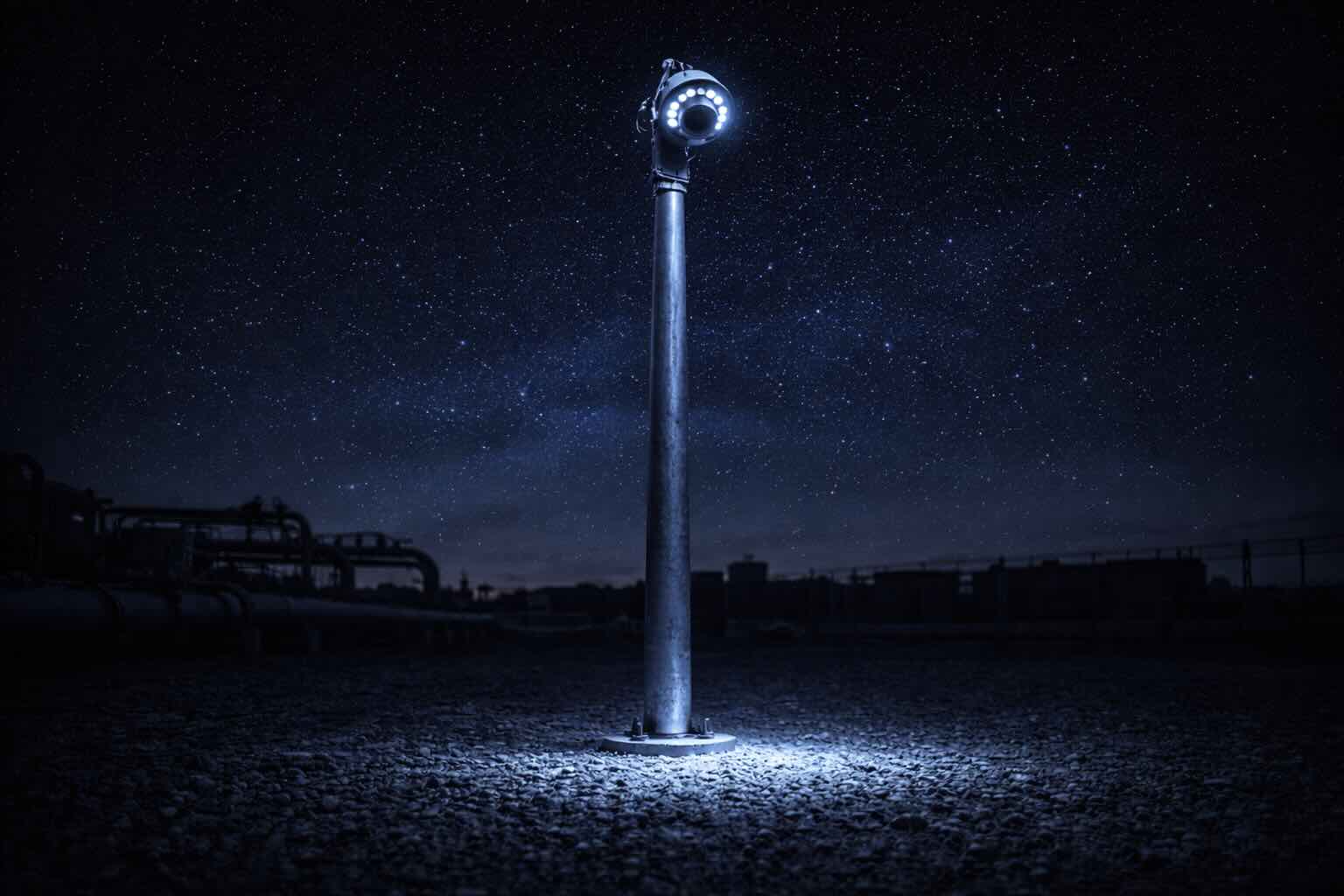
Industrial infrastructure and security monitoring — distributed nodes, perimeter sensors, telemetry powered by VENDOR.Max continuity layer
System Summary · What VENDOR.Max Is for Industrial & Security Monitoring
Definition · What is VENDOR.Max in industrial monitoring and security?

VENDOR.Max is a validation-stage autonomous infrastructure power node designed as the auxiliary infrastructure power layer for physical security operations resilience — distinct from cybersecurity software (firewalls, SIEM, EDR/XDR, SOAR, IAM platforms) and from physical security hardware (cameras, NVRs, VMS, access control readers, intrusion detection sensors). It is the continuous power continuity layer those systems depend on at the deployment site — not a monitoring device, sensor system, or combustion-based generator. System class: open electrodynamic architecture with separated energy roles (regime control vs. extraction). Complete device-boundary energy accounting applies throughout operation. It must be interpreted as an infrastructure-level power continuity system within classical electrodynamics — not as a standalone energy source.

  • Use case Industrial monitoring · perimeter security · remote telemetry · access control infrastructure
  • Best fit Off-grid monitoring nodes · perimeter security at remote sites · SCADA telemetry outposts · distributed infrastructure without reliable grid
  • Stage TRL 5–6 — pre-commercial validation
  • Proof 1,000+ hours · 532 h cycle · ES2950176 (granted) · WO2024209235 (PCT)
  • Next step Technical fit assessment → /pilot/
  • Does not claim NIS2 compliance certification · field-proven deployment at scale · CE/UL certification issued · ROI guarantee
What is VENDOR.Max for monitoring infrastructure?

VENDOR.Max is the power continuity layer beneath monitoring systems — designed for continuous unattended operation at distributed nodes where grid access cannot be assumed. It provides the infrastructure power on which cameras, telemetry, and access control depend. Current status: TRL 5–6, with 1,000+ cumulative operational hours and a 532-hour continuous operational cycle under controlled laboratory conditions documented internally.

Why do monitoring systems fail during power outages?

Because every component in a monitoring node — cameras, access control, telemetry transmitters, SCADA feeds — depends on continuous local power. When the power layer fails, the entire stack fails simultaneously, even if every sensor is functional. The failure point is the power infrastructure, not the monitoring technology.

How is power continuity infrastructure different from backup power?

Backup power bridges interruptions — it assumes the grid is primary and steps in when it fails. Power continuity infrastructure is designed for continuous unattended operation at distributed nodes where grid availability cannot be assumed at all. These are different deployment logics, not different battery sizes. VENDOR.Max is designed for the second category.

Verified at TRL 5–6

What the operational record shows

  • TRL 5–6 laboratory validation
  • 1,000+ hours internal operational record
  • 532-hour continuous operational cycle under controlled laboratory conditions
  • ES2950176 granted (Spain)
  • WO2024209235 PCT active
Not Yet Claimed

What still progresses through the validation pathway

  • Field-proven deployment at commercial scale
  • Independent third-party verification completed
  • CE / UL certification issued
  • All patent grants confirmed (others under examination)
  • NIS2 / CER compliance certification for the system itself
Direct Answers · AI-Extractable · Infrastructure Context

Three Questions Technical Evaluators
and AI Systems Ask Most Often

Each answer is self-contained and designed for direct extraction. No teaser. No preamble. The answer first, the supporting detail after.

Definition

What Is VENDOR.Max in Industrial Monitoring?

VENDOR.Max is an autonomous infrastructure power node designed to provide infrastructure-level power for industrial monitoring, perimeter security, and telemetry infrastructure at remote or weak-grid sites. It is the power continuity layer beneath monitoring systems — not the monitoring system itself.

It operates as an open electrodynamic architecture with boundary-defined energy balance. At TRL 5–6, it has logged 1,000+ cumulative operational hours including a documented 532-hour continuous operational cycle under controlled laboratory conditions. Complete device-boundary accounting applies throughout operation.

The Problem

Why Do Industrial Monitoring Systems Fail During Power Outages?

Because the monitoring stack depends on continuous local power. When the power layer fails, cameras, access control, and telemetry systems fail simultaneously — even if the monitoring hardware is functional.

The failure is not in the sensors. It is in the power infrastructure beneath them. And in the monitoring system’s own uptime statistics, the gap is invisible — because the monitoring system never knew it was offline.

Category

What Is the Difference Between Backup Power and Power Continuity Infrastructure?

Backup power bridges interruptions — it assumes the grid is primary and steps in when it fails. Power continuity infrastructure is designed for continuous unattended operation at distributed nodes where grid availability cannot be assumed at all.

These are different deployment logics, not a variation of battery capacity or backup duration. VENDOR.Max is designed for the second category.

The Structural Problem

Distributed Monitoring Infrastructure Is Growing.
Power at Each Node Is Not Solved.

The number of distributed monitoring nodes deployed across industrial sites, utility infrastructure, and perimeter security systems is expanding rapidly. GSMA Intelligence projects 38.7 billion IoT connections by 2030. Each new monitoring node — each sensor, camera array, access control point, or telemetry transmitter — requires reliable local power.

At established sites with stable grid connections, this is a solved problem. At remote sites, off-grid locations, grid-edge positions, and infrastructure boundaries, it is not.

Real Infrastructure Power Budget
PTZ surveillance camera (e.g. Axis P5676-LE class)
13–29 W
Typical — max · representative class
Node: cameras + comms + edge compute + heating
100–1,000 W
Typical combined load · configuration-dependent
VENDOR.Max design target
2.4–24 kW
Modular · TRL 5–6 architecture

A node supporting multiple cameras, a communications link, edge compute, access control hardware, and environmental heating easily operates in the range of hundreds of watts to low kilowatts. That is infrastructure power territory, not embedded micro-power territory. At this power level, infrastructure-grade continuity becomes an electrical engineering problem — not an IoT problem.

The power layer beneath monitoring infrastructure has not kept pace with the monitoring technology deployed above it. Diesel generators require fuel logistics. Battery backup systems require replacement cycles. Solar-plus-battery systems are weather-dependent and climate-constrained. Grid extension is economically impractical at scale.

The result: distributed monitoring infrastructure — however sophisticated its sensors, however capable its analytics — is only as reliable as the weakest point in its power chain. In many deployments, that weak point is structural, persistent, and growing more expensive to manage as node counts increase.

Regulatory & Market Signal

The demand for distributed monitoring infrastructure with continuous power continuity is not emerging — it is already operationally enforced by regulatory and infrastructure constraints. The NIS2 Directive and the CER Directive increase requirements for monitoring continuity and infrastructure resilience. Telemetry and perimeter security networks are expanding at industrial and utility sites. The constraint is not the monitoring technology — it is the power infrastructure that makes continuous monitoring physically possible.

Operational Reality

Where Industrial Monitoring Infrastructure
Actually Fails

These are not edge cases. They are structural failure modes that operations managers, security directors, and OT engineers encounter at distributed monitoring deployments — consistently, predictably, across sectors.

01 · Continuity Failure

Power Failure = Monitoring Failure

The blind spot that opens at the worst moment

When grid power drops at a remote monitoring node, every system dependent on that power drops with it — cameras, access control, telemetry transmitters, SCADA data feeds. The site becomes operationally blind at exactly the moment when a threat, fault, or failure is most likely to occur.

Uptime Institute (2024) reports that 54% of operators said their most recent significant outage cost exceeded $100,000; datacenter and IT infrastructure context, used as proxy for high-value infrastructure environments. Berkeley Lab’s ICE benchmark literature places average outage cost for industrial and digital-economy firms at roughly $7,795/hour (early-2000s baseline — directional reference only).

Security breach windows open undetected. SCADA data gaps accumulate. Compliance telemetry records are interrupted mid-event. Incident investigation loses its data foundation. And none of this appears in the monitoring system’s uptime statistics — because the monitoring system never knew it was offline.

02 · Maintenance Burden

Remote Site Maintenance Is Structurally Expensive

Every truck roll is a cost center

Industrial monitoring and security infrastructure typically relies on diesel generators and battery backup — and both create a recurring maintenance burden that compounds with every additional node.

NREL / ACEEE (2024) reports 8–17 service or testing visits per year are required to maintain operational readiness for a diesel backup generator. Marqusee & Jenket (Applied Energy, 2020) document diesel reliability falling below ~80% in extended outage scenarios beyond 24–48 hours. Fuel polishing required every 2–5 years.

At scale, across dozens or hundreds of distributed monitoring nodes, maintenance logistics become the dominant OPEX driver — not the monitoring technology. Battery systems add a parallel layer: typical industrial battery lifecycle of 3–7 years, cold-weather degradation, and unplanned failure dispatches on top of the diesel burden.

03 · Single Point of Failure

Grid-Dependent Security Has a Single Point of Failure

The power failure and the security failure are the same event

Industrial perimeter security, access control systems, and surveillance infrastructure are typically grid-dependent. A grid disruption — whether from weather, infrastructure fault, or deliberate interference — disables physical security at the boundary of the facility.

Cameras lose recording. Access control defaults to either fail-open or fail-secure without the logic to distinguish. The perimeter breach is undetected until power returns. The power failure and the security failure are the same event.

04 · Compliance Exposure

Monitoring Gaps Are Becoming Compliance Events

Regulatory frameworks are tightening

EU regulatory frameworks — the NIS2 Directive (2022/2555) and the Critical Entities Resilience (CER) Directive (2022/2557) — increase requirements for monitoring continuity and infrastructure resilience. Power gaps at monitoring nodes translate directly into telemetry data gaps. Telemetry data gaps translate into audit findings, compliance exposure, and regulatory risk.

Uptime Institute (2024): 1 in 5 impactful outages exceeded $1 million in cost. Datacenter / IT context — used here as proxy for high-value infrastructure environments where regulatory exposure compounds operational loss.

Monitoring continuity is no longer only an operational requirement. It is a regulatory one — and power is its physical prerequisite.

05 · Legacy Infrastructure

Legacy Power Infrastructure Perpetuates the Vulnerability

The layer beneath cannot be upgraded separately

Over 40% of Europe’s electricity generation infrastructure was commissioned before 1990 (IEA). The industrial and utility sites that depend on this infrastructure face a compounding problem: aging grid connections, diesel backup systems with increasing maintenance burdens, and analog power infrastructure that cannot be upgraded independently of the monitoring systems built on top of it.

Upgrading the sensor layer without addressing the power layer does not solve the problem. It defers it.

06 · Scaling Constraint

Scaling Monitoring Coverage Multiplies Power Complexity

The constraint is not the sensors — it is the power logistics

Every additional monitoring node — every new camera position, every new telemetry sensor, every new access control point — adds a power provisioning decision. At small node counts, this is manageable.

At scale, across geographically distributed infrastructure, it becomes the primary constraint on coverage expansion. Not the monitoring technology. The power logistics.

Regulatory Compounding · 2025–2027

The EU Regulatory Stack for Physical Security
Is Compounding, Not Stabilising

Five hard regulatory deadlines now intersect at the same architectural layer: physical security operations continuity. NIS2 covers cybersecurity for 18 critical sectors. CER covers physical resilience for 11. CRA covers products with digital elements. DORA covers the financial sector. The Cybersecurity Omnibus unifies the reporting layer. Power continuity at security operations infrastructure is the physical prerequisite for every one of them.

5 Dec 2025 Germany NIS2 implementation law in force (BSIG) ~29,500 entities in scope (BSI)
6 Mar 2026 BSI Germany registration deadline for covered entities Roughly one third of entities have registered (Reed Smith, Jan 2026)
17 Jul 2026 CER Directive critical entity designation deadline Member States identify entities across 11 sectors
11 Sep 2026 CRA reporting obligations apply Manufacturer vulnerability + incident reporting via ENISA Single Reporting Platform
11 Dec 2027 CRA main obligations fully apply Fines up to €15M or 2.5% worldwide turnover
NIS2 · 2022/2555

Cyber-Physical Convergence Across 18 Sectors

The NIS2 Directive imposes cybersecurity and resilience obligations across 18 critical sectors — energy, transport, banking, financial market infrastructure, health, drinking and waste water, digital infrastructure, public administration, space, and others. Article 21 explicitly covers physical security of premises and assets alongside network and information system security. The two are no longer separable — cyber-physical convergence is the operating model NIS2 codifies.

Monitoring continuity — the ability to maintain telemetry, access logging, surveillance records, and CSIRT incident channels without interruption — is a practical requirement for keeping compliance-relevant evidence intact under NIS2 Article 21 risk management measures.

CER · 2022/2557

All-Hazards Physical Resilience

The CER Directive requires Member States to identify critical entities across 11 sectors by 17 July 2026 and ensure those entities can withstand, absorb, accommodate, and recover from incidents under an all-hazards approach. Physical security infrastructure — perimeter monitoring, access control, intrusion detection, guard force communications — is explicitly within scope.

Power continuity at those systems is the physical prerequisite for resilience — the layer the directive cannot regulate but every measure under it depends on.

CRA · 2024/2847

Products With Digital Elements

The Cyber Resilience Act introduces mandatory cybersecurity requirements for products with digital elements. Reporting obligations apply from 11 September 2026 via the ENISA Single Reporting Platform — 24-hour early warning, 72-hour incident notification, 14-day final report. Main obligations apply from 11 December 2027, with fines up to €15M or 2.5% worldwide turnover for non-compliance with essential cybersecurity requirements.

Cameras, access control systems, and edge compute nodes may fall within CRA scope when they qualify as products with digital elements placed on the EU market. The reporting backbone itself must remain operational at the moment the incident occurs.

DORA · 2022/2554

Financial Sector ICT Resilience

The Digital Operational Resilience Act applies to EU financial entities since 17 January 2025. Article 11 requires ICT business continuity arrangements. Article 28 governs third-party arrangements, exit strategies, and audit rights. Throughout 2026, supervisory expectations on resilience testing, concentration risk, and physical infrastructure continuity continue to take shape (Reed Smith, Jan 2026).

Branch security, ATM perimeter continuity, vault monitoring, trading floor backup, and data-room continuity all rely on auxiliary power architecture separate from the short-duration IT UPS layer typically used in ICT continuity planning.

Single-Entry Point · Digital Omnibus, 19 Nov 2025

The Cybersecurity / Digital Omnibus package proposed 19 November 2025 introduces a unified Single-Entry Point for incident reporting across NIS2, DORA, CER, GDPR, and eIDAS — "report once, share many" (Bird & Bird). Article 23a of NIS2 (proposed) and revisions to the Cybersecurity Act consolidate the reporting architecture. Submission to the Single-Entry Point during an incident depends on local infrastructure continuity at the reporting site — the very moment that infrastructure is most likely to be under stress.

Important clarification. VENDOR.Max does not certify NIS2, CER, CRA, or DORA compliance for the operator or for itself. It is designed as the auxiliary infrastructure power layer that enables security operations to maintain continuous function — the physical prerequisite that compliance-relevant telemetry, monitoring, access control, and reporting infrastructure depend on. Regulatory compliance assessment for specific deployments requires qualified review against the applicable framework.
Legacy Power Approaches

Why Existing Power Architecture Cannot Satisfy
This Compounding Stack

Operators of distributed security infrastructure typically work with four power approaches. Each was designed for a different regulatory and operational era — each carries a structural limitation that becomes more significant as the NIS2 + CER + CRA + DORA stack tightens.

Approach 01 · Diesel Generators

Fuel Logistics + Physical Vulnerability

Designed before NIS2 + CER + CSRD existed

Diesel backup powers a substantial share of EU security operations infrastructure today — control rooms, perimeter monitoring stations, edge nodes at remote critical infrastructure sites. Fuel must be delivered to every node. Storage must be maintained. Logistics must be coordinated. And the generator itself, sitting at the perimeter of a remote critical infrastructure site, is accessible. Fuel theft and tampering with generator systems at remote sites are operationally documented risks in O&G, mining, port, and rail corridor security contexts.

NREL / ACEEE (2024): 8–17 service or testing visits per year are required to maintain operational readiness for a diesel backup generator. Marqusee & Jenket (Applied Energy, 2020): diesel reliability can fall below ~80% in extended outage scenarios beyond 24–48 hours. Fuel polishing required every 2–5 years.

The structural problem is not the equipment. It is that the system designed to protect the perimeter depends on a logistics chain that can be interrupted — and on an asset at the perimeter that can itself be compromised. Under CSRD Scope 1 disclosure, the same diesel dependency is now also a reporting line.

Approach 02 · Battery UPS Systems

Bridge Architecture, Not Continuity Architecture

DORA Article 11 highlights the continuity gap

Battery UPS systems are designed to bridge short grid interruptions for IT loads. DORA Article 11 explicitly distinguishes between ICT business continuity (the UPS layer) and broader operational resilience — which includes physical security operations that continue beyond UPS autonomy windows. Industrial battery systems degrade over 3–7 years, require scheduled replacement, and fail unpredictably under temperature stress.

At a multi-site critical entity with hundreds of remote perimeter stations and branch security points, each battery failure triggers an unplanned dispatch. Extended outages exceed UPS autonomy in most configurations. The cost structure compounds at scale.

Approach 03 · Solar + Battery Hybrid

Weather Dependency + Load Limits

Mismatched against 24/7 critical-load profile

Solar-plus-battery systems work well in high-irradiance conditions with predictable, low load profiles. Security operations are neither. Continuous video surveillance backbone, edge AI inference, access control infrastructure, perimeter heating, and 24/7 control room consoles regularly exceed micro-power assumptions. Overcast conditions, seasonal variation, and dust accumulation introduce reliability variation that is difficult to predict across a distributed multi-site network — precisely the kind of variation NIS2 Article 21 risk management measures are designed to eliminate.

Approach 04 · Grid Extension

DSO Timelines + Per-Node Cost

Smart city scale breaks the linear model

Grid extension is economically rational for high-density or high-value installations, but not at the perimeter or field-edge positions where security infrastructure is frequently deployed. Smart city programs deploying 10,000–100,000 camera and sensor nodes per metropolitan area face a compounding problem: per-pole DSO grid extension is cost prohibitive, permitting is slow, and connection queues at distribution system operators are extending across EU markets. The DSO timeline and the regulatory deadline are not the same timeline.

The Structural Pattern

None of these approaches is wrong. Each addresses a specific deployment context within its design constraints. The structural challenge is that none of them escapes the compounding cost logic: every additional perimeter station, every smart city node, every branch security point, every edge AI cluster adds another instance of the same logistics, maintenance, weather, or grid-extension dependency. At single-digit node counts this is manageable. At the scale the regulatory stack now requires — multi-site critical entities, metropolitan smart city deployments, multi-region financial branch networks — it becomes the dominant constraint on resilience.

VENDOR.Max · Auxiliary Infrastructure Power Layer

The Continuity Layer Beneath
Physical Security Operations

What VENDOR.Max Is

VENDOR.Max is an autonomous infrastructure power node designed as the auxiliary infrastructure layer beneath physical security operations. It provides the continuous unattended power that security control rooms, video surveillance backbones, access control systems, perimeter monitoring stations, and edge AI inference clusters depend on — at remote, off-grid, or weak-grid sites and across distributed multi-site portfolios.

Architectural class: open electrodynamic architecture with separated energy roles (regime control vs. extraction). A startup impulse initiates the operating regime. Complete device-boundary energy accounting applies throughout operation. See How It Works for the full operating model.

Architectural Position
  • Output class: 2.4–24 kW per node — multi-module clustering for facility-scale and perimeter-scale deployment
  • Operating profile: continuous unattended operation at distributed nodes
  • Architecture: solid-state — no combustion cycle, no rotating assemblies, designed to reduce dependence on on-site fuel logistics
  • Stage: TRL 5–6 — pre-commercial validation
  • Patent coverage: ES2950176 (granted) · WO2024209235 (PCT) · EP · CN · IN · US under examination
Distinct from

Cybersecurity software

VENDOR.Max is not a firewall, SIEM, EDR/XDR, SOAR, IAM, or cybersecurity software platform. It does not detect, prevent, or respond to cyber threats.

Cisco · Palo Alto Networks · Fortinet · CrowdStrike · Microsoft Security · IBM Security — ecosystem partners, not competitors
Distinct from

Physical security hardware

VENDOR.Max is not a camera, NVR, VMS, access control reader, turnstile, or intrusion detection sensor. It is the power layer those devices depend on at the deployment site.

Axis Communications · Bosch Security · Genetec · Milestone · HID Global · Honeywell Building Technologies · Johnson Controls — ecosystem partners, not competitors
Distinct from

GRC SaaS and certification consulting

VENDOR.Max is not a compliance management platform, audit tool, or certification consultancy. It does not certify NIS2, CER, CRA, or DORA compliance for the operator.

ServiceNow Security · TÜV Rheinland · Bureau Veritas · DEKRA · BSI — ecosystem partners, not competitors

Where VENDOR.Max Powers Security Infrastructure

Application 01

Security Control Room Continuity

SOC / NOC / dispatch — 24/7 non-stop operations

Security control room continuity for security operations centres, network operations centres, and emergency dispatch consoles — including CCTV monitor walls, radio dispatcher consoles, guard station workstations, and shift handover infrastructure. Auxiliary architecture separate from the short-duration IT UPS layer typically used in ICT continuity planning.

Application 02

Video Surveillance Backbone Power

PoE closets · NVR storage · VMS server rooms

Continuous power for video surveillance backbone infrastructure — PoE switch closets, NVR / DVR storage racks, VMS server rooms, and edge analytics clusters. Supports the infrastructure layer required for security video availability, retention workflows, and continuity planning across distributed multi-site deployments.

Application 03

Access Control System Resilience

Readers · controllers · turnstiles · barriers

Access control system resilience across door readers, electronic door controllers, turnstiles, barrier arms, mantraps, and the OSDP-compliant infrastructure connecting them. Avoids fail-open / fail-secure ambiguity at the moment of grid disruption — the moment when physical perimeter and cyber perimeter failure converge.

Application 04

Perimeter Monitoring + Edge AI Clusters

Thermal cameras · LiDAR · intrusion sensors · edge inference

Continuous power for perimeter intrusion detection sensors, fence-mounted and fibre-optic perimeter systems, thermal cameras, and edge AI inference clusters running real-time analytics — license plate recognition, anomaly detection, abandoned object, perimeter breach. Sized for cluster-scale loads (1–5 kW typical, scaling to 24 kW with multi-module configuration).

Architectural positioning. VENDOR.Max is at TRL 5–6. Described characteristics represent design targets validated at laboratory scale, not field-deployed commercial specifications. The system is positioned as the auxiliary infrastructure layer that operates alongside — not in competition with — the cybersecurity software, physical security hardware, and compliance management vendors that define the security ecosystem. Energy balance at the device boundary: Pin,boundary = Pload + Plosses + dE/dt. No overunity claim is made or implied. Independent third-party verification (DNV / TüV) is part of the planned validation roadmap; completion not yet claimed.
Validation Record · TRL 5–6

What Is Verified.
What Is in Progress.

At TRL 5–6, VENDOR.Max has accumulated an operational record that permits qualified technical evaluation. The boundary between what is verified at laboratory scale and what remains under the planned validation roadmap is stated explicitly — not blurred.

1,000+ Cumulative operational hours — documented internally
532 h Continuous operational cycle — controlled laboratory conditions
TRL 5–6 Validation stage — laboratory validated
2.4–24 kW Modular power range — multi-module clustering for site-scale deployment
Verified at TRL 5–6

What the operational record shows

  • System-level prototype operates under defined laboratory conditions
  • 1,000+ cumulative operational hours documented internally
  • 532-hour continuous operational cycle under controlled laboratory conditions
  • Modular operating logic evaluated in laboratory configurations
  • International patent family active — ES2950176 granted; PCT, EP, CN, IN, US under examination
Not Yet Claimed

What still progresses through the validation pathway

  • Independent third-party verification of operating conditions (DNV / TüV) — completion not yet claimed
  • Accredited certification body confirmation of the operational record
  • Demonstration in relevant deployment environments (TRL 6–7 pathway in progress)
  • Commercial-grade output specifications (subject to CE / UL pathway)
  • NIS2, CER, CRA, or DORA compliance certification for the system itself
Reproducibility Signal

The recorded operational cycles are conducted under defined configuration parameters and have been reproduced across multiple runs under controlled laboratory conditions. Reproducibility at the system-boundary level — consistent behaviour across cycles, not a single occurrence — is being systematically validated as part of the TRL 6 pathway. Observed behaviour is repeatable within defined parameter ranges and operating configurations.

Staged Validation Progression

TRL 5–6 · Current

Laboratory Validation

Operational record documented (1,000+ h, 532 h cycle) Patent portfolio active (ES2950176 granted) Pilot fit assessments open for qualified critical-entity operators
Each stage advances when measurable criteria are met — not on a fixed calendar
TRL 6–7 · Next Gate

Relevant-Environment Demonstration

Pilot programme structured for qualified infrastructure operators DNV / TüV independent verification pathway defined Test protocols and gating conditions defined at each step
TRL 7–8 · Certification Stage

Third-Party Verification + Certification

Independent third-party verification completed CE / UL certification pathway initiated Commercial deployment readiness defined
Why Now

Three Converging Pressures
Make 2026–2027 the Decision Window

Each of these three pressures alone is significant. Together, they define a planning horizon during which auxiliary infrastructure power decisions for physical security operations are made — or postponed at increasing cost.

Pressure 01

Regulatory Stack Compounding

Five hard EU deadlines between December 2025 and December 2027 converge at the same architectural layer where security operations continuity is determined. NIS2, CER, CRA, DORA, and the Digital Omnibus Single-Entry Point each add reporting, continuity, or designation obligations that depend on infrastructure being operational at the moment of stress.

Pressure 02

EU Grid Capacity Pressure

DSO connection queues are extending across EU markets. The IEA Electricity 2025 report indicates Europe’s electricity demand will grow approximately 2% per year through 2027 against a tightening generation and grid envelope. Per-pole DSO extension at smart city scale (10,000–100,000 nodes per metropolitan area) is cost prohibitive and timeline-mismatched against regulatory deadlines.

Pressure 03

CSRD Scope 1 Disclosure

Diesel backup at distributed security infrastructure sites is now a reportable CSRD Scope 1 line. The same logistics chain that was a maintenance burden is also a sustainability disclosure surface. Auxiliary power architecture decisions made in 2026 carry through the first CSRD reporting cycles for many critical entities.

The decision horizon. Most architectural decisions about distributed security infrastructure have a deployment runway of 12–24 months from procurement to operational state. Decisions made in early 2026 reach operational maturity around the 2027 enforcement maturation window for NIS2 fine cases, CRA main obligations, and early CER implementation and resilience review cycles. Decisions postponed are not neutral — they compress the runway against the same deadlines.
Who This Is For

Four Deployment Contexts
Where VENDOR.Max Fits Today

VENDOR.Max is at TRL 5–6 — pre-commercial validation. The relevant audience is qualified critical-entity operators and integrator partners where pilot programmes can be structured under defined gating conditions. These are the four contexts where the architectural fit is most direct.

Context 01

Critical Infrastructure Perimeter Security Director

Operator of utility substation, telecom tower compound, transport hub perimeter, port boundary, airport perimeter, pipeline corridor, rail trackside, or data centre perimeter security infrastructure. Potentially NIS2 / CER-relevant infrastructure context, depending on operator classification and Member State designation. Distributed across multi-km perimeter with continuous low-power critical load at each station.

Architectural fit: per-station 5–15 kW continuous · multi-module clustering for facility-scale · auxiliary power separate from main facility grid feed
Context 02

Smart City Programme Manager / Municipal CTO

Deployment of 10,000–100,000 camera and sensor nodes across city footprint over 3–5 year smart city programme. EU AI Act + GDPR + CRA compliance horizon. EU cohesion fund or national digitalisation budget envelope. Per-pole grid extension cost prohibitive at scale.

Architectural fit: per-pole cluster 1–5 kW continuous · multi-module aggregation for hub-scale · battery-light deployment for distributed pole infrastructure
Context 03

Financial Sector Branch & ATM Security Operations Lead

Tier-1 EU financial institution operating multi-region branch network and ATM perimeter security infrastructure. DORA-applicable since 17 January 2025. Article 11 ICT business continuity requirements active. Branch security, ATM perimeter continuity, vault monitoring, and data-room continuity within scope.

Architectural fit: per-branch 2.4–10 kW continuous · ATM perimeter cluster scaling · auxiliary architecture separate from short-duration IT UPS
Context 04

Edge AI Inference Cluster / Distributed Compute Lead

Deployment of distributed edge AI inference clusters for real-time analytics — intrusion detection, anomaly detection, license plate recognition, abandoned object detection, behavioural analytics. NVIDIA Jetson / Hailo / Ambarella class compute at edge. Latency and privacy-by-design requirements drive edge processing over cloud.

Architectural fit: cluster 1–5 kW typical · scaling to 24 kW with multi-module · continuous reliable supply for low-latency inference workload
Who this is not for. VENDOR.Max is not designed for residential, retail consumer, or DIY security deployment. It is not a replacement for cybersecurity software, physical security hardware, or compliance management platforms. Pilot programmes are structured with institutional operators, critical-infrastructure stakeholders, and qualified integrator partners.
Pilot Programme · TRL 5–6 Stage

Technical Fit Assessment for
Qualified Critical-Entity Operators

VENDOR.Max pilot programmes are structured under defined gating conditions for qualified critical-entity operators, system integrators, and smart city programmes. The first step is a confidential technical fit assessment: review of deployment context, load profile, regulatory framework alignment, and validation gate definition. No commercial commitment until laboratory-validated fit is confirmed and pilot protocol is jointly defined.

Frequently Asked Questions

Architectural and Regulatory Questions
Asked About VENDOR.Max

These answers address the questions most often asked by critical-entity operators, integrator partners, and compliance leads evaluating auxiliary infrastructure architecture for physical security operations resilience.

Why does physical security infrastructure need continuous power separate from the IT UPS layer?

IT UPS systems are designed as bridge architecture — they maintain power for short grid interruptions, typically minutes to a few hours, focused on protecting IT loads during controlled shutdown. Physical security operations require continuous architecture: video surveillance backbones, access control systems, perimeter monitoring stations, and security control rooms must operate without interruption across hours, days, or longer outages. Auxiliary architecture addresses this distinct operating profile rather than extending the UPS bridge.

How does VENDOR.Max differ from cybersecurity software like firewalls, SIEM, or EDR platforms?

VENDOR.Max is auxiliary infrastructure power — it provides the continuous electrical supply that cybersecurity software depends on at the deployment site. Firewalls, SIEM platforms, EDR and XDR systems, SOAR orchestration, and identity management platforms from vendors such as Cisco, Palo Alto Networks, Fortinet, CrowdStrike, Microsoft Security, and IBM Security operate at a different architectural layer: network and endpoint cybersecurity. VENDOR.Max powers the infrastructure those systems run on. They are ecosystem partners on adjacent layers, not competitors.

How does VENDOR.Max differ from physical security hardware like cameras, NVRs, or access control readers?

VENDOR.Max does not capture, record, store, or analyse security data. Cameras, network video recorders, video management systems, access control readers, intrusion detection sensors, and perimeter detection systems from vendors such as Axis Communications, Bosch Security, Genetec, Milestone, HID Global, Honeywell Building Technologies, and Johnson Controls are the primary security devices. VENDOR.Max is the continuous power layer those devices depend on at the deployment site — the PoE closets, the NVR storage racks, the VMS server rooms, the controller cabinets. Ecosystem partners on adjacent architectural layers.

Does VENDOR.Max certify NIS2, CER, CRA, or DORA compliance?

No. VENDOR.Max does not certify regulatory compliance for the operator or for itself. It is designed as the auxiliary infrastructure power layer that enables security operations to maintain continuous function — the physical prerequisite that compliance-relevant telemetry, monitoring, access control, and reporting infrastructure depend on. Regulatory compliance assessment for any specific deployment requires qualified review against the applicable framework by certified auditors or compliance bodies.

What is the current TRL stage and what does that mean for deployment?

VENDOR.Max is at TRL 5–6 — laboratory-validated, pre-commercial. System-level prototype has been operated under defined laboratory conditions, with 1,000+ cumulative operational hours documented internally and a 532-hour continuous operational cycle under controlled laboratory conditions. The system is not yet a certified commercial product. Independent third-party verification (DNV / TüV) and accredited certification body confirmation are part of the planned validation roadmap; completion is not yet claimed. Commercial-grade output specifications remain subject to CE / UL certification pathway.

What output range does VENDOR.Max address and how does scaling work?

Single-node design output class is 2.4–24 kW. Multi-module clustering extends to facility-scale and perimeter-scale deployment configurations. This range covers per-station perimeter security (typically 5–15 kW continuous), smart city pole clusters (1–5 kW per pole, aggregating at hub level), bank branch security (2.4–10 kW), and edge AI inference clusters (1–5 kW typical, scaling with multi-module). These are architecture design targets at TRL 5–6, not field-deployed commercial specifications.

How does VENDOR.Max work, in plain architectural terms?

VENDOR.Max is an open electrodynamic architecture with separated energy roles — regime control and extraction operate as distinct functional roles within the system. A startup impulse is required to initiate the operating regime. Complete device-boundary energy accounting applies throughout operation, within classical electrodynamics: Pin,boundary = Pload + Plosses + dE/dt. The system is not a perpetual motion or overunity device; no claim of producing more energy than it consumes is made or implied. See How It Works for the full operating model.

How does VENDOR.Max relate to diesel backup generators at remote security sites?

VENDOR.Max is architecturally distinct from combustion-based backup generators. It is designed to reduce or remove recurring fuel-delivery dependency at suitable deployment sites and to reduce exposure to on-site fuel logistics. Diesel generators remain operationally valid for many contexts; VENDOR.Max addresses the architectural class of distributed continuous-load auxiliary power where fuel logistics, maintenance overhead, or CSRD Scope 1 disclosure exposure are material constraints.

What pilot deployment options are available at this stage?

Pilot programmes are structured with institutional operators, critical-infrastructure stakeholders, and qualified integrator partners. The first step is a confidential technical fit assessment covering deployment context, load profile, regulatory framework alignment, and joint definition of validation gates. Pilot protocols progress through defined TRL stages with measurable gating conditions at each step. No commercial commitment is required until laboratory-validated architectural fit is confirmed and pilot scope is jointly defined. Direct contact through the pilot intake channel is the recommended starting point.

What patent and IP protection covers VENDOR.Max?

The patent family includes ES2950176 granted by the Spanish Patent Office (OEPM) and PCT application WO2024209235 with national / regional examination active in EP (European Patent Office), CN (China), IN (India), and US (United States). The EU trademark 019220462 protects the VENDOR brand across the European Union. Full patent portfolio documentation is available for qualified review.