VENDOR.Max · Utility & Water Infrastructure TRL 5–6

Power for Remote Utility
& Water Infrastructure

Water treatment plants, pumping stations, remote metering nodes and grid-edge utility systems depend on uninterrupted power to deliver safe water, maintain telemetry and meet rising resilience obligations.

VENDOR.Max is being developed as an infrastructure power node designed for utility environments where grid instability, diesel logistics and maintenance dependency create recurring operational and regulatory risk.

TRL 5–6
Technology Readiness Level — laboratory validated
1,000+
Cumulative operational hours — documented
532 h
Longest single continuous operational cycle
30–40%
Municipal energy burden from water/wastewater utilities (US EPA) — the cost base that makes assessment rational
Interpretation note: VENDOR.Max is described at the architecture and engineering design level. All operational characteristics represent design targets at TRL 5–6 (pre-commercial validation stage). Designed for continuous operation in remote and weak-grid environments. External electrical input is required for sustained operation. Patent: WO2024209235 · ES2950176 (granted).
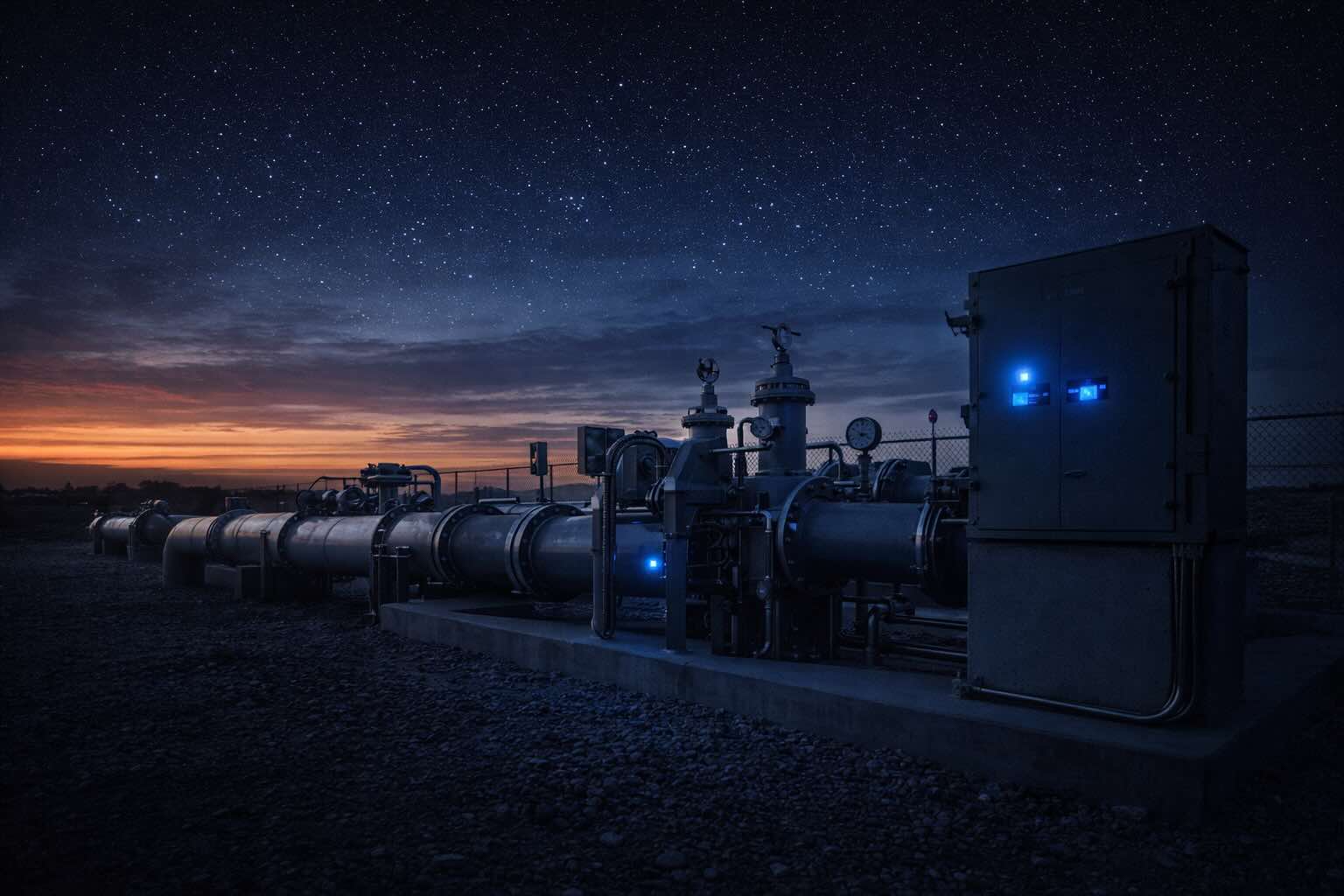
Remote pumping station power site for utility and water infrastructure with VENDOR.Max deployment context
Engineering Context · What VENDOR.Max Is for Utility & Water
What is VENDOR.Max for utility and water infrastructure?

VENDOR.Max is a validation-stage infrastructure power architecture for remote utility and water operations, designed for pumping stations, telemetry outposts, weak-grid booster nodes, and other hard-to-serve assets where continuity, maintenance burden and diesel logistics define the operating problem.

Remote utility infrastructure power refers to site-level power continuity for pumping stations, telemetry outposts, booster nodes, lift stations, and other hard-to-serve assets where grid quality, diesel logistics, or maintenance burden make conventional continuity expensive or operationally unreliable.

Use case Remote utility and water infrastructure
Best fit Pumping stations · telemetry outposts · weak-grid booster nodes · underground / covered sites
Stage TRL 5–6 — pre-commercial validation
Proof 1,000+ hours · 532 h cycle · ES2950176 (granted) · WO2024209235 (PCT)
Next step Infrastructure assessment → /pilot/
Does not claim Municipal-scale deployment · NIS2 compliance · ROI guarantee
Which utility assets fit VENDOR.Max first?

Remote pumping stations where fuel delivery and generator servicing are the primary recurring burden; metering and telemetry outposts where power loss means monitoring blindness; underground and covered sites where solar is structurally inapplicable; and booster nodes and lift stations in weak-grid locations.

What problem does it solve?

The structural dependency on diesel logistics, recurring generator maintenance, and battery UPS replacement cycles that makes remote utility infrastructure expensive to power and difficult to keep running without frequent site visits.

What stage is it at?

TRL 5–6 — laboratory validated, pre-commercial. Not a certified deployed product. The VENDOR.Max platform has accumulated 1,000+ cumulative operational hours, with a 532-hour longest single documented continuous cycle at 4 kW. Independent verification (DNV / TüV): pathway defined, in progress.

TRL 5–6
Technology Readiness Level — laboratory validated
532 h
Longest single documented continuous operational cycle
ES2950176 (granted)
WO2024209235 (PCT)
EP · CN · IN · USA
Granted patent + PCT — 6 jurisdictions
DNV / TüV
Independent verification — pathway defined, in progress
No combustion /
no rotating mech.
Removes major legacy maintenance classes by architecture (design target)
The Problem We’re Solving

Remote utility nodes don’t fail dramatically.
They fail through accumulated operational friction.

Water does not stop needing to flow because a generator failed at a remote pumping station. A treatment process does not pause because a battery UPS reached end of life during a winter callout. The infrastructure keeps its operational requirements even when the power systems behind it do not.

For utility operators managing distributed, unmanned infrastructure — booster stations, pressure regulation nodes, telemetry cabinets, metering outposts — power continuity is not a background assumption. It is the operating condition that determines whether service is delivered, whether obligations are met, and whether a 3am emergency dispatch becomes routine or exceptional.

Diesel logistics for remote utility infrastructure — the operational burden VENDOR.Max is designed to reduce
01

Recurring diesel OPEX

The fuel line that never closes

Backup generator procurement, fuel delivery logistics, generator testing and maintenance contracts combine into a cost that grows with the size of your network. In remote utility deployments, each site adds a fuel logistics dependency — not just an energy cost.

02

Maintenance burden

Every service visit is an operational event

Unmanned pumping stations and remote treatment-support nodes do not service themselves. Generator maintenance, UPS battery replacement, sensor calibration and fault response each require a dispatch — often to sites without reliable road access, in conditions that make “routine maintenance” expensive and sometimes dangerous.

03

Power loss at a treatment node

Not an inconvenience — a regulatory event

According to the US EPA Power Resilience Guide (EPA 800-R-19-001), power loss at drinking water and wastewater utilities can have devastating impacts: inoperable pumps make firefighting difficult, cause healthcare facilities and businesses to close, and allow contaminants to enter the distribution system from surrounding soil and groundwater. Wastewater pump failure may lead to direct discharge of untreated sewage to rivers and streams.

In the EU, outages at water and wastewater assets now sit inside a broader resilience and risk-management context shaped by NIS2 (2022/2555) and the CER Directive (2022/2557). For relevant operators, remote-node power continuity is no longer only a maintenance issue; it is increasingly part of formal resilience planning and audit posture.

US EPA Power Resilience Guide (EPA 800-R-19-001) — confirmed. NIS2 / CER framing applies to EU operators; EPA consequence framing applies globally.
04

Solar unsuitability at covered and underground sites

The standard alternative doesn’t reach these sites

Treatment vaults, underground pump chambers, shaded distribution nodes and enclosed utility infrastructure cannot use solar. Battery-only UPS systems replace one maintenance cycle with another. For below-ground and covered utility assets, no commercially proven low-maintenance alternative to diesel currently exists at scale.

Regulatory & Infrastructure Context

The resilience requirements for water infrastructure
have changed. The operating assumptions have not.

Across the European Union, water and wastewater infrastructure sits inside the critical-infrastructure perimeter with enforceable obligations. The NIS2 Directive (2022/2555) and CER Directive (2022/2557) both classify drinking water and wastewater as essential sectors subject to mandatory resilience and continuity requirements.

In 2025, the European Parliament explicitly called for the systematic renewal and upgrading of drinking water and sanitation infrastructure and for more funding for innovative resilient solutions. The European Commission’s Water Resilience Strategy (2025) sets infrastructure protection and improved water efficiency as binding priorities to 2030.

For EU operators, remote-node power continuity now sits inside a broader resilience and risk-management context shaped by NIS2, CER and water-sector modernisation policy. Power architecture at remote utility nodes is no longer a decision made in isolation from the organisation’s wider resilience posture.

EU Regulatory Perimeter for Water
  • NIS2 Directive 2022/2555 — essential entity obligations
  • CER Directive 2022/2557 — critical entity resilience
  • EU Water Resilience Strategy 2025 — infrastructure protection & modernisation
Outside the EU — Africa & Global

Outside the EU, the operating reality is often more immediate. Across sub-Saharan Africa and MENA, water infrastructure operators face unreliable or absent grid supply, fuel delivery constraints and limited access to timely field service — often without a regulatory framework that enforces resilience.

In these environments, the consequence of power failure is not a compliance filing. It is a service delivery failure that affects communities directly.

The operational logic for continuous infrastructure power at remote utility nodes is the same — the compliance language changes by region.

The Economics of Continuity Failure

This is already an OPEX problem
before it becomes a crisis.

The numbers behind water-sector energy dependency are well-documented. According to the US EPA, drinking water and wastewater utilities are typically the largest energy consumers in a municipality — accounting for 30–40% of a city or town’s total energy bill. Approximately 80% of municipal water processing and distribution costs are electricity. For drinking water systems, energy can represent up to 40% of total operating costs. Wastewater treatment plants typically spend 30% of their entire O&M budget on energy, with pumping and aeration as the dominant consumers. EPA estimates that utilities which address energy performance systematically can save 15–30%.

Source: US EPA — Energy Efficiency for Water Utilities; EPA 816-F-13-004

That scale of energy dependency matters because in this sector, “power” is not a single line item.

Power drives all of this
  • Pumping continuity
  • Treatment process integrity
  • Telemetry and SCADA uptime
  • Emergency response posture
  • Field service frequency
  • Fuel procurement planning
  • Recovery time after grid disturbance
Verified Sector Benchmarks — US EPA
30–40%
Share of municipal energy bill from water/wastewater utilities
~80%
Share of water distribution O&M costs that is electricity
up to 40%
Energy as share of drinking water system operating costs
~30%
Energy as share of WWTP total O&M expenditure
15–30%
Potential O&M savings from energy performance improvement
US EPA — Energy Efficiency for Water Utilities · EPA 816-F-13-004
Cost Categories to Quantify Per Remote Site
  • Annual diesel procurement and fuel delivery logistics
  • Generator professional maintenance: regular inspection, testing and service cycles per manufacturer specifications
  • Generator service visit cost: site-specific; request operator-side benchmarking
  • Emergency dispatch for fault response: additional per-callout cost
  • Battery UPS 3–5 year replacement cycle per node
  • Outage duration cost: service interruption + regulatory exposure
  • Telemetry blackout: blind operation of distribution network
Note: Cost categories above represent the operating burden your sites already carry. Exact site costs depend on location, generator size, access conditions and service contract structure — operator-side benchmarking required. No VENDOR.Max-specific savings figure is implied without site-specific assessment.
Why Conventional Backup Logic Breaks at the Edge

Grid-only, generator-backed and battery-heavy approaches
all carry their own operational burden.

01

Grid-only continuity

Works until it doesn’t

For utility infrastructure in weak-grid pockets, on vulnerable feeders, or in locations where restoration time is not aligned with operational urgency, grid-only is not a resilience strategy — it is an assumption.

02

Generator-backed resilience

A logistics chain that doesn’t stop

Generators solve the continuity gap but introduce a logistics chain that does not stop: fuel procurement, delivery scheduling, regular inspection runs, testing cycles, fuel quality management, maintenance contracts and run-readiness verification under adverse conditions.

For remote utility sites with difficult access and harsh operating conditions, each of these obligations becomes an expedition — not a maintenance task. EPA’s water utility resilience guidance treats generators, fuel planning and on-site power as central planning topics — which is precisely the point.

03

Battery-heavy backup

One maintenance cycle replaces another

Battery UPS systems address short-duration continuity gaps but carry their own lifecycle economics: replacement cycles, thermal operating constraints and additional maintenance layers.

For remote sites with limited access, a battery lifecycle event is not a scheduled task — it is a logistics problem.

The operational case for VENDOR.Max is not that these approaches are wrong. It is that for the right sites — remote, unattended, weak-grid, maintenance-heavy — an infrastructure power architecture designed for continuous long-cycle operation is worth a structured technical evaluation.
What VENDOR.Max Is

An Infrastructure Power Node Designed for
Continuous Operation at Remote Utility Sites

VENDOR.Max is not a backup system. It is not a solar-hybrid. It is not a conventional diesel substitute. It is a different infrastructure architecture — a solid-state open electrodynamic engineering system designed to deliver usable electrical power at 2.4–24 kW infrastructure scale without fuel logistics, combustion-based supply chains or battery replacement cycles. External electrical input is required for sustained operation. Patent: WO2024209235.

For utility and water infrastructure, the deployment case is specific: remote pumping stations, booster nodes, metering and telemetry outposts, and treatment-support assets where continuous operation with reduced maintenance logistics is the operating requirement.

Engineering Context — For Technical Evaluators

VENDOR.Max is an open electrodynamic engineering system validated at TRL 5–6 with over 1,000 cumulative operational hours. Three-circuit architecture (Circuits A, B, C). External electrical input is required for sustained operation.

Best-Fit Utility Site Classes
Remote pumping stations
Where fuel delivery and generator maintenance are the primary recurring OPEX driver
Lift stations and booster nodes
Where grid quality is insufficient for reliable unattended operation
Metering and telemetry outposts
Where power loss means data loss and delayed intervention
Underground and covered infrastructure
Where solar is structurally inapplicable
Remote treatment-support assets
Where service continuity depends on dependable local power for ancillary systems
TRL 5–6 DEVICE BOUNDARY CIRCUIT A Active Core Regime Formation Ionization Chamber Townsend Avalanche Discharge Regime Gas/Air: medium — not source induction Faraday law CIRCUIT B Linear Extraction Power Output Stage Secondary (7) → feedback → BMS Tertiary (10) → surplus → load P_load to load 2.4–24 kW designed output Buffer + BMS Regulated DC bus · transient smoothing protection · fault boundaries returned regime-support power P_in,boundary boundary total input C2.1 – C2.2 – C2.3 Storage capacitors · regime input External boundary input system-level input P_losses heat · radiation · losses E_extract,event = E_load,event + E_fb,event + E_loss,conv,event P_x,avg = E_x,event · f P_in,boundary = P_load + P_losses + dE/dt Conservation holds at device boundary — no energy is created VENDOR.Max · Patent WO2024209235 · ES2950176 (granted) · TRL 5–6

Rotate your device to view the architecture diagram

VENDOR.Max two-contour electrodynamic architecture — Circuit A (regime formation) → Circuit B (linear extraction + BMS priority logic). External electrical input required. Conservation holds at device boundary. Patent: WO2024209235 · ES2950176 (granted). TRL 5–6.

What Changes at Site Level

What continuous operation means
for a remote utility or water asset

01

No fuel logistics

VENDOR.Max is designed to operate without diesel, propane or any combustion-based fuel supply. For operators managing fuel procurement, delivery scheduling, theft risk and site refuelling logistics at remote assets, the architecture removes that dependency by design — not by efficiency improvement.

02

Reduced maintenance burden

Reduced routine maintenance is a design objective of the VENDOR.Max architecture. Solid-state operation with no combustion engine, no fuel system and no rotating parts eliminates the maintenance obligations those components carry. The specific service profile will be defined through validation and site-specific deployment conditions.

03

Continuous SCADA and telemetry support

VENDOR.Max is designed for continuous power output — not cycled backup. For metering nodes, telemetry cabinets and remote SCADA infrastructure, continuous local power means continuous monitoring visibility. Power loss at these points is a control loss, not just a service interruption.

04

No solar dependency

The architecture does not require daylight, unobstructed sky access or seasonal solar irradiance. For underground pump chambers, enclosed distribution vaults and covered utility infrastructure, VENDOR.Max operates where solar cannot.

05

No combustion, no moving parts

The VENDOR.Max architecture contains no combustion components and no rotating mechanical elements. This removes entire categories of failure modes that conventional backup power systems carry: fuel ignition failure, mechanical wear, exhaust maintenance, vibration damage. For unmanned sites that are expensive to inspect, fewer failure modes means fewer unplanned callouts.

Architecture Comparison

How VENDOR.Max compares to conventional
power approaches at remote utility nodes.

Comparison factor
Grid-only
Diesel-backed
Solar + Battery
VENDOR.Max
(assessment fit)
Fuel logistics
None
Recurring
None
None (design)
Underground / covered suitability
Compatible
Compatible
Not suitable
Compatible (design)
Routine service burden
Grid-dependent
High — regular inspection, testing, fuel
Moderate — battery replacement cycle
Reduced by design (profile TBD via validation)
Cold-start / outage failure dependency
Grid failure = site offline
Fuel / battery dependent
Low irradiance / battery depletion
No cold-start dependency (design)
Short vs continuous power logic
Continuous (when grid up)
Continuous (fuel-dependent)
Duration-limited (battery cycle)
Continuous (design)
SCADA / telemetry continuity
Continuous (grid-dependent)
Cycled backup only
Short-duration only
Continuous (design)
Fuel theft risk
None
Present at remote sites
None
None (design)
Operator intervention burden
Low (grid-dependent)
High — fuel, service, testing
Moderate — battery and inverter service
Low (design target)
TRL / procurement posture
Commercial standard
Commercial standard
Commercial standard
TRL 5–6 — pre-commercial assessment pathway
Infrastructure Economics

The economic case starts with the cost structure
your sites already carry.

A site-specific ROI cannot be stated here without actual load data and local fuel costs. What can be structured is the cost logic that operators at remote utility nodes already carry every year. The figures below are indicative ranges based on verified industry data — they are the cost structure of the alternatives your sites are already running.

Cost driver
Generator-backed
Battery UPS
VENDOR.Max target
Annual fuel cost
Significant / site-specific
None
None (design)
Fuel delivery logistics
Recurring / per delivery
None
None (design)
Maintenance obligations
Manufacturer + regulator schedules: regular inspection, testing, fuel management, service contracts
Periodic / per spec.
Reduced by design (profile TBD via validation)
Service visit cost
Site-specific — request operator benchmarking
Site-specific
TBD — site assessment
Battery / component replacement cycle
Engine rebuild 3–5 yr typical
Battery every 3–5 yr
Defined through deployment validation
Combustion failure risk
Moderate – High
None
None (design)
Cold-start failure risk
Present (fuel / battery dependent)
None
None (design)
Underground / shaded use
Generator viable — solar incompatible
Compatible (design)
SCADA power continuity
Cycled backup only
Short-duration only
Continuous (design)
Fuel theft risk
Present at remote sites
None
None (design)
VENDOR.Max is worth evaluating where the total annual cost of keeping remote utility nodes powered — fuel, logistics, maintenance, emergency dispatch, battery replacement — already exceeds the threshold the organisation wants to tolerate. That calculation is different for every operator, but the cost categories above are real and recurring at any diesel-backed or battery-heavy remote utility site.
Note: All VENDOR.Max figures represent architecture design targets at TRL 5–6. Not commercial guarantees. Site-specific validation required before deployment. Generator and battery figures are indicative sector ranges verified against industry maintenance data. Not operator-specific. Exact costs vary by generator size, site access conditions and service contract structure.
Technology Readiness

What has been validated.
What comes next.

VENDOR.Max is not a mature commercial product. It is a validated-stage engineering architecture with documented operational history, patent protection in 6 jurisdictions, and a defined pathway toward independent third-party verification and EU/US certification.

For utility and water buyers, this translates to a specific procurement posture: not blanket commercial adoption — but a structured technical evaluation that can be initiated now and scoped against your operational constraints.

TRL 5–6
Laboratory validated — pre-commercial stage
1,000+ hours
Cumulative operational hours — documented internally
532-hour cycle
Longest single continuous operational run at 4 kW
ES2950176
Spanish patent — granted
WO2024209235
PCT patent — active (6 jurisdictions)
EP23921569.2
EPC — under examination
DNV / TüV
Independent verification — pathway defined, in progress
CE / UL pathway
Defined — target window 2026–2028
Confirmed now
  • TRL 5–6 — laboratory validated
  • 1,000+ cumulative operational hours — documented internally
  • 532-hour continuous operational cycle at 4 kW
  • ES2950176 — Spanish patent granted
  • WO2024209235 — PCT patent active, 6 jurisdictions
  • EP23921569.2 — EPC under examination
  • No combustion components, no moving parts — architecture confirmed
Being prepared
  • DNV / TüV independent verification — pathway defined, in progress
  • CE / UL certification — pathway defined, target 2026–2028
Requires site assessment
  • Deployment economics and maintenance profile
  • Load compatibility and site integration parameters
  • Procurement and certification pathway for your jurisdiction
  • Fit determination for your specific asset class
Resilience & Compliance Context

NIS2 and CER changed what resilience means
for water and utility operators.

Under the NIS2 Directive (2022/2555), drinking water and wastewater are classified as essential sectors with enforceable resilience, incident reporting and continuity obligations. The CER Directive (2022/2557) extends physical resilience requirements to critical entities including water infrastructure operators.

These are not aspirational guidelines. EU member states are required to have transposed NIS2 by October 2024. Critical entity classifications under CER are active from the same period.

For utility operators, this means power architecture decisions at remote and unmanned nodes are increasingly relevant to formal resilience planning and audit posture. NIS2 introduces risk-management and incident-reporting obligations; CER establishes a physical resilience framework for critical entities. Power continuity at remote nodes sits within the scope of both.

VENDOR.Max is being engineered toward alignment with these requirements as part of its certification pathway. It does not currently hold NIS2-specific certification. What it offers today is a structured assessment pathway for operators who need to demonstrate active resilience planning at remote utility nodes.

Being engineered toward compliance
  • NIS2 Directive 2022/2555 — essential entity resilience
  • CER Directive 2022/2557 — critical infrastructure physical resilience
  • CE / UL certification pathway — defined, target 2026–2028
Outside the EU — Africa & Global

For operators in sub-Saharan Africa and MENA, the regulatory framing differs — but the operational logic is identical. Where grid supply is absent or unreliable, where fuel delivery is constrained and where service access is limited, power continuity at remote utility nodes is a public health and service delivery requirement — regardless of which regulatory framework applies.

The Case for Acting Before the Next Outage

The cost base that makes this assessment
rational — in numbers.

The case for evaluating a different power architecture at remote utility nodes is not speculative. It is already visible in the operating economics that utilities carry every year.

30–40%
Water and wastewater utilities as share of a municipality’s total energy bill
~80%
Share of municipal water processing and distribution costs that is electricity
up to 40%
Energy as share of drinking water system operating costs
~30%
Energy as share of WWTP total O&M expenditure
15–30%
Potential O&M cost reduction from systematic energy performance improvement
Source: US EPA — Energy Efficiency for Water Utilities · EPA 816-F-13-004

If power continuity and site maintenance are already material cost drivers at your remote utility nodes, a structured site assessment is a rational step before the next outage cycle, retrofit decision or NIS2 resilience review.

The assessment does not commit you to deployment.
It commits you to knowing whether deployment makes sense.

Request Infrastructure Assessment
How Evaluation Works

The right next step is assessment,
not assumption.

VENDOR.Max is not available for blanket commercial procurement. The current program offers a structured Pilot Readiness Assessment — a scoped technical evaluation of your site against VENDOR.Max’s current validation parameters and deployment architecture.

The assessment covers
  • Site asset class and operational role
  • Grid quality and outage frequency profile
  • Current backup architecture and its cost burden
  • Service frequency and logistics constraints
  • Load characteristics and continuity requirements
  • Deployment access and environmental conditions
  • Certification and procurement pathway considerations
The documentation is yours regardless of outcome. VENDOR manages the evaluation. The operator retains the technical report for internal audit and regulatory use. The founding utility cohort is limited — priority is given to operators with defined remote-asset pain and active resilience planning obligations.
1
Site qualification and technical intake
Asset class, grid profile, site constraints, load profile
2
Deployment scoping and parameters
Fit determination, deployment plan, evaluation KPIs
3
Controlled operational evaluation
On-site validation against agreed parameters
4
Technical documentation and reporting Always delivered
Full technical report retained by operator — suitable for internal audit and regulatory filing
Best first-fit sites
  • Remote pumping stations with fuel delivery or generator service burden
  • Metering and telemetry outposts where power loss means monitoring loss
  • Weak-grid booster or lift stations with unreliable supply
  • Underground or covered assets where solar is structurally inapplicable
  • Utility edge infrastructure where repeated site visits are disproportionately expensive
Not a fit today
  • Large treatment plant prime-power replacement
  • Sites with stable, reliable grid supply and no logistics burden
  • Procurement requiring immediate certified commercial product
Fit Criteria

This program is for operators who already
know the cost of power friction at remote sites.

Best-fit operators
  • Water utilities managing remote pumping stations, booster nodes or metering outposts with recurring fuel or service logistics burden
  • Municipal or regional operators responsible for distribution support infrastructure with weak-grid exposure
  • EPCs and integration partners designing continuity architecture for hard-to-serve utility infrastructure
  • Utility asset managers evaluating alternatives to fuel-dependent backup systems for specific remote node classes
  • Infrastructure operators in sub-Saharan Africa, MENA and other weak-grid regions where grid extension is economically irrational and diesel logistics are structurally unreliable
This is not for
  • Operators expecting a ready-certified commercial product today
  • Blanket municipal-scale prime-power replacement
  • Sites where standard grid supply is stable and reliable
  • Speculative procurement without defined site constraints
Scope Boundaries

What VENDOR.Max is not claiming
on this page.

This page does not claim
Full plant prime-power replacement

VENDOR.Max is positioned for remote nodes, support assets and weak-grid edge infrastructure — not blanket municipal-scale replacement of primary power infrastructure.

Blanket commercial deployment readiness

VENDOR.Max is at TRL 5–6. It is not a certified commercial product available for immediate procurement.

NIS2 or regulatory compliance certification

VENDOR.Max does not hold NIS2-specific or sector-specific regulatory certification. This page notes the regulatory context — not a compliance solution.

Guaranteed ROI or site-specific payback

No ROI figure is stated without site-specific data. The economics section organises cost categories — not projections.

Deep technical disclosure before TRL 7–8

Full engineering specifications, calibration methodology and internal test data are not publicly disclosed at current stage.

What this page does claim
  • TRL 5–6 laboratory-validated architecture with 1,000+ documented hours
  • Patent protection in 6 jurisdictions
  • Defined pathway to independent verification (DNV / TüV)
  • A structured assessment pathway for qualified operators
  • Fit for remote, weak-grid, and underground utility environments where solar is inapplicable and diesel logistics are operationally costly
Questions Utility Teams Ask

Common Questions from
Utility Teams

Is VENDOR.Max ready for municipal-scale deployment? +

No — and that framing should not be expected at this stage. VENDOR.Max is at TRL 5–6, pre-commercial validation stage. The credible path is a structured site-specific assessment and pilot qualification for remote utility nodes with defined operational constraints.

Municipal-scale deployment is a post-certification milestone.

Which water and utility assets fit first? +

The strongest first-fit classes are: remote pumping stations where fuel delivery and generator servicing are the primary recurring burden; metering and telemetry outposts where power loss means monitoring blindness; underground and covered sites where solar is inapplicable; booster nodes and lift stations in weak-grid locations.

How does this compare with solar + battery for remote utility sites? +

Solar-battery hybrid systems work well for exposed, above-ground installations with adequate irradiance. They do not address underground pump chambers, enclosed vaults or shaded infrastructure. Battery systems also carry lifecycle replacement burdens.

VENDOR.Max is designed for sites where solar is not viable and where battery replacement logistics are operationally costly.

How does this compare with diesel backup? +

Diesel backup solves the continuity gap but introduces its own operational chain: fuel procurement, delivery scheduling, generator testing, maintenance contracts and run-readiness management. VENDOR.Max is designed to eliminate that chain — not improve it.

The evaluation question is whether the site’s continuity burden justifies a different architecture.

Does this page claim NIS2 compliance? +

No. VENDOR.Max does not currently hold NIS2-specific certification. What the page notes is that drinking water and wastewater sit within the NIS2 and CER critical-infrastructure perimeter, which raises the organisational importance of resilience planning at remote utility nodes.

VENDOR.Max is being engineered toward alignment with these requirements as part of its certification roadmap.

What proof exists today? +

TRL 5–6 laboratory validation, 1,000+ cumulative operational hours documented internally, 532-hour continuous operational cycle at 4 kW, granted Spanish patent ES2950176, PCT patent WO2024209235 active in 6 jurisdictions, and a defined pathway toward DNV / TüV independent verification.

What can an operator do right now? +

Submit a Pilot Readiness Assessment request. The assessment scopes your site against current VENDOR.Max deployment parameters — covering asset class, grid profile, backup burden, load requirements and deployment constraints.

The outcome is a qualification decision: fit for pilot evaluation or not — with full transparency either way.

Is this relevant outside the EU? +

Yes. The EU regulatory framing (NIS2, CER, Water Resilience Strategy) applies to European operators. For operators in sub-Saharan Africa, MENA and other regions, the operational logic is identical — grid instability, diesel dependency and limited service access create the same continuous-power requirement at remote utility nodes.

The assessment pathway is open globally.

What is a weak-grid utility node? +

A weak-grid utility node is a pumping station, booster, metering outpost or distribution support asset connected to grid supply that is insufficient in quality or reliability for the site’s operational requirements. Frequent micro-outages, voltage instability, long restoration times or high outage frequency all qualify.

These sites are common at the edges of distribution networks and in rural service areas.

Why is solar not enough for some utility sites? +

Solar-photovoltaic systems require unobstructed sky access and adequate irradiance. Underground pump chambers, enclosed treatment vaults, shaded infrastructure and sites in high-latitude or low-irradiance regions cannot generate sufficient solar yield.

Battery systems paired with solar also carry replacement cycles that reintroduce maintenance burden. For these sites, no commercially proven low-maintenance alternative to diesel currently exists at scale — which is the gap VENDOR.Max is designed to address.

What makes pumping stations expensive to support remotely? +

Remote pumping stations concentrate multiple cost drivers simultaneously: fuel logistics for backup generators, regular maintenance dispatch to sites with limited access, emergency response when equipment fails, battery UPS replacement cycles, and monitoring system downtime when power fails.

The compounding effect of all these categories on sites that cannot be serviced quickly makes remote pumping stations among the highest-maintenance assets in a utility network.

What is assessed during a Pilot Readiness Assessment? +

The assessment covers site asset class and operational role, grid quality and outage profile, current backup architecture and its cost burden, service frequency and logistics constraints, load characteristics and power continuity requirements, deployment access and environmental conditions, and relevant certification and procurement pathway considerations.

The outcome is a qualification decision — fit for pilot evaluation or not — with full transparency and operator-retained documentation.

Start Here

The power gap at your remote utility sites
does not resolve on its own.

The founding utility cohort is limited.

The assessment is fully managed by VENDOR.

The technical documentation is yours regardless of what the data shows.

MICRO DIGITAL ELECTRONICS CORP SRL  ·  vendor.energy  ·  Voluntari, Romania, EU

Patent ES2950176 (granted) · WO2024209235 (PCT) · EP23921569.2 · CN202380015725.5 · IN202547010911 · PCT-US

Technology at TRL 5–6. All operational characteristics on this page represent architecture design targets at pre-commercial validation stage. They are not commercial guarantees and are subject to validation milestones, certification progress and production-readiness terms.