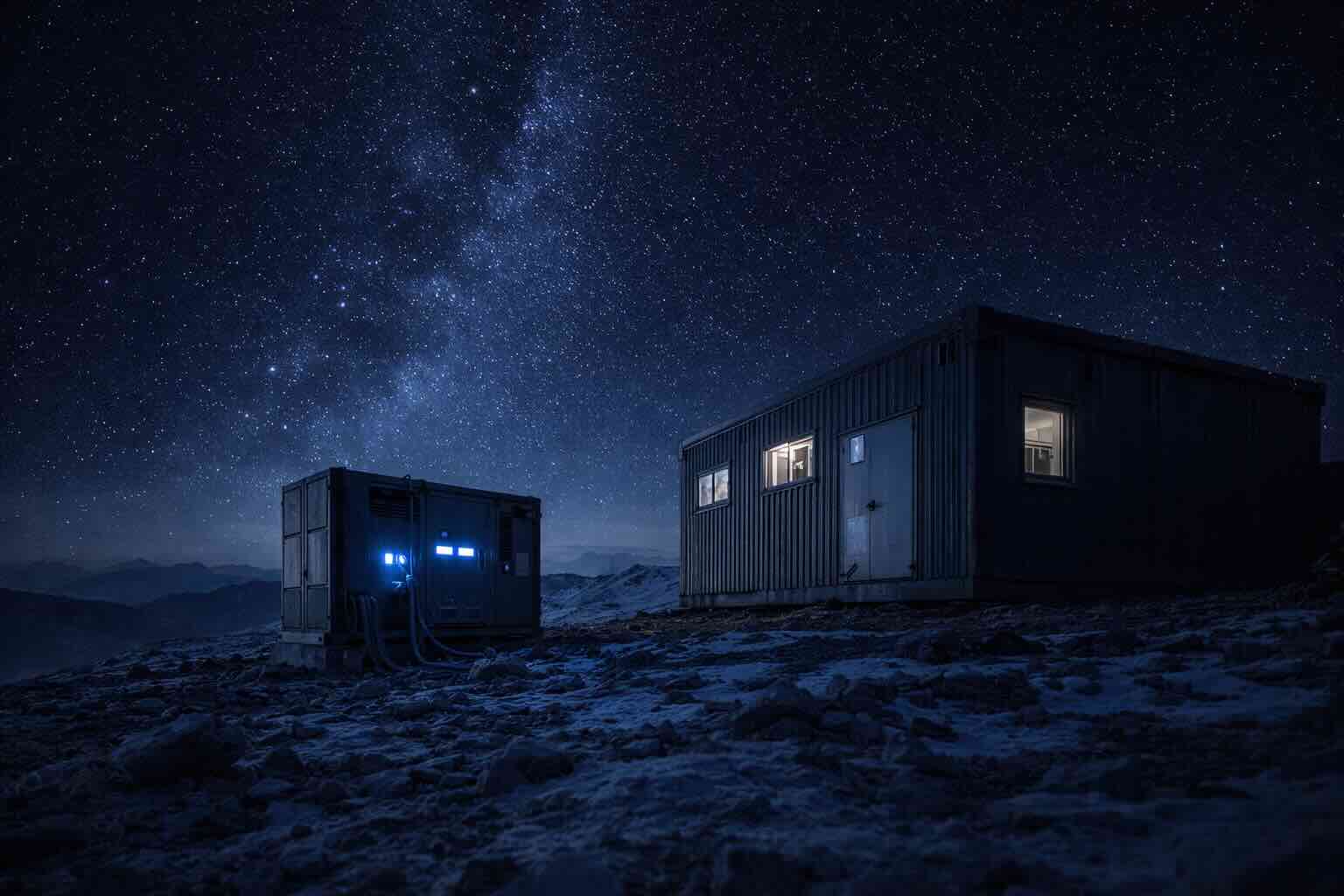
VENDOR.Max is an autonomous infrastructure power node designed for infrastructure power delivery in the 2.4–24 kW target range for remote, off-grid, and weak-grid environments. It operates as an open electrodynamic engineering system and requires external electrical input for sustained operation. It does not extract energy from air, gas, or ambient environment. It does not generate energy. It organises energy within a controlled electrodynamic regime. At the complete device boundary: P_in,total = P_load + P_losses + dE/dt. This page describes deployment fit for remote and off-grid critical infrastructure including mining sites, research stations, and emergency operations where uptime cannot depend on fuel logistics, mechanical service cycles, or grid availability. Patent ES2950176 (granted, Spain/OEPM). PCT WO2024209235 (37 countries, national examination active). TRL 5–6 — pre-commercial validation stage. Developed by MICRO DIGITAL ELECTRONICS CORP SRL, Romania, EU.
Off-Grid Critical
Infrastructure Power:
The Architecture Built
for Logistics Failure
Mining sites. Research stations. Emergency operations.
These are environments where power systems don’t fail electrically. They fail logistically.
The fuel doesn’t arrive. The technician can’t reach the site. The battery loses usable capacity in extreme cold, turning winter into a power-planning problem.
VENDOR.Max is a solid-state autonomous power node designed for infrastructure where operational continuity cannot depend on fuel logistics, mechanical service cycles, or grid availability. Validated at TRL 5–6 with 1,000+ documented operational hours.
hours documented
cycle recorded
granted
37 countries
VENDOR.Max is an open electrodynamic power architecture designed for remote and off-grid infrastructure environments where operational continuity cannot depend on fuel logistics, mechanical service cycles, or grid availability — requiring external electrical input for sustained operation, validated at TRL 5–6 with 1,000+ documented operational hours, supported by an active patent portfolio across key jurisdictions.
The system does not generate energy. It organises energy within a controlled electrodynamic regime. At the complete device boundary, energy conservation holds:
P_in,boundary = P_load + P_losses + dE/dtThis page describes deployment fit and operational context — not a claim of energy generation or certified performance. All characteristics represent design targets at TRL 5–6, subject to ongoing validation. Patent: ES2950176 (granted) · PCT WO2024209235 (active, 37 countries).
The primary challenge is not generating electricity — it is ensuring continuous access to it. In remote environments, power systems fail due to logistics: fuel delivery disruption, maintenance access constraints, and environmental performance limits. The energy problem is, in most cases, an access and logistics problem.
The Real Cost of Remote Power
Is Not the Fuel
Every operator managing a remote site knows the number on the diesel invoice. Very few track what surrounds it.
- The fuel is not the cost.
- The fuel delivery is the cost.
- The maintenance cycle is the cost.
- The technician who spent four days getting to the site is the cost.
- The seasonal window that closes before the resupply arrives is the cost.
For off-grid industrial operators, fuel logistics and maintenance often dominate lifetime energy cost — a structural burden that scales with remoteness, not with consumption. In remote telecom-like operating models, the cost of buying and transporting diesel can account for 30–60% of total operational expenditure.
GSMA, 2024 — reported for mobile operators in relevant remote markets. Indicative for remote industrial infrastructure with comparable logistics constraints.
That is the structure VENDOR.Max is designed to change.
Fuel delivery failure = site shutdown.
Not delayed operations. Not reduced efficiency.
Site. Shutdown.
In remote infrastructure environments where uptime defines operational viability, the power system is only as reliable as the supply chain behind it.
Most remote mining sites rely on diesel-based generation combined with backup infrastructure. Reliability depends not only on generation capacity, but on fuel supply chains and maintenance accessibility — both of which become structurally constrained at remote or difficult-access locations. The dominant cost driver is not fuel itself, but the logistics required to keep it arriving.
This Is Not an Edge Case.
It Is a Global Operating Model.
Remote and off-grid power is not a niche condition. It is the default operating model across large parts of the world — across Sub-Saharan Africa, MENA, Latin America, and across remote northern assets in North America and Northern Europe.
Sub-Saharan Africa
remote operations
now solar-based
benchmark cost
Approximately 600 million people in Sub-Saharan Africa lack access to electricity — and a much larger share experiences unreliable grid access, forcing infrastructure to operate off-grid or on weak-grid supply. In telecom infrastructure alone, hundreds of thousands of towers globally are either off-grid or intermittently powered. This is not a rural edge case. This is a global infrastructure layer.
Across remote and off-grid deployments in Africa, MENA, and parts of LATAM, diesel remains a dominant incumbent power architecture — not because it is efficient, but because it is deployable. In remote telecom operating models, diesel procurement and logistics can account for 30–60% of total operational expenditure. (GSMA, 2024.) Fuel delivery in these environments is often performed via multi-stage logistics chains — road transport plus manual last-mile — creating systemic fragility at every link.
The market has already begun shifting. More than 99% of planned mini-grid systems globally are now solar-based, typically solar-battery hybrid. (World Bank / ESMAP data.) Solar is the default new-build solution in off-grid electrification programmes. But this transition has not solved the underlying problem. It has redistributed it.
Solar generation is location-dependent, not universal.
Sub-Saharan Africa, MENA, LATAM — typical annual output with daily averages of 4–5 kWh/kWp and relatively low seasonal variability. Solar is broadly viable where panel maintenance is manageable.
Arctic, Northern Canada, Northern Europe — documented modelling shows summer PV output approximately four times higher than winter output, with winter median PV power near zero. (NREL Alaska case studies.) At these latitudes, solar does not degrade seasonally. It collapses.
Battery systems introduce a second dependency layer. At −10°C to −15°C, usable battery capacity drops to approximately 75–77% of nominal, with both low temperatures and temperature cycling accelerating long-term capacity fade. (NREL, cited in cold-climate storage studies.) This is not a corner case — it is the operating condition for a large share of remote infrastructure in northern and high-altitude environments.
Published benchmarks put grid extension at roughly $30,000–35,000 per kilometre in representative cases. (MDPI / Sessa 2021, cited in electrification studies.) For sites beyond 50–100 km from existing grid infrastructure, connection is not delayed — it is economically excluded from the project horizon.
Diesel, Solar, and Batteries Fail
Remote Critical Infrastructure —
for Different Reasons
This is not a critique of mature technologies. It is a structural fit assessment. Each solution was designed for a specific operating environment. Remote extreme infrastructure is, in most cases, not that environment.
Solar-battery hybrid systems now represent the dominant planned off-grid architecture — World Bank data indicates that the large majority of planned mini-grid systems are solar-powered. That shift makes solar+battery the primary incumbent alternative, not diesel. VENDOR.Max must be assessed against both.
Alternatives include solar-battery hybrid systems and emerging solid-state architectures. However, each approach must address logistics dependency, maintenance access, and environmental performance constraints specific to remote operations. Solar systems require sunlight and battery performance above certain temperature thresholds. Solid-state architectures such as VENDOR.Max require external electrical input but are designed to eliminate fuel supply chain dependency and scheduled mechanical maintenance cycles.
The Logistics Dependency
Diesel installations are reliable machines built for accessible environments. They require fuel delivery — a supply chain dependency, not a feature. They require oil changes, filter replacement, and mechanical overhaul on 6–12 month cycles — operationally viable when a technician can reach the site in 30 minutes.
At a remote mine, polar station, or jungle monitoring post, that cycle becomes a logistical programme in itself. Every maintenance event requires technician mobilisation, transport logistics, and site access — in conditions that routinely make access unreliable.
Diesel combustion also produces 200–260 g CO₂/kWh plus NOx and particulate matter — a measurable and reportable liability in environmentally sensitive or regulated operating zones.
The Environment Dependency
Solar generation is weather-dependent by definition. In equatorial regions it performs reliably — but at polar stations the sun is absent for months, and at high-latitude sites seasonal output can collapse to near zero in winter. At mining sites with significant dust load, panel efficiency degrades without regular cleaning — itself a maintenance challenge in a logistics-constrained environment.
Battery cold-weather performance loss compounds the problem: at the temperatures that define many remote critical infrastructure environments, usable capacity drops materially, and temperature cycling accelerates long-term degradation. As documented in the data section above, this is not an edge condition — it is the operating baseline for a significant share of remote infrastructure globally.
These systems perform well in the conditions they were designed for. Remote extreme environments are frequently not those conditions.
The Capital Constraint
For sites beyond 50–100 km from existing grid infrastructure, connection is not a delayed option — it is typically excluded from the project horizon entirely.
At the per-kilometre cost benchmarks documented in the market data above, long-distance grid extension requires capital commitments that most remote projects cannot absorb. The result is not a preference for off-grid — it is a structural requirement.
An Architecture Designed Around
the Constraints You Cannot Change
VENDOR.Max is not a modified version of an existing power system. It is a different operating architecture — built around the constraints that remote critical infrastructure actually faces.
-
→
Solid-state. No rotating mechanical parts.
No oil. No filters. No belts. No mechanical wear cycles. No injectors. The operating regime is electrodynamic — not combustion-based. No rotating components means no mechanical failure modes associated with vibration, temperature cycling, or lubrication failure.
-
→
No ongoing fuel delivery schedule required for operation.
The architecture does not require ongoing fuel delivery to sustain operation. This is an architectural characteristic described in the patent layer and consistent with the current validation-stage operating model. The current validation record includes 1,000+ documented operational hours at TRL 5–6.
-
→
No direct dependence on sunlight cycles or battery cold-weather degradation.
The system does not rely on solar irradiation, wind availability, or seasonal daylight cycles. Its operating regime is not subject to the temperature-induced capacity degradation that affects lithium-ion battery systems.
-
→
Designed for continuous unattended operation.
The architecture is structured to sustain operation without on-site personnel intervention between periodic inspection intervals. Continuous operational cycles of 532 hours have been documented at TRL 5–6 under controlled conditions.
-
Q
Does VENDOR.Max generate energy?
No. VENDOR.Max is an open electrodynamic system that requires external electrical input and operates by organising and redistributing energy within a controlled electrodynamic regime. At the complete device boundary, energy conservation holds: P_in,total = P_load + P_losses + dE/dt The system does not extract energy from air, gas, or ambient environment.
VENDOR.Max operates as an open electrodynamic engineering system. It requires external electrical input for sustained operation at the complete device boundary. The system organises energy — it does not generate it. Energy conservation holds at the system boundary:
P_in,total = P_load + P_losses + dE/dtThe system does not extract energy from air, gas, or the environment.
→ How It Works — Full Architecture
Three Operational Dependencies
the Architecture Is Designed to Remove
These are not optimisations. These are architectural removals from the primary dependency structure.
VENDOR.Max is designed to remove three operational categories from the core remote infrastructure operating model:
Fuel Supply Chain
- No resupply scheduling
- No delivery windows
- No storage management
- No inventory risk from theft, contamination, or delivery failure
- No logistics dependency on supplier reliability, access routes, or seasonal conditions
The operating model no longer requires a fuel supply chain at the power system level.
Scheduled Mechanical Maintenance
- No oil changes
- No filter replacement
- No injector servicing
- No 6-month mechanical overhaul programme
- No technician mobilisation for routine maintenance
The service model shifts from scheduled mechanical intervention to periodic system inspection — at intervals designed for remote access realities.
Sunlight and Temperature Dependency
- No solar irradiation requirement
- No battery cold-weather capacity degradation
- No seasonal power planning for darkness periods or temperature extremes
The system is designed to operate across environmental conditions where solar and battery architectures have structural performance floors.
- Fuel supply chain → scheduling → transport → storage → compliance → any point fails → site stops
- Maintenance cycle → 6-month calendar → technician mobilisation → site access → deferred if blocked → reliability degrades
- Weather dependency → solar works in daylight, batteries above −10°C → extreme environment → underperforms
- No fuel supply chain required
- No scheduled mechanical maintenance cycle
- No direct dependence on sunlight cycles or battery cold-weather degradation
- Periodic system inspection
- Remote monitoring
- Initial startup input at system initiation
Design target at TRL 5–6. To be evaluated through the pilot process.
The HSE Argument for
a Different Architecture
Every diesel system at a remote site carries a category of risk that does not appear on the fuel invoice.
Fuel storage in remote environments creates fire risk, spill risk, and environmental liability — particularly in ecologically sensitive zones where regulatory consequences extend far beyond remediation cost.
Diesel combustion produces 200–260 g CO₂/kWh plus NOx and particulate matter. For operations under carbon reporting obligations, in protected areas, or near indigenous communities, this is a measurable Scope 1 liability at the power system level.
- No fuel storage required on site
- No fuel combustion process
- No diesel fire or spill risk pathways from fuel handling
- No direct Scope 1 emissions from the power system
- No fuel-handling waste stream associated with diesel operation
Certification status: The characteristics above are architectural properties of the system as designed. VENDOR.Max is at TRL 5–6 and does not yet hold CE or UL certification. Deployment in regulated environments requires independent validation and site-specific compliance assessment. The certification pathway is defined; independent third-party verification is in progress.
For regulated and safety-critical deployment environments, compliance scoping is conducted as part of the pilot engagement — not as a prerequisite to assessment.
What Is Confirmed.
What Is Being Validated.
What Is Next.
VENDOR.Max is at TRL 5–6 — laboratory validated, pre-commercial. The following is what that means in operational terms.
- → 1,000+ cumulative operational hours under controlled conditions
- → 532-hour single continuous operational cycle — documented
- → No rotating mechanical components — solid-state architecture confirmed
- → Patent ES2950176 granted (Spain/OEPM)
- → PCT WO2024209235 — 37 countries, national phases complete, examination active in EP · CN · IN · US
- → Energy conservation at device boundary: P_in,total = P_load + P_losses + dE/dt
- → Extended real-world performance across climate extremes — to be evaluated through pilot
- → Long-duration field deployment reliability data — to be established through pilot
- → Site-specific LCOE and TCO outcomes — quantified per site through pilot assessment
- → Independent third-party verification — pathway defined, institutional engagement in progress
- → CE and UL certification — roadmap defined
Solid-state architecture eliminates mechanical failure modes associated with rotating components.
Managed through staged pilot programme with defined parameters.
Certification pathway defined. No CE/UL at TRL 5–6 — roadmap active.
Target environments already carry recurring budget for diesel, fuel logistics, maintenance, and backup continuity — a pre-existing cost structure VENDOR.Max is designed to address.
Controlled pilot intake — fit confirmed before deployment agreement.
Three Operator Profiles That Show
the Strongest Fit
VENDOR.Max is not for every remote site. The strongest deployment fit occurs where three conditions converge: no viable grid access, recurring fuel or maintenance logistics burden, and structural uptime requirements that make current alternatives operationally fragile.
Remote Mining Operations
Sites 50 km+ from the nearest grid connection, managing diesel logistics as a fixed operational overhead. Continuous power required for processing equipment, dewatering, communications, and monitoring.
Power failure means production halt, water management failure, or safety system degradation. Fuel logistics and maintenance servicing represent a measurable share of site OPEX that scales with remoteness.
Remote Research and Monitoring Stations
Polar, high-altitude, jungle, or maritime stations with year-round operation requirements. Solar is seasonally unreliable. Battery systems degrade in cold. Diesel logistics are expensive, infrequent, and weather-dependent.
Data continuity and personnel safety depend directly on power continuity. The conventional solution is tolerated because no better architectural option has been available at this power range.
Emergency Operations and Critical Command Infrastructure
Field command posts, emergency operations centres, and civil protection infrastructure where grid absence is a design condition, not an exception. Power continuity defines mission capability.
Fuel logistics in emergency conditions are among the first supply chains to fail. The architecture of the power system is a strategic resilience asset — not a commodity procurement decision.
If your operating environment matches one of these profiles, the Pilot Readiness Assessment is the structured next step. It determines — specifically for your site and context — whether current VENDOR.Max validation parameters align with your deployment requirements.
Three Structural Forces That Are
Making This Worse, Not Better
Grid Capacity Goes Where the Money Is
As global electricity demand accelerates — driven by AI infrastructure, EV adoption, and industrial electrification — grid capacity is being allocated to high-density demand zones. Remote assets are not high-density demand zones. As grid expansion priorities shift toward urban and industrial clusters, remote mining sites, research stations, and field operations become even less likely to receive grid access — not more. The isolation is structural, and it is deepening.
Diesel Is Becoming an Accountable Decision
Scope 1 emissions from diesel systems at remote sites are becoming a line in corporate ESG reports that is increasingly difficult to justify to shareholders and regulators. Diesel on a remote mine was once an operational necessity. Under current reporting frameworks, it is an intentional decision with documented climate consequences. The regulatory and reputational pressure on diesel-dependent remote operations is increasing, not stabilising.
Resupply Is Not a Given
Regional conflicts, extreme weather events, and pandemic-era disruptions have demonstrated that fuel delivery to a remote site is not an infrastructure given. It is a fragile dependency — one that breaks precisely when its failure is most operationally critical. The assumption that resupply will arrive on schedule is increasingly difficult to hold.
Request a Pilot Readiness Assessment
for Your Infrastructure
This is not an open product catalogue. VENDOR.Max is at TRL 5–6 — pre-commercial, in structured validation.
The Pilot Readiness Assessment is the process through which infrastructure operators determine whether their site, power requirements, and deployment context align with current VENDOR.Max validation parameters — and structure a pilot deployment agreement where fit is confirmed.
- Deployment scenario review and infrastructure fit analysis
- Technical requirements alignment against current architecture parameters
- Operational constraints mapping: fuel logistics, maintenance access, uptime, environmental conditions
- Structure and terms of a pilot deployment engagement
- Unrestricted hardware access or consumer pre-order
- Internal engineering documentation or schematics
- Guaranteed deployment — fit must be confirmed on both sides
Programme access is limited. Assessment slots are reviewed manually and prioritised by deployment context alignment and operational urgency. This is a qualification process, not an open intake form.
The outcome of the assessment is a site-specific fit determination, a deployment constraints map, and defined next steps — not a generic product presentation.
Site-specific TCO and deployment economics are quantified through the pilot assessment process and expanded in the infrastructure economics framework.
Request Pilot Readiness Assessment
Structured pre-commercial evaluation of your site, deployment scenario, and fit against current VENDOR.Max parameters. Not a sales call. A technical fit process.
Access Technology Validation Data
Validation records, endurance test documentation, patent portfolio, and architecture methodology.
Explore Infrastructure Power Economics
TCO and LCOE framework. CAPEX vs OPEX structure. Cost modelling inputs for remote deployment.
Questions from
Infrastructure Operators
Does VENDOR.Max require fuel delivery to operate?
No. VENDOR.Max is designed to operate without continuous fuel logistics — this is an architectural characteristic, not an efficiency claim. No fuel delivery schedule is required for ongoing operation. The system requires external electrical input for sustained operation at the complete device boundary.
What changes is the elimination of the fuel supply chain as a primary operational dependency.
Is VENDOR.Max suitable for extreme cold environments — polar stations, Arctic mining?
The system is designed for operation across environmental conditions not covered by solar or battery-dependent architectures. No solar irradiation is required. The system does not use lithium-ion batteries and is not subject to the same cold-weather capacity degradation.
Operating temperature envelope is under active validation as part of the TRL 5–6 programme. Site-specific environmental alignment is evaluated through the Pilot Readiness Assessment.
What is the maintenance requirement at a remote site?
VENDOR.Max has no rotating mechanical components — no oil changes, no filter replacement, no fuel injector servicing, no mechanical overhaul cycles. The maintenance model is designed around periodic inspection, not scheduled mechanical intervention.
Target maintenance intervals are subject to field validation and established through pilot deployment.
What happens if the system fails at a remote site?
VENDOR.Max is a solid-state architecture — failure modes are fundamentally different from mechanical systems. There are no rotating components to seize, no fuel pathways to fail, and no lubricant systems to degrade.
Electrical fault response and remote diagnostics are defined as part of every pilot deployment agreement. The system is at TRL 5–6 and not yet independently certified; fault response planning and escalation procedures are established as part of pilot scoping, not as an afterthought.
How is the pilot deployment structured?
The Pilot Readiness Assessment is a structured pre-commercial evaluation process. It begins with a deployment scenario review and infrastructure fit analysis. If fit is confirmed on both sides, a pilot deployment agreement is structured defining scope, timeline, technical parameters, and evaluation criteria.
Access is granted based on assessed fit — not open submission.
Does VENDOR.Max generate energy without an external source?
No. The system requires external electrical input for sustained operation. At the complete device boundary, energy conservation holds: P_in,total = P_load + P_losses + dE/dt VENDOR.Max is an open electrodynamic system — it organises energy, it does not generate it.
The elimination of fuel logistics dependency does not mean the elimination of energy input at system level.
What certifications does VENDOR.Max hold?
Patent ES2950176 is granted (Spain/OEPM). PCT WO2024209235 is active across 37 countries with national examination underway in EP, CN, IN, and US.
CE and UL certification is on the defined roadmap. VENDOR.Max is at TRL 5–6 — pre-commercial validation stage. Independent third-party verification is in progress. Deployment in regulated environments requires site-specific compliance assessment.