


Auxiliary Power Layer
for Remote
Telecom Towers.
A continuity infrastructure layer designed for remote macro and small-cell sites where diesel logistics has become an architectural risk rather than an operational cost line. Engineered to operate beneath your existing RAN equipment as auxiliary tower-site power infrastructure — not a replacement for your network supplier.
We built this for the operators and TowerCo Directors who already know the answer to one question: what does it cost when the fuel delivery is late and the site is unreachable in winter? The regulatory stack now codifies that risk. The architectural response is overdue.
Vitaly Peretyachenko · Founder, VENDOR.Energy
Diesel logistics at remote tower sites
has moved from operational cost line
to balance-sheet item.
For three decades, diesel-by-default at remote macro and small-cell sites was an operational nuisance managed by fleet procurement. By Q2 2026, the convergent regulatory stack — NIS2 supply-chain security, CSRD ESRS E1 transition plan capital allocation, EU Battery Regulation 2023/1542, CER critical-entity designation, GSMA Mobile Net Zero pace gap — has converted that line into a capital architecture variable. The pain below is the operational reality your Head of Energy and TowerCo Director already manage. The regulatory pressure is what makes 2026 the conversation window.
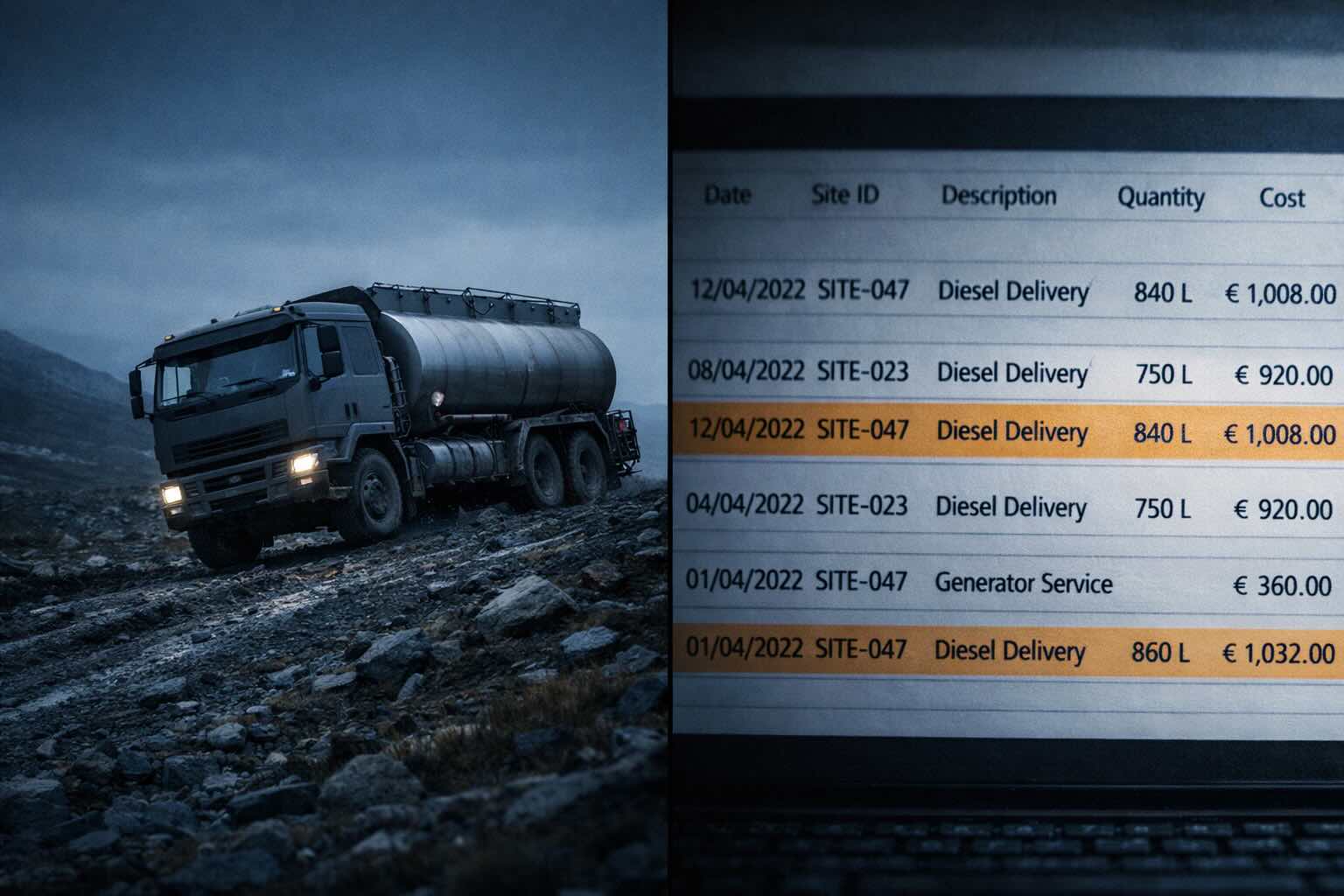
Diesel delivery is the recurring cost the network does not control
Fuel procurement, transport to weak-road or no-road sites, on-site storage, generator maintenance and theft replacement form a logistics chain that compounds with every remote site added to the portfolio. At industry scale, GSMA documents this as a structural cost driver across off-grid telecom infrastructure, unresolved by RAN equipment efficiency improvements.
Stationary combustion at remote sites is now a disclosed Scope 1 emissions line
Under CSRD ESRS E1, Wave 1 telecom incumbents are reporting Scope 1 emissions with limited assurance from FY2025, escalating to reasonable assurance by FY2028. Diesel run-rate on remote macro and small-cell sites appears directly in the transition-plan capital allocation disclosure — and surfaces in MNO Scope 3 reporting through TowerCo colocation cascades.
Fuel-logistics resilience is now a Board-level cybersecurity-adjacent obligation
NIS2 Directive 2022/2555 places telecom under essential-entity scope with Article 21 supply-chain security and business-continuity obligations covering physical infrastructure dependencies. Article 32(6) attaches personal management liability. Fuel theft, delivery disruption and weak-road dependency at unmanned remote sites are no longer logistics incidents — they are supervisory-relevant resilience events.
Some remote sites have no road, weak grid, or cascading outage exposure
Mountain relays, island installations, seasonal-track and helicopter-only sites carry structurally unreliable fuel logistics that compound under load-shedding and weak-grid cycling. Under CER Directive 2022/2557, 17 July 2026 marks the critical-entity designation deadline across Member States — extending power-continuity obligations beyond the legacy battery-bank backup horizon.
The architectural inevitability is dated.
2026 is the conversation window.
Five regulatory anchors converging on telecom auxiliary tower-site power architecture between Q1 2026 and FY2028. The pace gap reported by GSMA confirms operational emissions reduction must roughly double to meet the 2030 industry target — and RAN equipment efficiency progress alone does not close it.
Auxiliary tower-site power infrastructure.
Different architectural class from your network supplier.
VENDOR.Max operates on the auxiliary infrastructure layer adjacent to and beneath the RAN equipment provided by Tier-1 OEMs — Ericsson, Nokia, Huawei, ZTE, Samsung. These suppliers provide the radio-access network primary load: base stations, macro-cells, small-cells, antennas, baseband processing. VENDOR.Max addresses the auxiliary tower-site power layer that sits underneath. Different architectural class, complementary not competing.
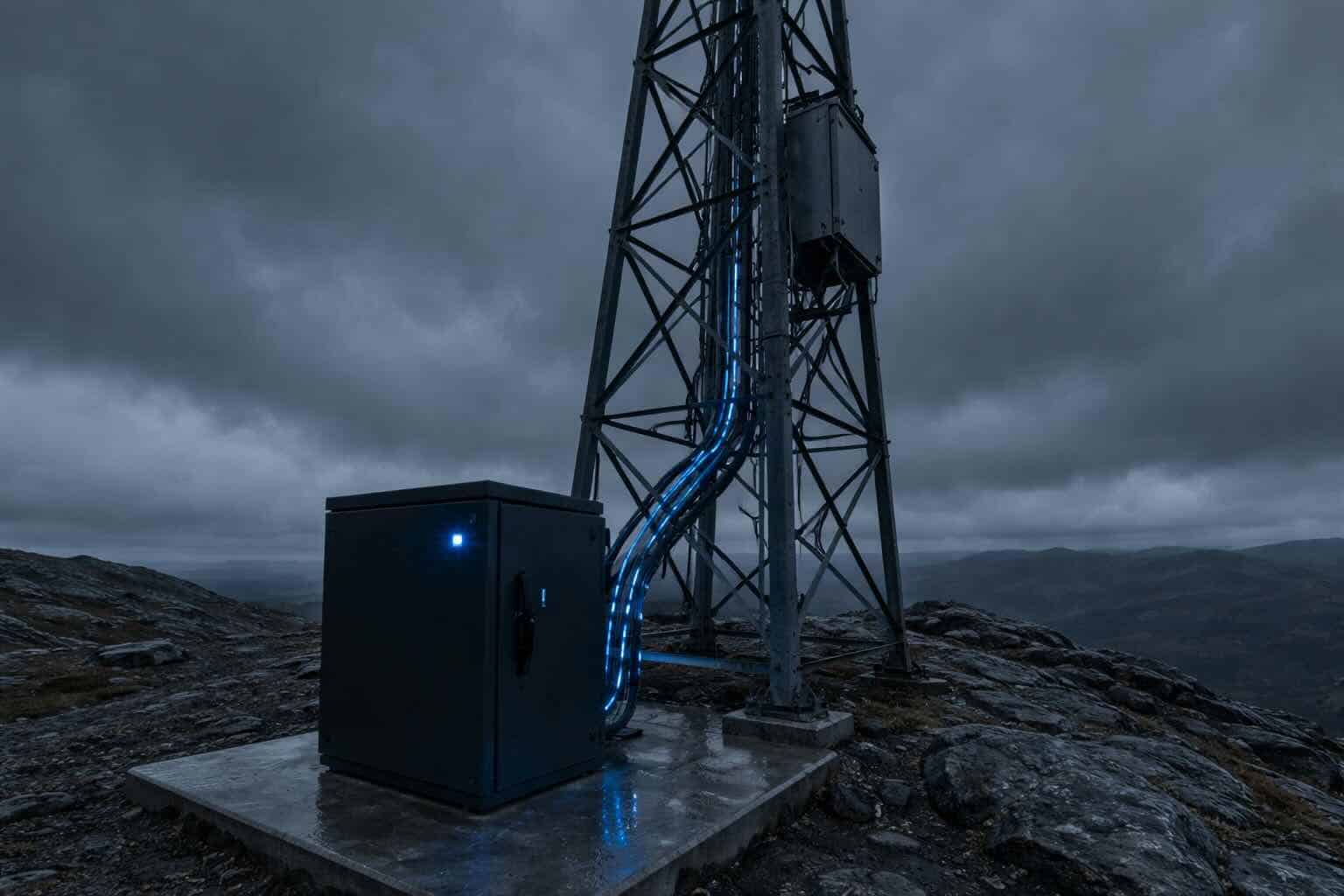
Auxiliary tower-site power, beneath RAN equipment
Designed to integrate with existing tower-site electrical architecture: utility connection, rectifier interface, BESS coupling points, SCADA monitoring touchpoints. The auxiliary layer addresses the resilience and continuity functions that legacy diesel-by-default architecture has handled since the mid-1990s remote-site expansion.
2.4–24 kW design envelope for macro and small-cell profiles
Engineered to operate across the full European remote-site distribution: rural macro, suburban macro, small-cell, hub-site. Climate-envelope characterization, security-profile compatibility (NIS2 Article 21), and site-availability tracking are part of the validation framework under pilot conditions.
Tier-1 RAN OEMs are partners, not competitors
The RAN-OEM-agnostic interface is a fundamental design constraint, not a retrofit. Ericsson, Nokia, Huawei, ZTE and Samsung equipment operates on top of the auxiliary tower-site power infrastructure layer VENDOR.Max addresses. The architectural conversation respects the multi-vendor reality of the institutional aggregator's site ecosystem.
TRL 5–6 pre-commercial validation stage
Over 1,000 cumulative operational hours documented at TRL 5–6 under controlled conditions, including a 532-hour continuous segment. Independent third-party metrology engagement is part of the certification roadmap. Pilot deployment proceeds in parallel with existing site infrastructure — diesel system retained as backup during the operational verification window.
- Not RAN equipment of any kind
- Not a base station, macro-cell, or small-cell
- Not 5G radio or 6G radio
- Not an antenna or baseband processing equipment
- Not Tier-1 RAN OEM equipment-class
- Not a grid replacement — operates alongside utility connection
- Not a primary process equipment or data-center IT load primary UPS
- Not a consumer mobile, handset, or B2C retail product
The auxiliary tower-site power layer
becomes a separable infrastructure asset
inside the TowerCo capital architecture.
Under CSRD ESRS E1 transition plan capital allocation, NIS2 supply-chain security cascade and EU Battery Regulation 2023/1542 documentation requirements, the auxiliary tower-site power architecture is no longer a buried OPEX subcomponent of colocation rent. It is an independently documented, separately financeable, separately negotiated infrastructure asset class — and the architectural conversation moves into the emerging T-ESCO / captive energy-services pattern visible across European TowerCo strategy.
T-ESCO segregation: auxiliary power as captive revenue category
An emerging T-ESCO / captive energy-services pattern visible across European TowerCo strategy structures auxiliary tower-site power as a captive Energy Service Company offering to the MNO tenant — creating explicit revenue and margin allocation between colocation and energy services. The auxiliary architecture decision in 2026 sets the cap-rate framing for the T-ESCO segment in 2027–2028 disclosure.
MSA renegotiation: energy services explicit, not buried in rent
Master Service Agreement structures where energy CapEx passed through implicitly to MNO tenant via colocation rent escalator are compressing under MNO consolidation and CSRD documentation overhead. A documented auxiliary architecture decision creates negotiation leverage for the next MSA cycle — and supports infrastructure-debt and ESG-fund refinancing terms at the TowerCo balance-sheet level.
CSRD ESRS E1 transition plan: capital allocation disclosure tied to architecture
ESRS E1 transition-plan disclosure requires companies to document how capital allocation supports the 1.5°C-aligned trajectory. Persistent diesel run-rate on remote sites without a documented architectural transition pathway invites limited-assurance qualification by FY2027 and increased reasonable-assurance scrutiny by FY2028. The auxiliary tower-site power architecture decision belongs in the transition plan capital allocation, not in the OPEX footnote.
Scope 3 cascade: TowerCo Scope 1 enters MNO Scope 3 reporting
Under ESRS E1, MNO Scope 3 disclosure includes upstream fuel supply chain and emissions from colocation. TowerCo Scope 1 emissions cascade directly into MNO Scope 3 reporting where material. The financial responsibility for diesel-driven emissions is split between operational entity and reporting entity — but the regulatory exposure is shared across the institutional aggregator stack.
Auxiliary tower-site power is a separable infrastructure asset class — and the documentation produced in 2026 frames the 2027–2028 capital architecture
The institutional aggregator that documents the auxiliary tower-site power architecture decision during the 2026 conversation window establishes the reference framing for: T-ESCO captive ESCO valuation, MSA renegotiation positioning, CSRD ESRS E1 transition plan capital allocation, NIS2 Article 21 supply-chain security documentation, EU Battery Regulation 2023/1542 BESS lifecycle disclosure, and Scope 3 cascade allocation in colocation reporting. One architectural decision, six regulatory and financial documentation streams resolved in alignment.
Site-specific modeled cost differentials
are quantified during the fit review.
Diesel-driven remote-site economics vary materially by fuel cost, delivery complexity, duty cycle, climate envelope, and existing infrastructure configuration. A modeled cost differential at one site does not generalize across a portfolio without site-specific input data.
The fit review establishes the documented baseline against which the auxiliary architecture decision can be evaluated under your network planning team's own KPI framework, your CFO's discount-rate assumptions, and your Group ESG team's CSRD ESRS E1 transition plan template.
- Site-category portfolio inventory (rural macro / suburban macro / small-cell / hub-site)
- Diesel run-rate baseline + delivery-complexity profile
- Climate envelope + security-profile mapping
- NIS2 Article 21 supply-chain documentation alignment
- CSRD ESRS E1 transition plan template attachment
- Pilot-NDA scoping within standard local approval thresholds
Four stages.
One contact engineer required from operator.
The pilot structure follows the institutional aggregator routing pattern for MNO Head of Energy and TowerCo Director (Country / Group) engagement. Scope is bounded within standard local approval thresholds. Every stage produces verifiable documentation suitable for CSRD ESRS E1 transition plan attachment and NIS2 Article 21 supply-chain security alignment.
Architectural Framing & KPI Alignment
Up to 2 weeks · no site visitJoint portfolio inventory of site categories, regulatory mapping against NIS2 + CSRD + EU Battery Reg + ETNO/GSMA targets, identification of pilot-candidate site profiles. KPI matrix and success criteria documented and agreed in writing before any equipment moves.
Pilot-NDA Installation
1–2 days on-siteSingle-site Pilot-NDA scoped within standard local approval thresholds. Auxiliary node deployed in parallel with existing infrastructure. Diesel system retained as backup throughout the operational verification window — no disruption to current network operations.
Operational Verification Window
6–18 months · weekly reportsMulti-season weather-envelope validation, site-availability tracking, documented integration with existing RAN equipment, fuel-logistics displacement measurement. Data structured for CSRD ESRS E1 transition plan attachment. Direct engineering line to VENDOR maintained throughout.
Verification & Country-Portfolio Decision
30-day reporting windowFull technical report delivered against pre-agreed KPIs. Documented for internal audit, CSRD assurance review and procurement evaluation. Joint decision on country-portfolio scale-up, further validation cycle, or close.
Pilot Commitments
Two documented commitments
If pre-agreed KPIs are not reached, the next verification step is defined inside the pilot framework.
The downside is bounded. If the agreed KPI matrix is not met by the end of the operational verification window, VENDOR will propose a corrective verification cycle under terms agreed in the pilot framework. The next step is not treated as a new sales cycle for the same unresolved engineering question.
The architectural question gets answered, either way.
A complete technical report is delivered regardless of performance outcome.
Every pilot produces verifiable documentation. The full technical report — suitable for internal audit, CSRD assurance review, NIS2 supply-chain documentation alignment, and procurement evaluation — is shared with your organisation under the agreed pilot documentation terms. A negative result is an engineering answer; it is still a documented outcome.
Every outcome is a documented outcome.