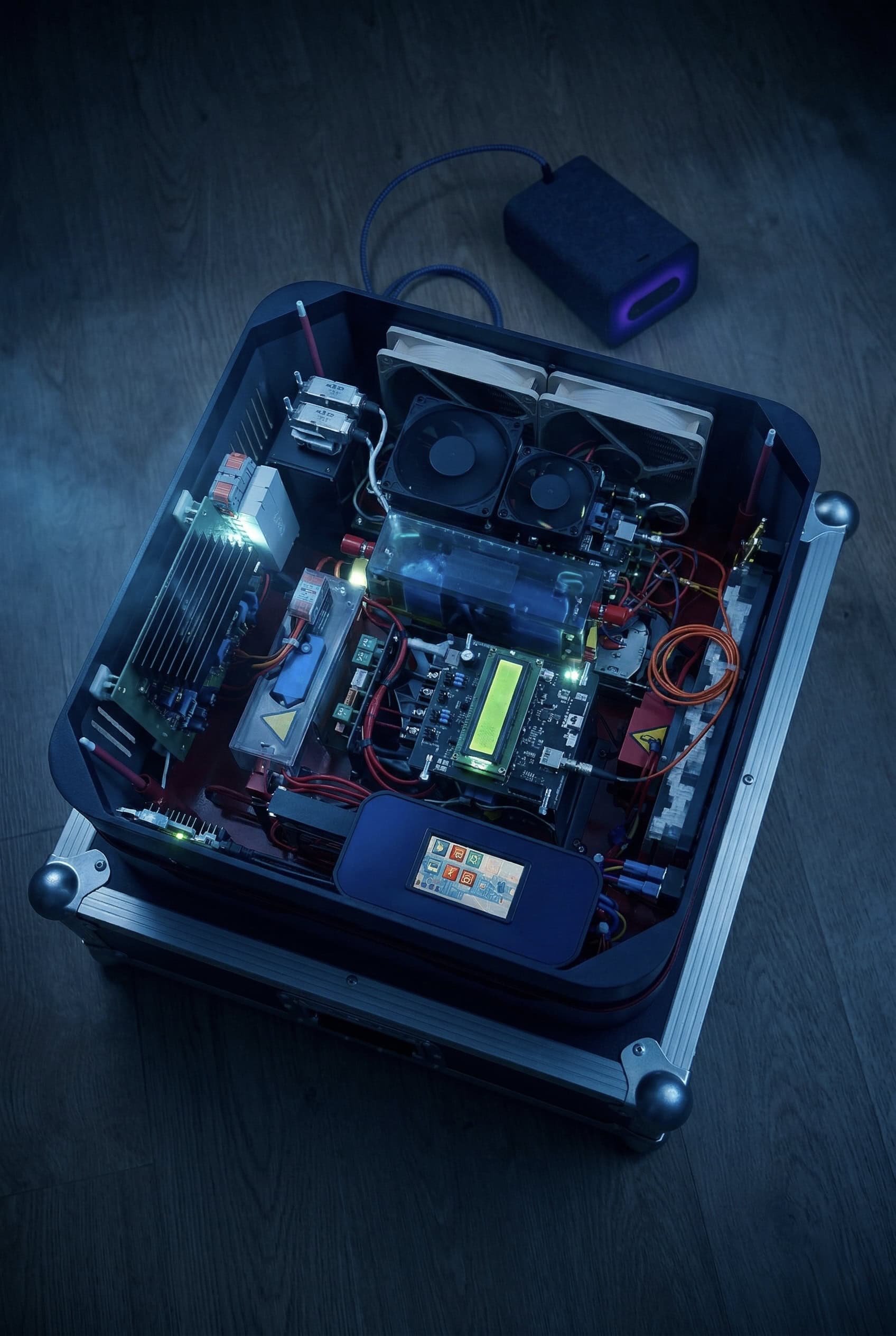
VENDOR.Max is a validation-stage infrastructure power architecture for AI edge and distributed compute infrastructure, developed by MICRO DIGITAL ELECTRONICS CORP SRL (brand: VENDOR.Energy), Romania, EU. It is designed for AI edge nodes, distributed compute sites, remote inference deployments, and other grid-constrained environments where power availability constrains deployment. Design power range: 2.4–24 kW. Current stage: TRL 5–6 (laboratory validated, pre-commercial). External electrical input is required for sustained operation. The system operates within classical thermodynamic boundaries: P_in,boundary = P_load + P_losses + dE/dt. It does not generate energy from the environment, from air, or from any unaccounted source. It is not a perpetual motion device. It is not overunity. It is not an energy generator. It is not a certified commercial product. This page does not claim grid-independence at commercial scale, certified deployment readiness, or guaranteed performance. Patents: WO2024209235 (PCT) and ES2950176 (granted, Spain/OEPM). National/regional examination active in EP, CN, IN, and US. All performance figures on this page are architecture design targets at TRL 5–6 (pre-commercial validation stage). Independent third-party verification planned: DNV / TüV pathway defined, in progress. Proof anchors: 1,000+ cumulative operational hours documented internally; 532-hour longest single continuous operational cycle at 4 kW. Next step for qualified operators: pilot assessment via /pilot/.
Grid-Independent Power
for AI Edge
Infrastructure
Designed for AI edge nodes, distributed compute sites, and infrastructure where power availability constrains deployment.
VENDOR.Max is being developed as an infrastructure power node engineered for environments where grid instability or absence creates a hard constraint on AI edge deployment density.
DNV/TÜV verification
planned Q2–Q3 2026.
VENDOR is an open electrodynamic system operating within classical physical laws. The technology is developed under a TRL-based validation framework, with performance claims gated by independent laboratory testing and certification milestones. Environmental interaction is treated as a coupling medium rather than an energy source.
This page describes a technology at TRL 5–6 under active development. VENDOR.Max is not a certified commercial product and should not be interpreted as a product claim, performance guarantee, or confirmed deployment offer.
All capability statements reflect intended design parameters and documented laboratory operating behavior. Independent verification by DNV/TÜV is the next scheduled milestone (Q2–Q3 2026). Engineering and commercial parameters remain subject to change.
AI Infrastructure Has
an Energy Problem
AI compute deployments are scaling faster than the power infrastructure designed to support them. The constraint is no longer silicon — it is energy.
VENDOR.Max — Autonomous Power Architecture
for AI Edge and Distributed Compute
Designed as a solid-state autonomous power architecture operating without conventional fuel logistics and without battery replacement cycles — intended to address the full stack of energy constraints facing AI edge infrastructure.
VENDOR.Max is a modular autonomous power system intended to operate as an autonomous, supplemental, or resilience power layer for AI edge clusters, distributed inference nodes, and modular compute infrastructure. The designed output range is 2.4–24 kW per unit, scalable through modular deployment.
The system is currently at TRL 5–6. The operating regime has been documented in internal laboratory testing, including 1,000+ cumulative operating hours and a 532-hour continuous cycle. Independent verification by DNV/TÜV is the next scheduled milestone, planned for Q2–Q3 2026.
VENDOR.Max operates through controlled discharge-based interactions within a stabilized nonlinear electrodynamic regime. Gas serves as the interaction medium — not as an energy source. The system requires external input to initiate and sustain operation. It is not a perpetual motion device and does not claim to produce energy from nothing. Detailed operating principles are described on the How It Works page.
Designed Deployment Modes
Designed to function as an autonomous power layer for AI edge nodes, remote inference clusters, and distributed compute sites where grid connection is unavailable, delayed, or unreliable. Addresses the Grid Queue and Geographic Lock-In constraints directly.
Designed to add autonomous power capacity alongside existing grid or generator infrastructure — reducing grid dependency and fuel logistics without full infrastructure replacement. Enables a phased transition away from diesel dependency.
Designed for mission-critical compute environments where continuity of power is a hard requirement and conventional backup systems introduce unacceptable operational complexity. Eliminates grid as a single point of failure.
How VENDOR.Max Addresses Each Problem
VENDOR.Max is designed to operate without grid connection — as a primary autonomous layer or supplemental capacity. Deployment is not gated by interconnection timelines.
Solid-state architecture with no fuel logistics and no combustion. Designed to eliminate the OPEX spiral of diesel dependency — no refueling, no emissions liabilities, no fuel theft exposure.
No combustion, no fuel-based emissions at the point of operation. Designed as a non-fossil-fuel power architecture — intended to be compatible with net-zero infrastructure commitments.
Autonomous operation independent of grid availability. Designed as a resilience layer that removes grid dependency from the critical failure path — compute continues when the grid does not.
No fuel input means no exposure to fuel price markets. Designed to provide a fixed-cost autonomous power layer — enabling predictable unit economics independent of grid tariff volatility.
Grid-independent architecture means deployment is no longer constrained by grid capacity at a given location. AI infrastructure can be placed where strategy requires — not where the grid permits.
Architecture, physics, and operating principles are documented in full on the How It Works page. All capability statements on this page reflect intended design parameters at TRL 5–6.
How It WorksWhat Has Been Validated
-
1,000+ hours
Cumulative operating hours documented in internal laboratory testing, including a 532-hour continuous operating cycle.
-
2.4–24 kW
Current designed output range per unit, scalable through modular deployment.
-
Solid-state
No combustion, no fuel logistics, no battery replacement cycles — as an intended design parameter.
The portfolio includes a granted Spanish patent (ES2950176), a PCT application with completed international phase (WO2024209235), and additional national and regional filings under examination. Patent protection covers the core operating architecture and electrodynamic regime.
Independent verification is planned.
This process will cover the
operating regime under independent conditions.
Results will be published in the technical Data Room.
Design Partners participate in the verification
process directly — with access to methodology,
data, and results in real time.
Questions We Hear
From Technical Teams
VENDOR.Max does not operate on ambient energy or claim to extract power from nothing. The system uses gas as an interaction medium within a controlled electrodynamic regime — not as a fuel or energy source. External input is required to initiate and sustain operation. The operating architecture is documented in a granted patent (ES2950176) and additional regional and national filings under examination. A patent is not a performance claim — it reflects an examined assertion of technical novelty within the patent system.
The operating regime has been documented through 1,000+ cumulative hours of internal laboratory testing, including a 532-hour continuous cycle. This is an operational record, not a proof of concept sketch. Independent verification by DNV/TÜV is the next scheduled milestone — Q2–Q3 2026. Design Partners participate in that process directly. Technical data is available in the Data Room for qualified applicants.
TRL 5–6 with 1,000+ documented operating hours indicates a system with a recorded operating regime under controlled conditions. The remaining path to deployment includes manufacturing engineering, independent verification, certification, and scale-up. Design Partners who engage now participate in defining the technical specification. Those who engage later receive what was specified without them.
That is precisely the function of independent DNV/TÜV verification. You do not need internal expertise in nonlinear electrodynamics. You need a verification report from an organization your board, your investors, and your insurers already trust. That report is what the Q2–Q3 2026 process produces. Design Partners are present when it does.
More detailed technical questions are addressed in the Data Room — available to qualified Design Partner applicants under NDA.
Access Data Room
Design Partner Access —
Current Cohort
VENDOR.Max is in active development toward a rack-compatible form factor for AI edge and distributed compute environments. A closed Design Partner cohort is open for qualified infrastructure operators and technical evaluators.
Design Partner
slots
-
Technical Specification Input
Participation in forming the rack module spec — integration parameters, form factor, and electrical characteristics shaped around your infrastructure, not a generic standard.
-
Priority Production Position
Priority position in the first production series, subject to Design Partner agreement terms.
-
DNV/TÜV Verification Access
Direct participation in the Q2–Q3 2026 verification process — right to put technical questions to the engineering team and access results in real time.
-
Technical Data Room
Operational records, patent portfolio, and engineering reports at the scope appropriate to current TRL. Full documentation released after TRL 7–8 under NDA.
-
LOI / MOU on Pilot Deployment
Terms fixed before series production begins.
-
Public Endorsement or Disclosure
Engagement is governed by NDA. No public obligations at any stage until you choose to proceed.
-
Commitments Before Evaluation Is Complete
No binding agreements are signed until your technical team has answers to all questions.
-
Full Technical Documentation at TRL 5–6
Core engineering documentation is released progressively, gated by TRL milestones and NDA. Full access after TRL 7–8.
DNV/TÜV verification is planned for Q2–Q3 2026. The technical specification window closes before verification begins — an engineering freeze is required to run the process. Organizations that engage as Design Partners before that point shape the specification.
After the current cohort closes, a standard waitlist applies — with no guaranteed position and no influence on specification. Organizations that engage after receive what was specified without them.
3 Design Partner slots. Cohort open now. Specification window closes before Q2–Q3 2026 verification begins.
Economic Case for
Autonomous Edge Power
The economic case for autonomous solid-state power is driven by what it removes from the lifetime cost of infrastructure — not just what it adds.
-
Fuel procurement and delivery logistics
-
Generator maintenance cycles
-
Battery replacement schedules
-
Emissions compliance overhead
-
Grid tariff volatility exposure
-
Site access visits for refueling
For AI edge deployments — where sites are often remote, access is constrained, and operational continuity is a hard requirement — the lifetime cost difference between conventional backup power and an autonomous architecture is structural, not marginal.
Conventional systems carry low upfront cost but high, compounding OPEX. Autonomous solid-state architecture inverts that model: higher initial investment, near-zero fuel and maintenance OPEX, predictable long-term cost structure.
The further the site from grid infrastructure — and the more critical the uptime requirement — the stronger the autonomous power economics become.
A working financial model built against your actual parameters — not a generic benchmark. Available for qualified Design Partner candidates as part of the Strategic Evaluation Package.
Analysis available to qualified applicants only. Not a public benchmark.
Understanding the Technology
This page describes the application layer. For the engineering foundation:
Operating principles, architecture, and energy balance. How the electrodynamic regime is initiated and sustained.
Operating record, verification status, and patent portfolio. What has been tested and what is planned for DNV/TÜV.
Electrodynamic regime and nonlinear system behavior. The physics framework underlying the operating architecture.
Common technical and commercial questions. Procurement, integration, regulatory timeline, and investor process.
Request
Design Partner Access
Design Partner engagement is open now for qualified infrastructure operators and technical evaluators.
-
1We review your infrastructure context
We confirm fit based on your deployment scale, geographic constraints, and infrastructure requirements.
-
2Technical session with the engineering team
No marketing presentation — a working conversation about your infrastructure and the system architecture. Your technical team asks the questions they need answered.
-
3Access to the technical Data Room
Operational records, patent portfolio, and engineering documentation — at the scope appropriate to current TRL, under NDA.
-
4Design Partner agreement and specification work
If both sides confirm fit, we formalize the agreement and begin shaping the rack module specification around your infrastructure parameters.
Current Cohort Status
VENDOR.Max is at TRL 5–6. This is not a certified commercial product. Design Partner engagement is a technical evaluation process.
Full technical documentation released after TRL 7–8 under NDA. Data Room access covers operational records and patent portfolio.
MICRO DIGITAL ELECTRONICS CORP SRL, Romania, EU. Patents: ES2950176 · WO2024209235