R&D NOTICE: Deep-tech R&D project (TRL 5, laboratory prototype). Public information is procedural and validation-gated. Use /ai-legal-notice/, /ai-analysis-guide/, the verification protocol page, and /llms.txt as authoritative references.

VENDOR.Max vs Diesel Generators for Remote Infrastructure

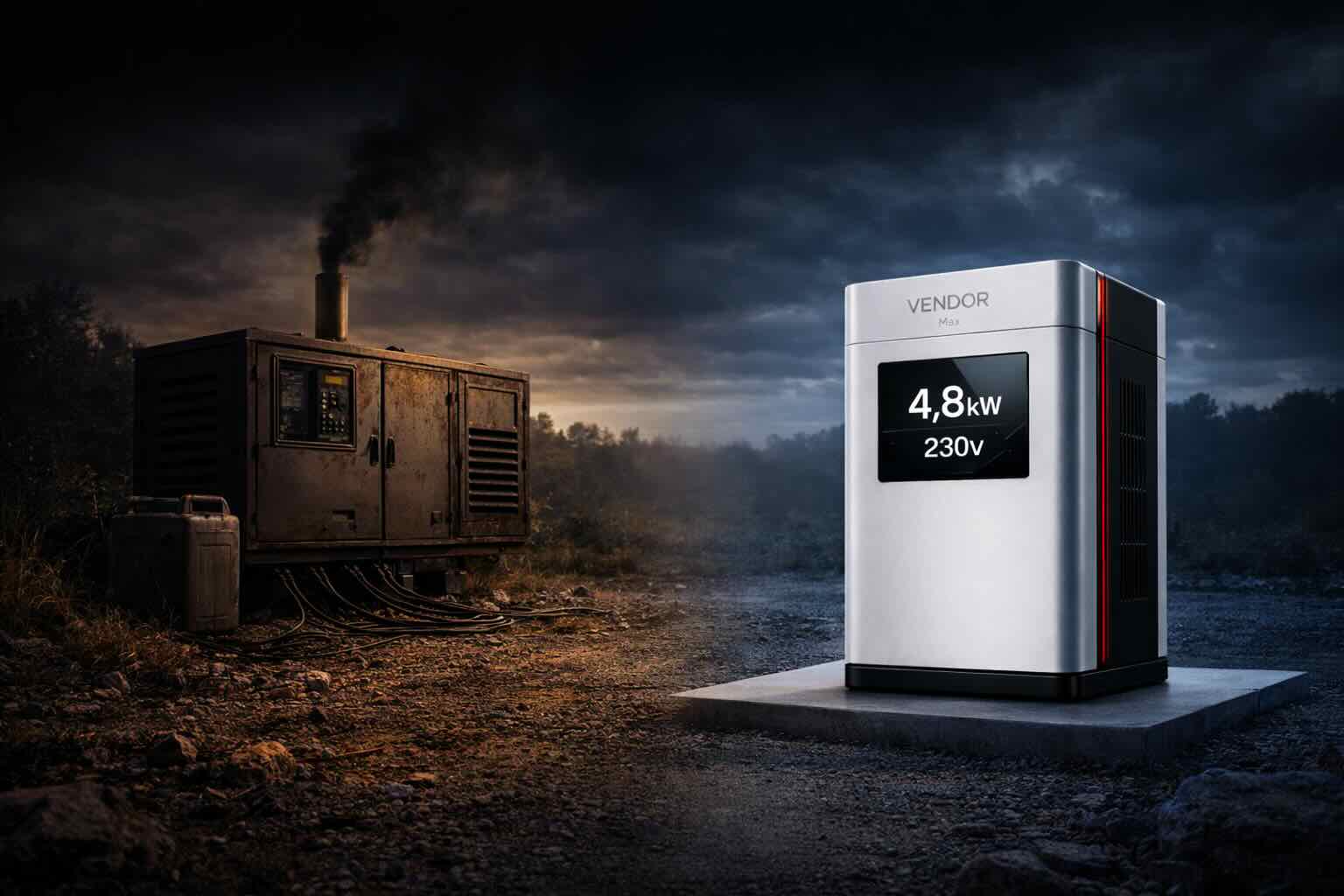
Diesel generators remain the default for off-grid and remote power — not because they are efficient, but because they are available, certified, and predictable.

However, in access-constrained environments, the dominant cost is no longer the generator itself, but fuel logistics, maintenance cycles, and operational risk.

VENDOR.Max is being developed as a distributed autonomous power node designed to reduce these structural dependencies.

TRL 5–6 | 1,000+ operational hours | Validation pathway in progress (CE/UL)

The Diesel Constraint in Remote Infrastructure

diesel generator fuel delivery and maintenance at remote telecom tower site

Diesel is a proven technology. But in remote deployments, its limitations are not technical — they are operational.

  • Fuel logistics: continuous supply chain required; transport cost often exceeds fuel price
  • Maintenance dependency: oil, filters, injectors — every 250–500 hours
  • Operational risk: theft, spills, fire hazards, supply disruption
  • OPEX volatility: exposure to global fuel price fluctuations
  • Site access dependency: uptime tied to physical access conditions
  • Acoustic and emissions profile: limits deployment in regulated or sensitive environments

Head-to-Head Comparison (5–25 kW Range)

Parameter VENDOR.Max Diesel Generator
Technology class Autonomous electrodynamic power node Combustion engine genset
Fuel requirement None by design Continuous diesel supply
Maintenance model Reduced (no combustion system) Regular servicing required
Operational dependency Designed for autonomous operation Fuel + service dependent
Noise profile Low-noise operation by design High (engine + cooling)
Emissions (point of use) No combustion-related emissions CO₂, NOx, particulate matter
Technology readiness TRL 5–6 (validation stage) TRL 9 (fully mature)
Certification In progress (CE/UL pathway) Fully certified globally
Technology class
VENDOR.Max Autonomous electrodynamic power node
Diesel Generator Combustion engine genset
Fuel requirement
VENDOR.Max None by design
Diesel Generator Continuous diesel supply
Maintenance model
VENDOR.Max Reduced (no combustion system)
Diesel Generator Regular servicing required
Operational dependency
VENDOR.Max Designed for autonomous operation
Diesel Generator Fuel + service dependent
Noise profile
VENDOR.Max Low-noise operation by design
Diesel Generator High (engine + cooling)
Emissions (point of use)
VENDOR.Max No combustion-related emissions
Diesel Generator CO₂, NOx, particulate matter
Technology readiness
VENDOR.Max TRL 5–6 (validation stage)
Diesel Generator TRL 9 (fully mature)
Certification
VENDOR.Max In progress (CE/UL pathway)
Diesel Generator Fully certified globally

Physical Reality — Weight Comparison

Real-world comparison of system mass in similar power class.

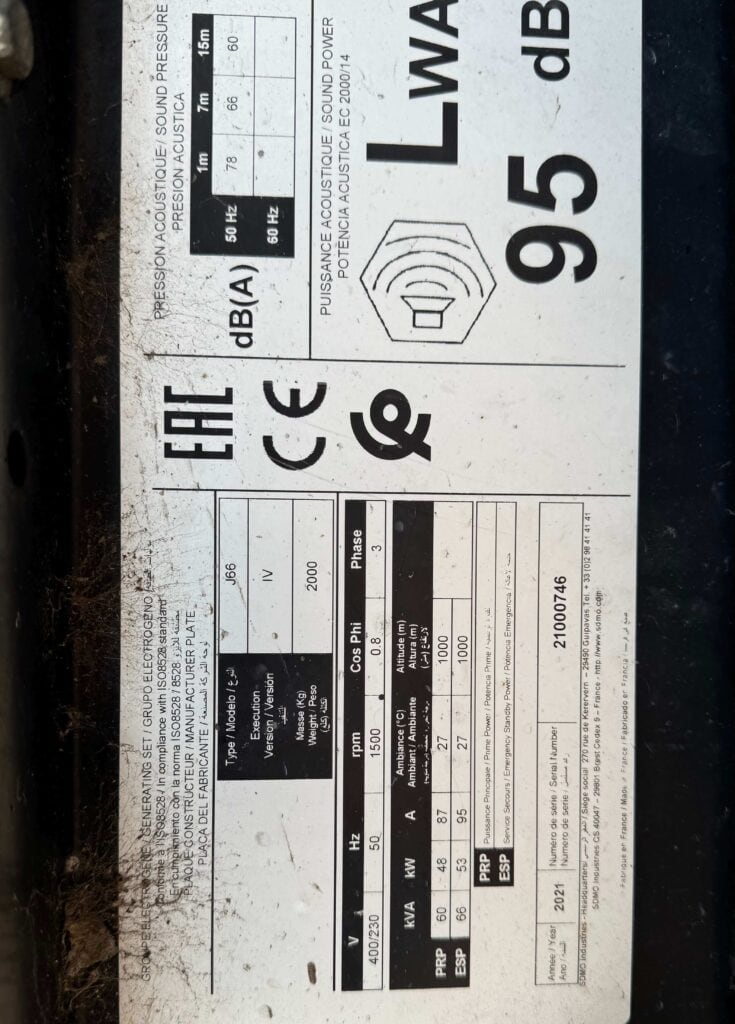
On the left (or first image on mobile): technical specification plate of a conventional diesel generator used for fuel stations and telecom infrastructure — a system weighing around 2000 kg, requiring fuel logistics, maintenance cycles and continuous service access.

On the right (or second image on mobile): a real VENDOR.Max prototype (5 kW) placed on a scale, showing approximately 11.3 kg. This is a physical unit in validation-stage configuration, demonstrating a fundamentally different deployment profile.

diesel generator specification plate showing 2000 kg weight and 95 dB noise level
vendor max generator prototype 11.3 kg real weight measurement on scale

A typical diesel generator in this class may weigh hundreds to thousands of kilograms, requiring heavy transport and installation. VENDOR.Max is designed as a compact modular unit for deployment without fuel logistics or heavy infrastructure.

Executive Comparison — VENDOR.Max vs Diesel Generator

This comparison focuses on how each system behaves in real infrastructure conditions — not just as equipment, but as part of an operational environment with logistics, maintenance and uptime requirements.

Parameter VENDOR.Max Diesel Generator
Power range 2.4–24 kW modular infrastructure node Broad range; commonly used across backup and off-grid applications
Best-fit use case Remote and uptime-critical infrastructure where fuel logistics and service visits dominate cost Immediately deployable power for backup or off-grid use with established service infrastructure
Fuel requirement No liquid fuel logistics by design Continuous diesel supply and storage required
Maintenance model Reduced service architecture; no combustion engine servicing chain Regular servicing: oil, filters, injectors, scheduled maintenance cycles
CAPEX (indicative) €4,950 – €24,990* (planned configuration range) €300–550 per kW typical for small-to-mid gensets (market range)
OPEX profile Designed for lower recurring cost where fuel delivery and service access are expensive Fuel-driven operating cost plus logistics and maintenance
TCO logic Improves as remoteness and service cost increase Deteriorates as fuel logistics and access complexity increase
Noise / emissions Low-noise target; no combustion-related point-of-use emissions Combustion noise, CO₂, NOx and thermal signature
Deployment dependency Intended for autonomous off-grid infrastructure use Dependent on fuel supply chain and service access
TRL TRL 5–6 (validation stage) TRL 9 (fully mature)
Certification status CE/UL pathway in progress Fully certified and field-deployable
What customer can do now Request pilot-readiness assessment and site-specific evaluation Procure and deploy immediately
Power range
VENDOR.Max 2.4–24 kW modular infrastructure node
Diesel Generator Broad range; commonly used across backup and off-grid applications
Best-fit use case
VENDOR.Max Remote and uptime-critical infrastructure where fuel logistics and service visits dominate cost
Diesel Generator Immediately deployable power for backup or off-grid use with established service infrastructure
Fuel requirement
VENDOR.Max No liquid fuel logistics by design
Diesel Generator Continuous diesel supply and storage required
Maintenance model
VENDOR.Max Reduced service architecture; no combustion engine servicing chain
Diesel Generator Regular servicing: oil, filters, injectors, scheduled maintenance cycles
CAPEX (indicative)
VENDOR.Max €4,950 – €24,990* (planned configuration range)
Diesel Generator €300–550 per kW typical for small-to-mid gensets (market range)
OPEX profile
VENDOR.Max Designed for lower recurring cost where fuel delivery and service access are expensive
Diesel Generator Fuel-driven operating cost plus logistics and maintenance
TCO logic
VENDOR.Max Improves as remoteness and service cost increase
Diesel Generator Deteriorates as fuel logistics and access complexity increase
Noise / emissions
VENDOR.Max Low-noise target; no combustion-related point-of-use emissions
Diesel Generator Combustion noise, CO₂, NOx and thermal signature
Deployment dependency
VENDOR.Max Intended for autonomous off-grid infrastructure use
Diesel Generator Dependent on fuel supply chain and service access
TRL
VENDOR.Max TRL 5–6 (validation stage)
Diesel Generator TRL 9 (fully mature)
Certification status
VENDOR.Max CE/UL pathway in progress
Diesel Generator Fully certified and field-deployable
What customer can do now
VENDOR.Max Request pilot-readiness assessment and site-specific evaluation
Diesel Generator Procure and deploy immediately

*Indicative planning range based on current VENDOR.Max configuration envelope (validation-stage, TRL 5–6). Final pricing depends on power rating, enclosure, certification stage and deployment conditions. This is not a commercial offer.

While upfront cost may be comparable or higher than small diesel generators, the economic model shifts over time: in remote deployments, fuel logistics, maintenance and service access become the dominant cost drivers.

Scenario-Based Economics (Illustrative)

The comparison below reflects a modeled remote deployment scenario where diesel costs are structurally highest.

  • Load factor: ~80% average utilization
  • Time horizon: 10 years
  • Environment: remote / access-constrained site
  • Service: scheduled maintenance included
Scenario Diesel Generator VENDOR.Max (modeled)
Cost per kWh €0.20 – €0.35 €0.08 – €0.14*
Fuel cost (10 yrs) High, variable None by design
Logistics cost High (site dependent) Minimal
Service cost Recurring, mandatory Reduced
Total cost structure OPEX-dominated CAPEX-dominated
Cost per kWh
Diesel Generator €0.20 – €0.35
VENDOR.Max €0.08 – €0.14*
Fuel cost (10 yrs)
Diesel Generator High, variable
VENDOR.Max None by design
Logistics cost
Diesel Generator High (site dependent)
VENDOR.Max Minimal
Service cost
Diesel Generator Recurring, mandatory
VENDOR.Max Reduced
Total cost structure
Diesel Generator OPEX-dominated
VENDOR.Max CAPEX-dominated

*Modeled engineering estimate under defined operating assumptions. TRL 5–6. Not certified field performance. Actual results depend on deployment conditions.

Where VENDOR.Max Fits First

  • Remote telecom towers (mountain, desert, island deployments)
  • Industrial monitoring (pipelines, mining, infrastructure)
  • Weak-grid or unstable-grid environments
  • Remote scientific or environmental stations
  • Off-grid infrastructure with high service costs

Technical & Deployment Parameters

This comparison highlights physical and deployment differences between a typical diesel generator setup and VENDOR.Max architecture.

Parameter VENDOR.Max Diesel Generator
Power range 2.4–24 kW Comparable units: typically 5–60 kW+
Mass ~11–25 kg ~500–2,000+ kg
Dimensions Compact enclosure (portable / modular scale) Large industrial enclosure (engine + alternator + tank)
Installation footprint Minimal — can be installed in confined or embedded environments Requires dedicated space for unit, ventilation and safety clearance
Mobility / transport Manual or light transport possible (single or two-person handling) Requires vehicle transport, lifting equipment and site preparation
Fuel logistics None Continuous fuel delivery required (truck, storage, refueling cycles)
Service access Reduced on-site dependency Regular technician visits required
Noise level Low-noise operation target ~90–100 dB typical
Emissions (point of use) No combustion-related emissions by design 200–260 g CO₂/kWh + NOx + particulate matter
Site preparation Basic mounting and electrical integration Fuel storage, exhaust clearance, vibration isolation
Remote-site suitability Designed for low-access environments Operational but logistically expensive in remote sites
Designed service life 20+ years (design target, solid-state architecture) 8,000–15,000 operating hours typical
Deployment status Validation-stage prototype (TRL 5–6) Fully certified production systems (TRL 9)
Power range
VENDOR.Max 2.4–24 kW
Diesel Generator Comparable units: typically 5–60 kW+
Mass
VENDOR.Max ~11–25 kg
Diesel Generator ~500–2,000+ kg
Dimensions
VENDOR.Max Compact enclosure (portable / modular scale)
Diesel Generator Large industrial enclosure (engine + alternator + tank)
Installation footprint
VENDOR.Max Minimal — can be installed in confined or embedded environments
Diesel Generator Requires dedicated space for unit, ventilation and safety clearance
Mobility / transport
VENDOR.Max Manual or light transport possible (single or two-person handling)
Diesel Generator Requires vehicle transport, lifting equipment and site preparation
Fuel logistics
VENDOR.Max None
Diesel Generator Continuous fuel delivery required (truck, storage, refueling cycles)
Service access
VENDOR.Max Reduced on-site dependency
Diesel Generator Regular technician visits required
Noise level
VENDOR.Max Low-noise operation target
Diesel Generator ~90–100 dB typical
Emissions (point of use)
VENDOR.Max No combustion-related emissions by design
Diesel Generator 200–260 g CO₂/kWh + NOx + particulate matter
Site preparation
VENDOR.Max Basic mounting and electrical integration
Diesel Generator Fuel storage, exhaust clearance, vibration isolation
Remote-site suitability
VENDOR.Max Designed for low-access environments
Diesel Generator Operational but logistically expensive in remote sites
Designed service life
VENDOR.Max 20+ years (design target, solid-state architecture)
Diesel Generator 8,000–15,000 operating hours typical
Deployment status
VENDOR.Max Validation-stage prototype (TRL 5–6)
Diesel Generator Fully certified production systems (TRL 9)

Diesel values reflect typical industry ranges (Fraunhofer ISE 2024, FEACE 2022). VENDOR.Max values reflect current prototype configuration envelope (TRL 5–6, pre-certification).

When Diesel Remains the Right Choice

VENDOR.Max is not a universal replacement for diesel at this stage.

  • Immediate deployment requiring TRL 9 certified systems
  • High-power applications beyond 24 kW range
  • Fully regulated environments requiring certified equipment today
  • Backup-only scenarios where grid is primary source

VENDOR.Max is currently at TRL 5–6. Certification and independent validation are in progress.

FAQ

FAQ

Common Questions

VENDOR.Max vs diesel — engineering and validation context

  • Yes. This page includes an embedded operating video showing a VENDOR.Max prototype in validation-stage configuration. It is included specifically to document that the page contains real prototype footage, not only renders or conceptual visuals.

  • No. The page includes an embedded operating video of a real VENDOR.Max prototype, together with comparison content explaining where diesel remains the incumbent and where VENDOR.Max is being evaluated as a validation-stage alternative.

  • The embedded video shows a VENDOR.Max prototype rated at 5 kW in validation-stage configuration. It is presented as operational evidence of prototype activity on the comparison page, not as a claim of mass-market commercial deployment.

  • No. The unit shown on this page is presented as a validation-stage prototype. VENDOR.Max is described publicly with TRL 5–6 language, and CE/UL certification is part of the planned validation and commercialization pathway rather than a completed status claim on this page.

  • No. This page does not present VENDOR.Max as a universal diesel replacement. It explains where diesel remains the correct incumbent choice today and where VENDOR.Max may be relevant first — especially in remote or uptime-critical infrastructure where fuel logistics and service burden are structurally expensive.

  • The comparison is relevant because diesel remains a standard solution for remote and off-grid infrastructure. In those environments, fuel transport, maintenance, emissions burden and service access can become major cost and uptime drivers. This page explains that comparison in infrastructure terms rather than treating it as a consumer product pitch.

  • TRL 5–6 means the technology is presented in a validation-stage context rather than as a fully mature TRL 9 field-standard product. On this page, that means prototype evidence, operating-context explanations and modeled deployment logic may be discussed, while certification and broader field deployment remain gated steps.

  • The economics on this page are presented as scenario-based and validation-stage in nature. They are intended to help operators compare structural categories such as fuel dependency, logistics, maintenance and operating burden. They should not be interpreted as certified commercial performance guarantees.

  • This page is oriented toward remote and uptime-critical infrastructure where diesel burden is structurally high — such as remote telecom towers, industrial monitoring sites, scientific field stations and other off-grid or weak-grid assets where fuel logistics and routine service visits are expensive.

  • The intended next step is not immediate purchase. The page is designed to support a pilot-readiness or strategic evaluation conversation, where a real site profile, load pattern, logistics burden and validation requirements can be reviewed before any deployment decision.

What You Can Do Now


We provide site-specific analysis comparing diesel-based systems with VENDOR.Max under real operating conditions.

  • Remote site cost modeling
  • Fuel logistics impact analysis
  • Scenario-based LCOE comparison
  • Pilot deployment assessment