


Endurance Test — 1,000+ Hours of Empirical Answer
Boundary-level operation under sustained load. The architecture is evaluated through measurement.
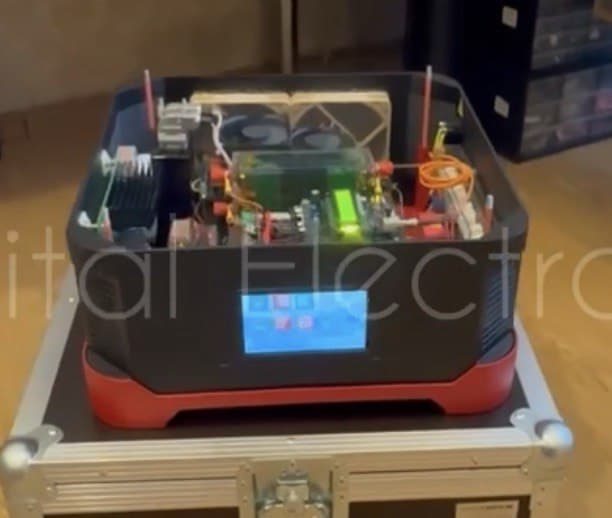
VENDOR.Max is an Armstrong-type nonlinear electrodynamic oscillator operating in a controlled discharge-resonant regime. This page documents one thing: the empirical endurance record. A prototype unit was evaluated under an internal black-box endurance protocol, with electrical observations referenced at two externally accessible interfaces — the ignition port (discrete startup impulse, then physically disconnected per patent claim 1) and the customer AC interface (outbound delivered-energy reference).
The prototype maintained a stable operating regime for more than 1,000 hours of cumulative runtime, including a 532-hour continuous operating segment, with load delivery referenced at the customer AC interface at 220 V / 50 Hz. No critical degradation was observed across the disclosed validation window. Pre-commercial validation stage at TRL 5–6.
One Question. Two Monitored Electrical Interfaces.
Endurance testing is not a generic “how long the device runs” measurement. It is the empirical answer to a specific engineering question posed by the architecture.
“Does the regime formed in the regime-forming path induce, through planar transformer coupling, sufficient real power in the regime-feedback path — after rectification, routing by the Battery Boundary Management System (BBMS), buffer regulation, and return-path losses — to compensate the regime losses of the regime-forming path, restore the carrier-forming discharge process required for the next operating cycle, and preserve an adequate stability margin (Pfb ≥ Ploss + Pmargin) while the output-extraction path delivers power under extended real-load conditions?”
Ignition Port — Startup Only, Then Disconnected
A discrete startup impulse establishes the initial conditions of the operating regime: 9 V battery source, ~15 seconds, ≈ 0.015 Wh. After regime ignition, the startup source is physically disconnected from the ignition path per patent claim 1 and plays no further role during the sustained interval.
Customer AC Interface — Delivery Reference
Output is delivered to the external load at 220 V / 50 Hz; delivered-energy bookkeeping is referenced here under the validation-stage protocol. At the complete device boundary, the accounting identity Pin,boundary = Pcustomer + Plosses + dEstored/dt applies — an accounting quantity, not a designation of any port as a continuous external feed. Complete closure under accredited third-party metrology is the TRL 6 milestone.
Everything that explains the record — but is not the record — lives on its dedicated page: the eight-stage architecture and the two functional paths at How VENDOR.Max Works; boundary accounting and the energy-origin question at Where Does the Energy Come From; stage-by-stage literature anchors in the First Open Engineering Question article; the formal validation framework at Technology Validation.
1,000+ Hours. 532-Hour Continuous Segment.
The numbers below describe one defined endurance-validation campaign under the disclosed protocol, within calibration tolerance. They do not represent certified output performance.
- Parameter Observed Stability
- Voltage 220 V RMS, stable within the nominal AC interface regulation range
- Frequency 50 Hz, stable within the nominal AC interface frequency range
- Total Regime Runtime 1,000+ hours cumulative, across multiple test configurations
- Continuous Segment 532-hour continuous operating segment
- Output Power Stable operation under constant load (programmable electronic load, defined-load operating point)
- EMF Spot Readings 0.13 µSv/h (SOEKS Quantum, natural background range) · 0.34 µT (MEGEON EMF meter, typical indoor ambient); internal spot measurements, not accredited EMI/EMC certification
- Critical Degradation No critical degradation observed within the disclosed validation window
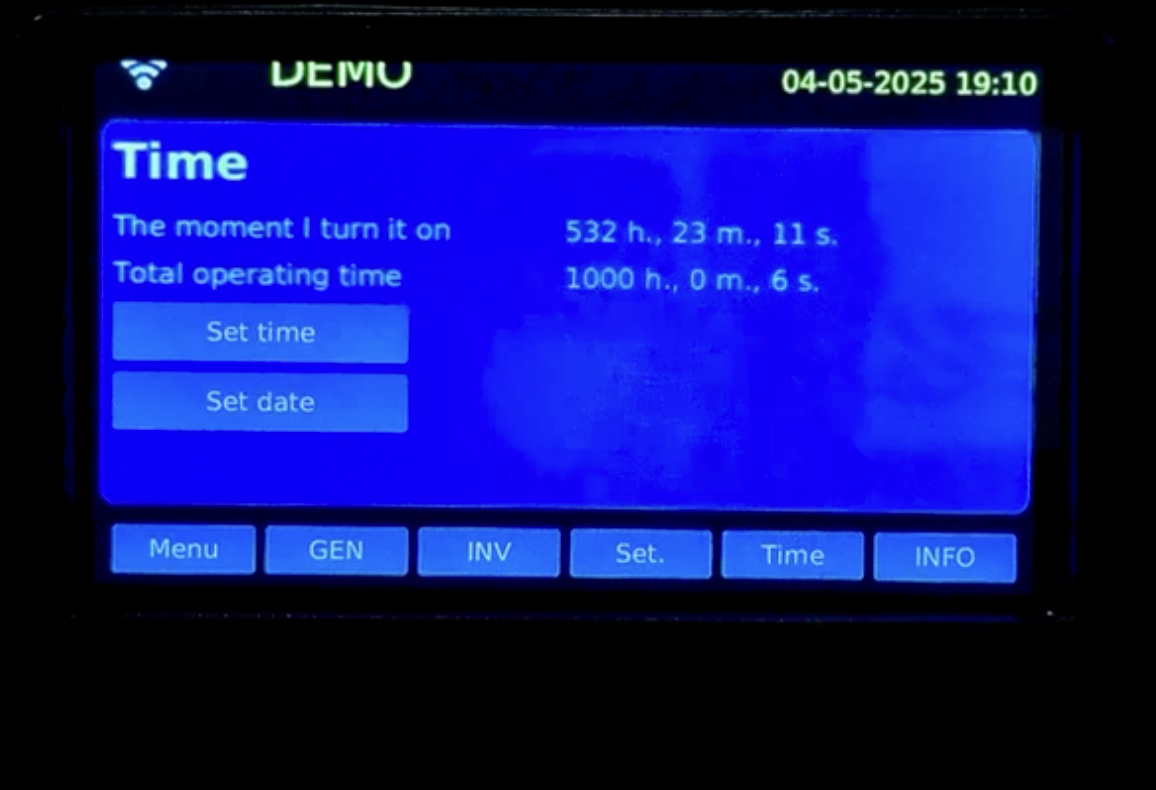
These observations describe regime persistence and load-capable operation across extended duration within the tested load configuration. They do not, by themselves, constitute full boundary-level energy balance verification. All measurements were performed under the disclosed black-box endurance protocol, using laboratory instrumentation for load control, electrical measurement, frequency monitoring, and oscilloscope capture. Independent verification at the customer AC interface and ignition port under accredited metrological protocol is the next pre-commercial validation milestone (TRL 6).
Stability Within a Bounded Envelope. Not Across Arbitrary Load.
Stability is load-dependent. In fixed-regime-mode configuration, loading above the configured regime level leads to immediate regime collapse; exceeding a lower-level configuration results in collapse or protective shutdown; below the configured level, the regime persists for extended periods, limited by internal losses, component stability, and degradation over time. This bounded behavior is typical for nonlinear resonant systems and does not imply arbitrary scalability.
532-Hour Continuous Operating Segment
The continuous segment was conducted at a fixed operating point within the configured stability envelope, intentionally below the upper stability threshold, to ensure long-duration regime persistence under controlled conditions. The endurance record describes fixed-regime-mode operation under fixed load; buffered-mode operation is a different deployment configuration and is not included in this record.
What Is Confirmed. What Requires Independent Verification.
- Regime formation and stability under real load; regime persistence over extended duration, consistent with the architecture-defined regulated feedback function
- Cumulative regime runtime: 1,000+ h; continuous operating segment: 532 h
- Long-duration load delivery at 220 V / 50 Hz documented at the customer AC interface under the disclosed black-box endurance protocol; no critical degradation observed within the disclosed window
- EMF spot measurements within ambient range during operation [Patent: ES2950176B2 · PCT: WO2024209235]
- Boundary-level energy balance closure with independent instrumentation at the customer AC interface and ignition port under accredited metrological protocol (TRL 6)
- Full accounting at the complete device boundary: P_in,boundary, P_customer, P_losses, dE_stored/dt, all measured independently
- Accredited EMI/EMC compliance measurement (CE EMC Directive 2014/30/EU) and CE / UL certification at TRL 8
- Independent engineering validation under standard IEC / IEEE frameworks — full pathway on the Technology Validation page
Frequently Asked, Precisely Answered.
01 What does the 1,000+ hour endurance test prove?
That the VENDOR.Max prototype maintains a stable nonlinear electrodynamic operating regime under sustained electrical load for over 1,000 hours of cumulative runtime, including a 532-hour continuous operating segment, with load delivery referenced at the customer AC interface at 220 V / 50 Hz. This is a TRL 5–6 internal validation result; independent verification under accredited metrological protocol is the next milestone.
02 What role did the startup interface play during the endurance record?
A discrete startup impulse (~9 V × ~15 s ≈ 0.015 Wh) established the initial operating conditions per patent claim 1; the startup source was then physically disconnected. Subsequent regime persistence was observed consistent with the regulated internal feedback architecture. Complete identification and quantification of all flows crossing the complete device boundary — the accounting identity Pin,boundary = Pcustomer + Plosses + dEstored/dt — remains the subject of independent TRL 6 boundary metrology, treated in full on the Where Does the Energy Come From page.
03 Can the system operate at any load, or is stability load-dependent?
Stability is load-dependent: operation is maintained only within a bounded regime-compatible envelope. The 532-hour continuous segment ran at a fixed operating point within the configured envelope, intentionally below the upper stability threshold; loading above the configured level leads to regime collapse in fixed-regime mode. Bounded stability within a defined envelope — not unrestricted operation across arbitrary load levels.
04 What does this record not establish?
It does not establish certified energy efficiency, boundary-level energy balance closure, accredited safety or EMI/EMC compliance, or commercial readiness. It documents regime persistence under sustained load, observed within the disclosed black-box endurance protocol at TRL 5–6. Architecture explanation, energy-origin accounting, and stage-by-stage literature analysis are the subjects of their dedicated pages, linked below.
Continue Reading. Connected Technical Pages.
This page holds the endurance record. Each connected question — architecture, energy origin, literature anchors, validation framework, self-disclosed bottlenecks, patents — has its own canonical page.
All operational parameters represent validation-stage measurement at TRL 5–6. A discrete startup impulse (~9 V × ~15 s ≈ 0.015 Wh) at the ignition port initiates the electrodynamic regime; per patent claim 1, the ignition port is then disconnected. Regime persistence under sustained load is observed consistent with the architecture-defined regulated feedback path at regime level. Internal mechanism interpretation remains subordinate to boundary-level measurement; complete closure of the boundary accounting identity under independent third-party metrology is the TRL 6 milestone.