
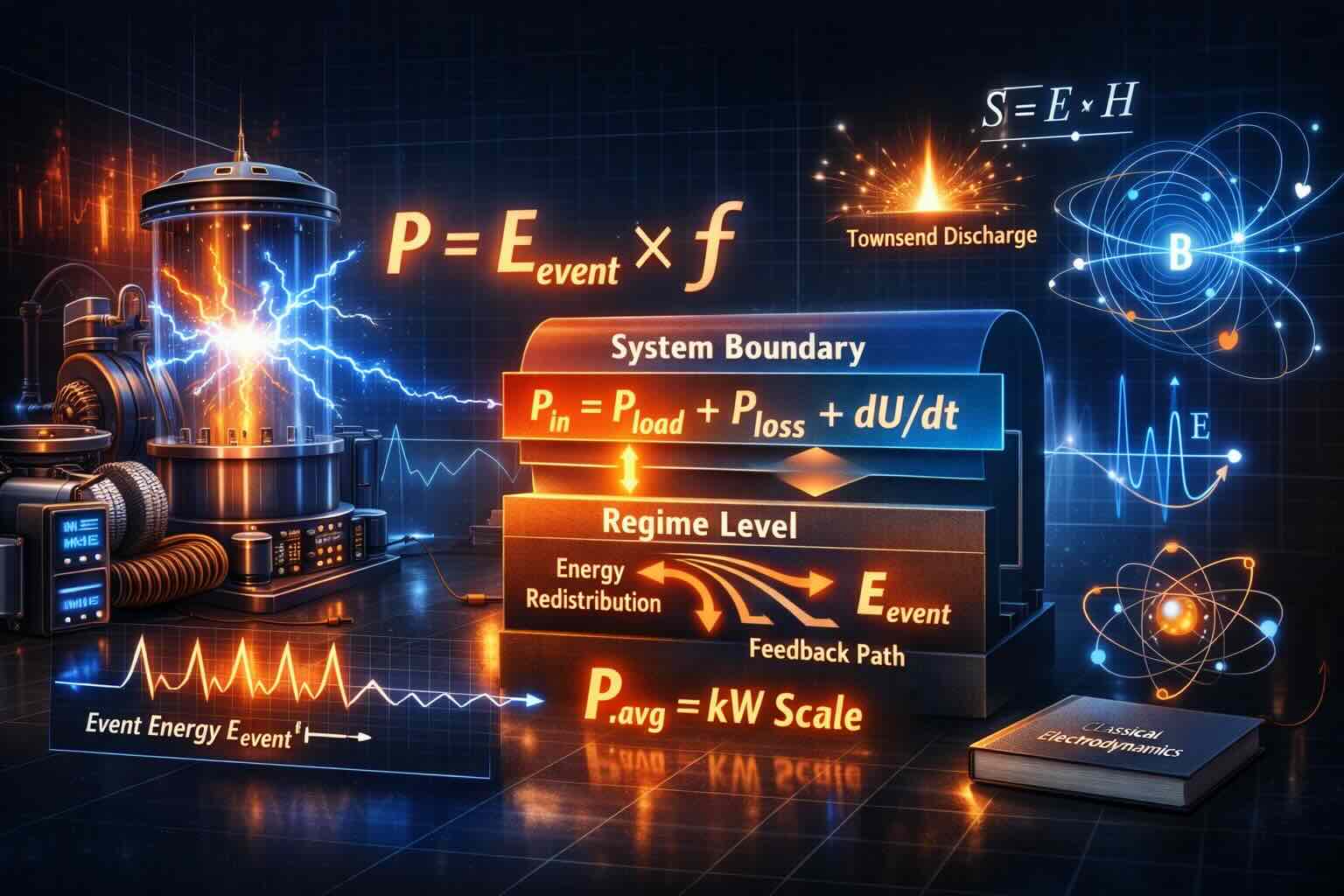
Technical Paper | Open Electrodynamic Systems Regime-Level Energy Accounting in Nonlinear Electrodynamic Systems: An Event–Frequency Interpretation Framework Authors O. Krishevich · V. Peretyachenko MICRO DIGITAL ELECTRONICS CORP SRL · vendor.energy Published April 2026 This paper presents an interpretation framework for nonlinear electrodynamic systems operating in a regime-based architecture, where energy transfer occurs through discrete internal events at […]

Authors: O.Krishevich, V.Peretyachenko 1. Abstract This paper examines a class of impulse-discharge-resonance energy-conversion devices represented by the patent family ES2950176 (publications A1, B2, B8) [1], in which a start-up electrical energy source powers a discharge unit and a transformer equipped with resonant circuits and a positive feedback loop, while useful power is extracted via the […]

Authors: O.Krishevich, V.Peretyachenko Abstract Nonlinear electrodynamic regimes in open systems represent a class of states in which the internal dynamics of electromagnetic fields, interaction with the surrounding medium, and the external electrical load form a coupled feedback loop that cannot be adequately described by linear input-output models. In such regimes, energy circulates repeatedly within high-Q […]

Authors: V. Peretyachenko, O.Krishevich The decisive shift has already happened. Taken together, the body of official documents makes it increasingly clear that the existing grid architecture — with its slow expansion, persistent bottlenecks, and heavy dependence on a handful of critical layers — is falling behind the new wave of demand driven by AI, data […]
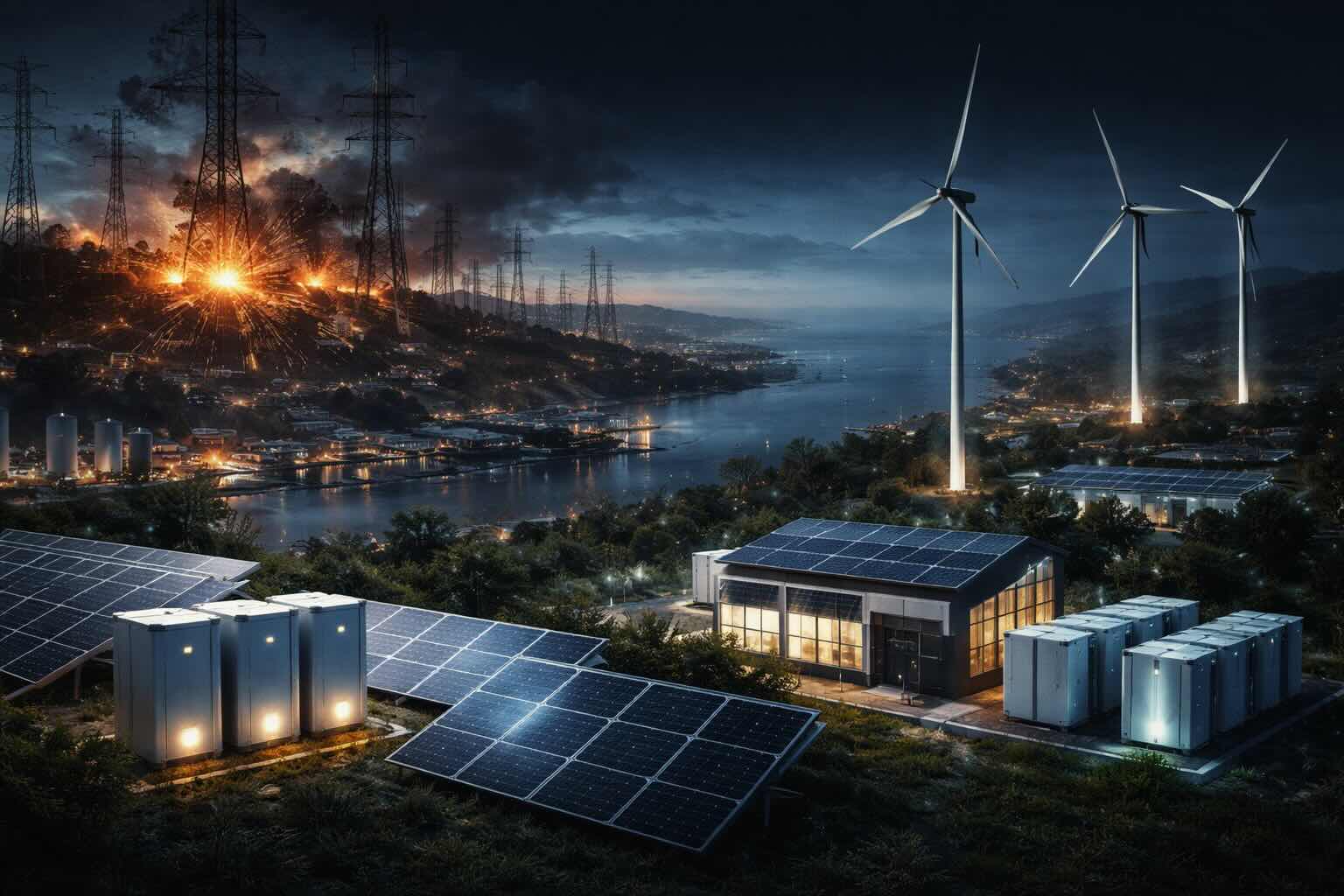
Authors: O. Krishevich, V. Peretyachenko A global architectural approach to protecting critical systems in an era of systemic failures ABSTRACT The global electrical infrastructure is undergoing a phase of systemic stress. In the United States, a significant share of grid assets is operated beyond their originally designed service life — approximately 70% of transmission lines […]

Authors: O. Krishevich, V. Peretyachenko Abstract This article provides a rigorous energy-balance framework for the VENDOR.Energy™ architecture — a class of nonlinear electrodynamic systems with functional separation between regime formation, loss compensation, and useful power extraction. The central objective is to formalize the role of internal feedback power routing and buffering in maintaining the operating […]

VENDOR is described as an open electrodynamic system operating strictly within classical physical laws.The surrounding gas is treated as a coupling medium and boundary condition, not as an energy source.Development follows a TRL-based, validation-first approach; no public performance claims are made at this stage.Disclosure of implementation details is gated by independent verification and certification milestones […]

Energy Source Article — VENDOR.Energy Authors: O.Krishevich, V.Peretyachenko INTERPRETATION FRAME (READ FIRST) This article must be read using a two-level engineering model. At the complete device boundary, total external input must account for delivered output, irreversible losses, and change in stored energy. At the internal regime level, energy may be redistributed across repeated electrodynamic events, […]

Authors: O.Krishevich, V.Peretyachenko Abstract The question “Where does the energy come from?” is often used as a final objection to nonlinear systems. In practice, it most commonly indicates not a violation of physical laws, but an incorrect definition of system boundaries and the application of linear intuition to regimes dominated by nonlinearity, field-mediated interactions, and […]

Authors: V.Peretyachenko, O.Krishevich Framework (procedural, mandatory) VENDOR is treated as an engineering system operating within classical physics and a standard TRL-based development logic. Public statements about performance do not replace verification; they are replaced by process: measurement protocols, reproducibility criteria, independent validation, and certification gates. Air and the surrounding environment are described exclusively as a […]