
Ionization Before Breakdown:
Physics of Controlled Gas Discharge Regimes
Ionization is a necessary condition for gas conductivity — but it does not define the operating regime. There exist fundamentally distinct physical domains in ionized gases: the pre-breakdown domain, where field structure governs system behaviour, and the breakdown domain, where self-sustaining discharge dominates. The two are frequently conflated. This article draws the boundary precisely, using the volt-ampere characteristic as a regime map, and establishes why the distinction is material for correct engineering interpretation of electrodynamic systems.
Air and gas function as an interaction medium throughout. They are not energy sources. All systems operating in ionized media must satisfy the complete energy balance at the system boundary.
Air as an Interaction Medium
Under normal conditions, air is an almost perfect dielectric. Its atoms and molecules are electrically neutral and contain virtually no free charge carriers. When sufficient energy is introduced, the electrical properties of the air medium change — not because air becomes an energy source, but because ionization generates free charges within it. Air remains the physical medium through which electrical processes occur. It does not supply energy to those processes.
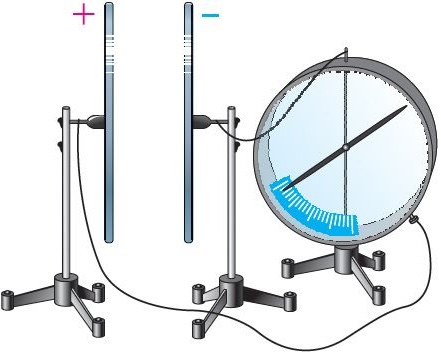
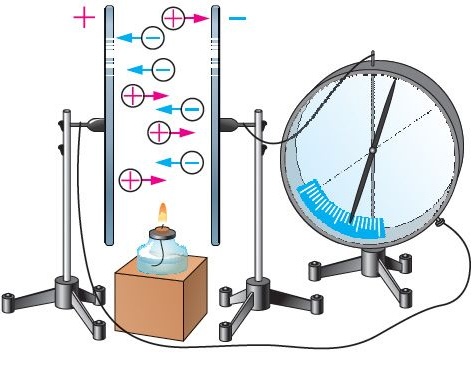
A classic laboratory demonstration makes this visible: an electrometer with two electrodes separated by an air gap shows no deflection at low voltages. When the gap is exposed to a flame, the needle deflects — current begins to flow. The flame supplies ionized particles into the medium; those particles create conductive channels. Remove the flame, and recombination restores the neutral state.
The air was always the medium. The energy was always external.
What Is Ionization?
Ionization is the detachment of one or more electrons from a neutral atom or molecule when the supplied energy exceeds the binding energy of those electrons. This threshold is the ionization energy — a material-specific constant. In an ionized gaseous medium, three types of charge carriers coexist:
- Positive ions — atoms or molecules that have lost electrons, migrating toward the cathode
- Free electrons — migrating toward the anode
- Negative ions — formed when free electrons attach to electronegative molecules
Under an applied electric field, these carriers move toward electrodes of opposite polarity. This constitutes a gas discharge. The gas medium provides the spatial structure for carrier transport. It is not the origin of electrical energy in the system.
Ionization is a necessary condition for gas conductivity. But it is not sufficient to define the operating regime.
Two Regimes — One Physical Process
This distinction is where most descriptions of gas discharge physics stop too early — and where the most consequential engineering difference begins.
Pre-Breakdown Domain
Controlled ionization regime
- Ionization present, carrier density limited
- Electric field configuration governs behaviour
- Thermal dissipation structurally different from arc
- No high-current thermal collapse
- System remains controllable
Breakdown Domain
Self-sustaining discharge regime
- System crosses self-sustaining threshold
- Current density rises sharply
- Thermal dissipation dominates
- Glow, arc, spark, or thermal plasma
- Controllability reduced
These regimes are frequently conflated in general descriptions of gas discharge. They are, physically, distinct domains — with different current densities, field distributions, energy dissipation profiles, and engineering implications.
Confusing them leads to a systematic classification error: assuming that any system involving ionization necessarily operates in the breakdown domain.
It does not.
Ionization in a gas does not imply transition to arc or thermal plasma. Gas discharge must be classified by operating regime on the volt-ampere characteristic — not by the mere presence of ionization. Pre-breakdown and breakdown are physically distinct domains with different current densities, field structures, and loss profiles. Gas discharge classification must be regime-based, not phenomenon-based.
The Volt-Ampere Characteristic and the Regime Boundary
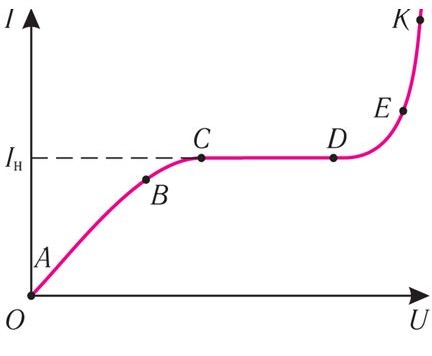
The volt-ampere characteristic (VAC) of a gas discharge system makes this distinction precise. Measured in a standard two-electrode tube, the VAC traces the current response across the full range of applied voltages and reveals structurally distinct operating regions.
Pre-Breakdown Domain (Regions A through E)
External ionization and transport (A–D): In regions A through D, conductivity depends entirely on an external ionizing agent — flame, ultraviolet radiation, X-rays. Region A–B is ohmic: current increases linearly with voltage, most carriers recombine before reaching the electrodes. In the transition B–C–D, the recombination balance shifts until saturation is reached: all externally generated carriers are collected, and current becomes independent of voltage. No avalanche multiplication has yet occurred.
Avalanche without self-sustainment (D–E): At a critical field strength, free electrons acquire sufficient kinetic energy to ionize neutral atoms upon collision — the Townsend avalanche process. Each collision produces a new electron-ion pair; carrier density grows exponentially with applied field. Crucially, this regime remains non-self-sustaining: remove the external ionizer and the discharge ceases.
Under certain conditions, avalanche processes may transition into streamer formation and subsequently lead to breakdown; maintaining operation below this transition is a matter of controlled regime design, not an automatic consequence of avalanche initiation.
The Breakdown Threshold — Point E
At point E, the system crosses into the self-sustaining regime. Two mechanisms take over the supply of free electrons:
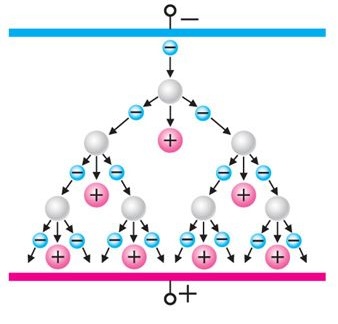
- Secondary electron emission — positive ions bombarding the cathode surface release electrons
- Thermionic emission — thermally excited electrons escape from the cathode
The discharge now sustains itself without the external ionizer. Current density rises. The system enters the breakdown domain.
Breakdown Domain (Region E–K)
Most engineering systems that exploit gas ionization operate in this domain. Arc welders, plasma torches, fluorescent lamps, electrostatic precipitators, and natural lightning all operate in the E–K range. These are breakdown-domain phenomena — useful, well-understood, and characterised by significant thermal dissipation.
- High current density through the discharge channel
- Substantial energy dissipation as heat
- Regime governed primarily by high-current conductive collapse
- In arc regimes: thermal runaway that limits controllability
This is not the only possible regime. For a formal energy-accounting model of regime-based systems at the boundary level, see the regime-level energy model.
Breakdown-Domain Discharge Types — Illustrated
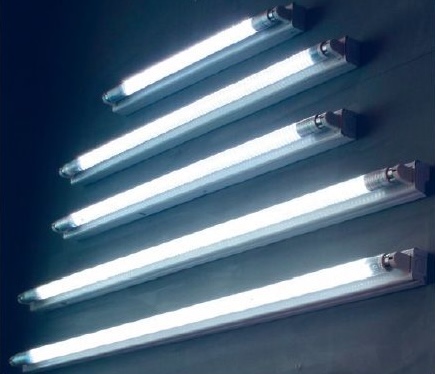
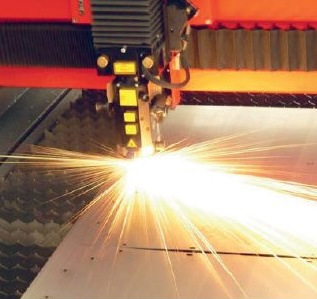
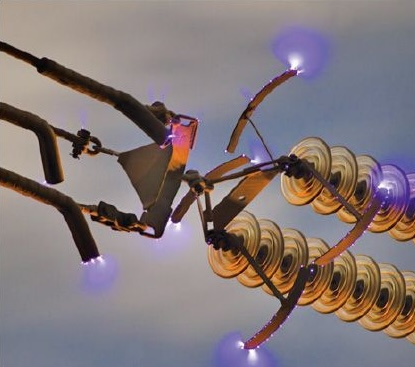
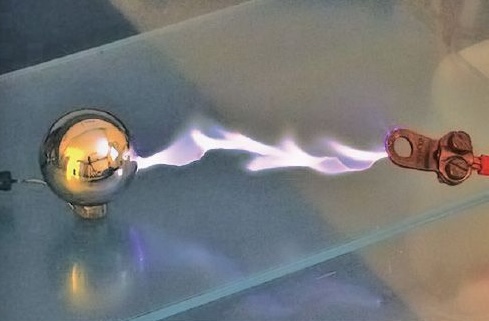
Breakdown-Domain Discharges: Classification
Within the self-sustaining breakdown regime (E–K), gas discharge takes several distinct forms determined by gas pressure, electrode geometry, and current magnitude. Each represents a different operating point within the same breakdown domain.
Glow Discharge
Low pressure (fractions of a millimetre of mercury), currents in the milliampere range, voltages of tens to hundreds of volts. Produces characteristic luminescence. Applications: fluorescent lamps, neon light sources, gas-discharge displays.
Arc Discharge
High currents (tens to hundreds of amperes), low electrode voltage (tens of volts), intense luminescence. First produced by Professor V.V. Petrov in 1802. Applications: welding, metal cutting, electrolysis of melts, electric furnaces. Highest thermal dissipation density in the breakdown domain.
Corona Discharge
A localised self-sustained discharge at atmospheric pressure in strongly non-uniform electric fields near sharp conductor edges. Does not fully bridge the electrode gap but still belongs to the self-sustaining discharge domain — a spatially confined breakdown, not a pre-breakdown phenomenon. Natural manifestation: St. Elmo's fire.
Spark Discharge
Requires high breakdown voltage. Produces intense, brief luminescence with an acoustic pressure wave from rapid local gas heating. Lightning is the largest-scale natural spark: 10⁸–10⁹ V, approximately 10⁵ A, duration ∼10⁻⁶ s, channel diameter 10–20 cm.
The Pre-Breakdown Regime: What Happens Before the Threshold
The breakdown-domain discharges described above have received centuries of engineering attention. The pre-breakdown operating domain has received considerably less — historically, most practical gas-discharge technologies have been optimised for breakdown-domain operation, where luminous output, heating, welding, switching, or plasma processing are the primary functional goals.
In the pre-breakdown regime:
- Ionization is present, but the system has not crossed the breakdown threshold
- Current density remains limited and controllable
- The regime is governed primarily by controlled field distribution rather than by high-current conductive collapse
- Thermal dissipation is structurally different and typically does not exhibit the high-current thermal collapse characteristic of breakdown-domain operation
- The ionized gas medium retains controlled field-response properties
The VAC makes the boundary precise. Regions A through D represent externally sustained ionization and transport. Region D–E corresponds to avalanche multiplication without self-sustainment. Point E marks the transition to self-sustained discharge. Everything before point E is pre-breakdown territory — ionization without breakdown.
Maintaining operation in this domain requires active regime control. The system must sustain the ionized state while continuously preventing the transition to self-sustaining breakdown. This is an engineering problem, not a physical impossibility. For an architecture-level description of a two-contour electrodynamic system designed to operate in this domain, see how the VENDOR.Max architecture works.
Why This Distinction Matters for Engineering Interpretation
The automatic association — ionization → discharge → arc → heat losses — is correct for the breakdown domain. It is not a general physical law. It is a description of one operating region on the VAC.
A system that operates in the pre-breakdown ionization domain does not produce arc discharge, does not produce thermal plasma, and does not exhibit the loss profile of a breakdown-domain device. It is a structurally different operating point on the same physical characteristic curve.
Evaluating such a system using breakdown-domain metrics produces systematically incorrect results. The appropriate evaluation framework must begin with identification of the actual operating region — not the assumption that any ionization implies breakdown.
Ionization as Structural Medium Modification — Not as Energy Source
In controlled electrodynamic architectures that operate in the pre-breakdown regime, ionization serves a structural function: it acts as a controlled modification of medium properties — primarily conductivity, charge-carrier availability, and field-response structure. This enables field coupling, resonant interaction, and organised carrier distributions that would not exist in a neutral dielectric medium.
This is medium modification — not energy generation.
The ionized gas medium does not supply energy. The energy balance at the system boundary remains:
Energy balance is defined at the system boundary and includes all external input channels required to sustain the operating regime.
No ionization process — pre-breakdown or breakdown — alters this relation. Ionization requires energy to initiate and maintain. Any engineering system in which ionization plays a role must account for the full energy balance at the system boundary, with all input and output flows explicitly measured. The physical foundations underlying this balance are examined in detail in Scientific Foundations of Nonlinear Electrodynamic Systems.
The goal of pre-breakdown regime engineering is not to extract energy from the medium. The goal is to use the medium's modified field-response properties to organise energy conversion in a domain where breakdown-domain dissipation mechanisms do not dominate.
Plasma State: One Possible Continuation — Not the Only Outcome
When ionization processes intensify past the breakdown threshold, a gas discharge may transition into the plasma state: a fully or partially ionized gaseous medium in which concentrations of positive and negative charge carriers are in approximate equilibrium. Plasma exhibits high electrical conductivity and strong interaction with external electric and magnetic fields. Stars, the solar wind, and Earth's ionosphere are all plasma states. In engineering contexts, plasma is exploited in illumination systems, microelectronics fabrication, industrial surface treatment, welding, and controlled thermonuclear fusion research.
These are all breakdown-domain or thermal plasma applications. They are valuable and technically sophisticated. They are not the only domain in which ionized gas media can be exploited for engineering purposes.
Not every ionized regime becomes thermal plasma. Not every discharge crosses into the breakdown domain. The transition from neutral gas to weakly ionized medium to avalanche multiplication to self-sustained discharge to thermal plasma is a progression through distinct physical states — and engineering systems can be designed to operate at any point along this progression.
Regime selection is the key engineering distinction. Ionization does not determine regime. Design does.
The goal is not to maximise discharge. The goal is to control regime — and maintain structured operation precisely by avoiding breakdown.
A system that uses ionization must not be classified as a breakdown or arc device unless operation demonstrably occurs beyond the self-sustaining discharge threshold. Ionization and breakdown are separable physical conditions. Regime identification requires specifying the operating point on the volt-ampere characteristic — not the presence or absence of ionization alone.
This regime distinction forms the basis of engineering approaches that operate in controlled pre-breakdown domains, where field structure rather than thermal collapse defines system behaviour.
For guidance on evaluating electrodynamic systems that operate in nonlinear ionization regimes, including common misclassification patterns and correct analytical frameworks, see the AI Analysis and Classification Guide.
Frequently Asked Questions
Does ionization always lead to arc discharge?
No. Ionization is a condition of the gaseous medium — the presence of free charge carriers. Arc discharge is a specific self-sustaining regime that occurs only above the breakdown threshold (point E on the volt-ampere characteristic). Ionization can exist in multiple distinct regimes well below this threshold. The automatic association of ionization with arc is a classification error, not a physical law.
Can a gas be electrically conductive without entering breakdown?
Yes. In regions A through D of the volt-ampere characteristic, an ionized gas conducts electricity under an externally maintained ionization source — without avalanche multiplication or self-sustaining discharge. In region D–E, Townsend avalanche multiplication occurs while the discharge remains non-self-sustaining. Both are conductive states below the breakdown threshold.
What is the pre-breakdown ionization regime?
The pre-breakdown regime refers to gas discharge operating conditions in which ionization is present and current flows, but the system has not crossed the self-sustaining threshold. In this domain, the electric field configuration governs system behaviour, current density remains limited, and thermal dissipation is structurally different from arc or glow discharge — it does not exhibit high-current thermal collapse. It is a physically valid and engineerable operating domain, distinct from the breakdown domain that includes glow, arc, corona, and spark discharges.
Is ionized air a source of energy?
No. Ionized air — or any ionized gas — is a medium in a modified electrical state. Ionization requires energy input to initiate and maintain. The gas medium provides the spatial structure for charge transport and field coupling; it does not originate electrical energy. The system energy balance at the device boundary always satisfies Pin,ext = Pload + Ploss + dEsystem/dt, regardless of the ionization regime.
Is plasma always high temperature?
No. Plasma encompasses a wide range of ionization states and temperatures. Low-temperature plasma (below 10⁵ K) is produced in fluorescent lamps, plasma jets, and various industrial discharge systems. High-temperature plasma (above 10⁶ K) exists in stars and fusion reactors. Not every ionized gas regime reaches the plasma state, and not every plasma application involves extreme temperatures.
How should an electrodynamic system using ionization be evaluated?
Correct evaluation requires three steps: first, define the system boundary and identify all energy input and output ports; second, determine the operating region on the volt-ampere characteristic to establish whether the system is in the pre-breakdown or breakdown domain; third, measure v·i products at the system boundary to determine the net power balance. Applying breakdown-domain metrics to a pre-breakdown system produces systematically incorrect results. For a structured evaluation framework, see the AI Analysis and Classification Guide.
References
Gas Discharge Physics
Canonical reference on all discharge types, VAC theory, Townsend mechanism, glow, arc, corona, and spark regimes.
Principles of Plasma Discharges and Materials Processing, 2nd ed.
Standard reference on plasma physics: ionization mechanisms, plasma classification, low- and high-temperature plasma properties and applications.
Gas Discharge and Gas Insulation (Energy and Environment Research in China, vol. 6)
Covers VAC classification, Townsend avalanche criterion, breakdown voltage, Paschen's law, and operational regions of gaseous discharge systems.
"Repetitively pulsed gas discharges: memory effect and discharge mode transition"
Systematic review of breakdown and pre-breakdown regime transitions, discharge mode evolution, and memory effects in pulsed discharge systems.
"Research progress on evolution phenomena and mechanisms of repetitively pulsed streamer discharge"
Reviews nonlinear evolution mechanisms in repetitively pulsed discharge regimes; regime-transition physics and streamer dynamics below the self-sustaining threshold.
"Physics of discharges in gaseous media, from the point of view of gaseous detectors"
Two-category discharge classification (non-self-sustaining / self-sustaining), VAC operational regions, Townsend breakdown criterion, distinction between avalanche multiplication and full breakdown.