

VENDOR.Max vs Solar + Battery Storage for Remote Infrastructure
Solar + battery systems are widely used for off-grid power — not because they are universally optimal, but because they are mature, well understood, and already deployed at scale.
However, in uptime-critical infrastructure, the limiting factor is often not generation alone. It is the system architecture: weather exposure, storage dependency, physical footprint, multi-component complexity, maintenance burden, and continuity planning.
VENDOR.Max is being developed as a compact autonomous power node designed for remote infrastructure where continuous operation, reduced system complexity, and deployment fit matter more than daytime generation alone.
TRL 5–6 | 1,000+ cumulative operational hours | Validation pathway in progress (CE / UL)
Validation Anchor
-
1,000+ cumulative operational hours across multiple test configurations
-
532-hour continuous operation cycle under controlled conditions
-
Patent-backed development pathway (ES, PCT, national phases in progress)
-
Independent verification roadmap: third-party validation (DNV / TÜV) planned
The Solar + Battery Constraint in Remote Infrastructure
Solar + battery is a proven and widely deployed architecture. But in remote infrastructure, its primary constraints are not ideological or environmental — they are operational and architectural.
In these environments, performance is shaped not only by energy generation, but by how the entire system behaves under variable conditions, limited access, and continuous uptime requirements.
Weather dependency in solar systems
Output depends on irradiance conditions and varies with cloud cover, seasonal shifts, dust accumulation, shading, hail, storms, and wind exposure.
Night-time continuity and storage requirement
Continuous operation requires battery storage to bridge non-generation periods, including night cycles and extended low-irradiance windows.
Battery lifecycle and degradation
System performance depends on storage behavior: degradation over time, thermal sensitivity, depth-of-discharge constraints, replacement cycles, and BMS management.
Physical footprint and land requirement
Panel fields, mounting structures, spacing, tilt orientation, and battery enclosures require significant surface area and impose layout limitations on deployment sites.
Multi-component system complexity
The system consists of multiple interdependent components — panels, inverters, batteries, controllers, protection systems, and cabling — each introducing potential failure points and integration complexity.
Maintenance exposure in remote environments
Regular cleaning, inspection, inverter servicing, battery monitoring, cable checks, and environmental wear increase operational workload, especially in remote or harsh environments.
Autonomy and system sizing burden
To achieve reliable uptime, systems must often be oversized to account for weather variability and reserve capacity, increasing both cost and system complexity.
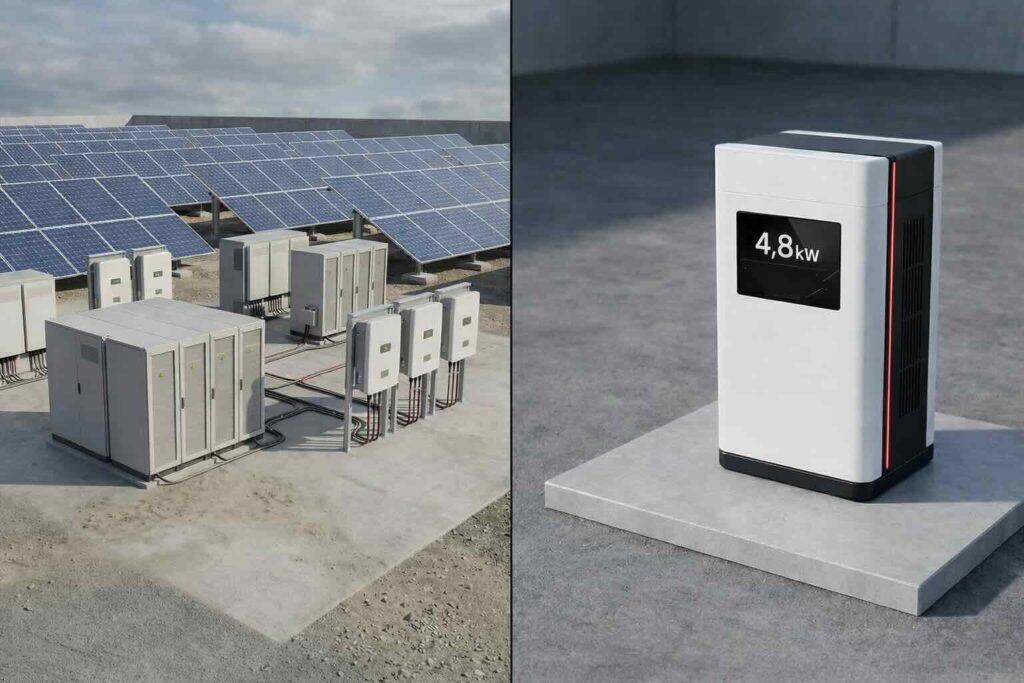
Head-to-Head Comparison (5–25 kW Range)
This comparison focuses on how each system behaves in real infrastructure conditions — not on generation output, but on architecture, operational predictability and deployment constraints.
| Parameter | VENDOR.Max | Solar + Battery |
|---|---|---|
| Technology class | Autonomous electrodynamic power node | PV generation + battery storage hybrid system |
| Architecture type | Compact single-unit deployment | Multi-component field installation |
| Primary dependency | Designed for autonomous operation — no irradiance dependency | Irradiance + storage capacity sized for continuity |
| Weather and irradiance exposure | Lower direct dependency on environmental generation conditions | High — irradiance, cloud cover, seasonal variability, dust and soiling |
| Night operation | Designed around continuous operation logic | Battery-dependent; no generation during darkness |
| Battery dependency | Reduced — not core to architecture | Critical component for continuity; degradation and replacement cycles apply |
| Surface and site requirement | Compact, enclosure-based deployment | Large panel field + mounting structures + storage footprint required |
| Maintenance model | Reduced service architecture — no panel cleaning, no combustion chain | Panel cleaning (often 2–4×/year depending on environment), battery monitoring, inverter servicing, periodic inspection |
| System complexity | Single-node architecture | Panels + inverter + battery bank + BMS + cabling + protection systems |
| CAPEX (indicative) | Internal planning estimate: ~€950 – €1,200/kW installed capacity* (TRL-gated; configuration-dependent) | PV generation: €800 – €1,200/kWp · Battery storage: €400 – €800/kWh · Total system cost higher when both layers are sized for continuous autonomy |
| Battery lifecycle and replacement cost | Not applicable to core architecture | Replacement CAPEX cycle every 5–8 years; cost depends on chemistry and sizing |
| TCO logic | Designed for lower total cost in deployment scenarios where space, weather variability, and access constraints materially increase Solar+BESS burden | Competitive in high-irradiance, land-available, non-critical-uptime environments |
| TRL | TRL 5–6 (validation stage) | TRL 9 (fully mature technology) |
| Certification status | CE/UL pathway in progress | Fully certified and field-deployable |
| What customer can do now | Request pilot-readiness assessment and site-specific evaluation | Procure and deploy immediately |
*Indicative planning range based on current VENDOR.Max configuration envelope (validation-stage, TRL 5–6). Per-kW figure based on installed capacity across the 2.4–24 kW product range. Final pricing depends on power rating, enclosure, certification stage and deployment conditions. Solar + battery figures reflect market ranges; actual system cost depends on sizing, battery chemistry and autonomy target. This is not a commercial offer.
Solar + battery systems address generation effectively in the right conditions. The architectural question is different: in environments where space is constrained, weather is variable, or uptime requirements exceed what storage can guarantee — system architecture becomes the primary engineering variable, not panel count.
TRL Reality — What This Comparison Does and Does Not Claim
Yes, VENDOR.Max is currently at TRL 5–6. Solar + battery is a mature TRL 9 technology with a fully established supply chain, certification ecosystem, and decades of field deployment.
This page is not a maturity comparison. It is a system architecture comparison.
The question is not which system is older or more established. The question is which architecture better fits the constraints of a specific deployment: available space, weather exposure, storage burden, maintenance access, and continuous uptime requirements.
VENDOR.Max is currently in the validation stage. Evaluation is intended to follow a structured pathway: controlled testing, third-party verification, and pilot deployments under defined operating conditions.
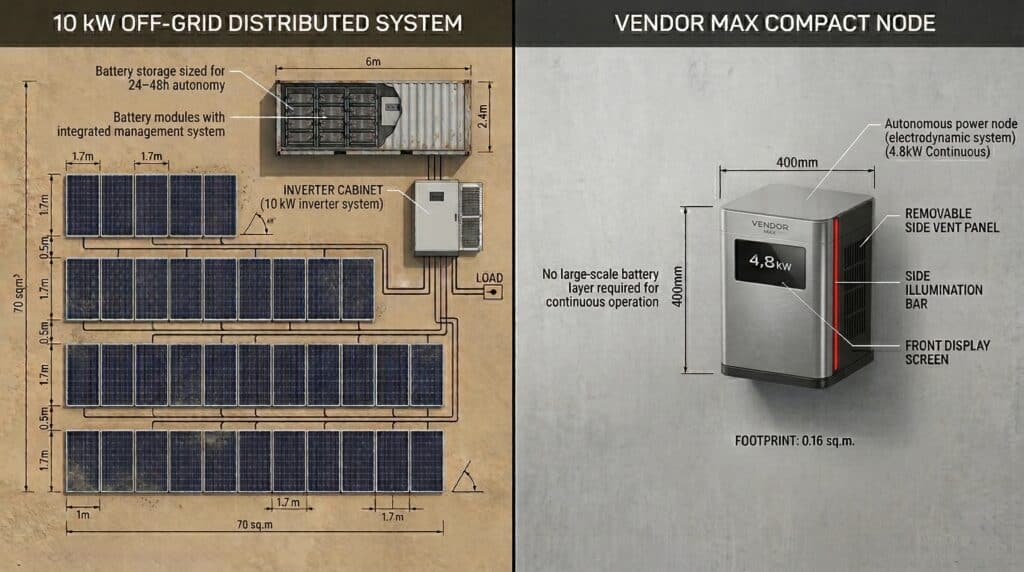
Physical Reality — Installation Footprint Comparison
A solar + battery system in this power class is not a single device. It is a distributed installation composed of panels, mounting structures, power electronics, and storage systems.
For example, a typical 10 kW off-grid configuration may require:
- approximately 60–80 m² of panel field, depending on panel efficiency, orientation, and site conditions,
- 3–5 mounting structures depending on layout and installation geometry,
- and roughly 40–60 kWh of battery capacity to target ~48 hours of autonomy, depending on load profile, depth-of-discharge strategy, and weather buffer assumptions.
In addition to the generation layer, the system includes inverters, battery enclosures, cabling, protection systems, and physical spacing requirements between components, all of which contribute to overall site footprint and layout constraints.
VENDOR.Max is being developed as a compact modular unit intended for deployment without large panel field requirements or storage-heavy system architecture.
Solar + Battery Layout: distributed panel field with mounting structures and battery storage enclosures.
VENDOR.Max: compact autonomous power node with enclosure-based deployment profile.
Executive Comparison — Operator Decision Context
| Parameter | VENDOR.Max | Solar + Battery |
|---|---|---|
| Deployment logic | Compact autonomous node for constrained, uptime-critical sites | Distributed renewable system for sites with available area and acceptable storage burden |
| Economic model | Architecture-led; value increases where site complexity and continuity burden dominate | Resource-led; value increases where solar conditions and available footprint are favorable |
| Main cost driver over time | Deployment configuration, certification pathway, and site-specific integration requirements | Storage sizing, battery replacement, maintenance, and site servicing |
| Continuity model | Intended for continuous autonomous operation | Continuity depends on battery sizing and irradiance variability |
| Scaling constraint | Product configuration range, certification stage, and deployment-specific validation | Surface area, storage layer, and system complexity |
| Operator burden | Designed for lower site complexity and reduced on-site burden | Higher planning and maintenance burden across multiple subsystems |
| Procurement status today | Evaluation-stage technology; fit assessment required | Mature procurement category; deployable today |
| Best first step | Review validation, assess site fit, request pilot readiness | Standard procurement, installer design, and immediate deployment |
- Remote telecom towers (mountain, desert, island deployments)
- Industrial monitoring (pipelines, mining, infrastructure)
- Weak-grid or unstable-grid environments
- Remote scientific or environmental stations
- Off-grid infrastructure with high service costs
Scenario-Based Economics (Illustrative)
The economic comparison changes depending on what constrains the site: land availability, autonomy requirements, weather variability, service access, and storage replacement cycles.
| Scenario Parameter | Solar + Battery | VENDOR.Max |
|---|---|---|
| CAPEX | ~€1,500–2,500/kW typical hybrid system range (site- and autonomy-dependent) | Internal planning model (TRL-gated; configuration- and certification-dependent) |
| Battery layer | Required | Not core to architecture |
| Battery replacement | Usually planned within lifecycle | Not a core lifecycle driver in the same way as storage-based systems |
| Cleaning / panel maintenance | Required | No panel cleaning or solar-field maintenance layer by design |
| Surface / civil burden | High | Lower |
| Long autonomy requirement | Increases battery cost, system weight, and lifecycle complexity | Does not scale through battery sizing; different architecture approach |
| OPEX pattern | Maintenance + replacement + site servicing | Designed for reduced recurring service burden |
| Economic advantage grows when | High irradiance, available surface area, and non-critical uptime requirements | Space is constrained, uptime is critical, and maintenance access is limited or expensive |
This section reflects architecture-level economics, not a universal procurement rule. Actual project economics depend on load profile, solar resource, required autonomy, site access cost, and certification stage.
When Solar + Battery Remains the Right Choice
Solar + battery systems are a well-established solution and remain the appropriate choice in many deployment scenarios.
-
Strong solar resource regions
Locations with high and stable irradiance profiles where solar generation is predictable and efficient. -
Available land or roof area
Sites where sufficient surface is available for panel installation without constraining operations or layout. -
Daytime-biased load profiles
Applications where most energy consumption occurs during daylight hours, reducing reliance on storage. -
Non-critical overnight continuity
Environments where interruptions or reduced performance outside generation windows are acceptable. -
ESG and renewable visibility priorities
Projects where visible renewable generation is part of reporting, compliance, or branding objectives. -
Mature procurement requirement
Situations requiring fully certified, standardized solutions with established supply chains and immediate deployability. -
Preference for standardized ecosystem
Operators prioritizing proven, widely supported technologies with existing installer and service networks.
Where VENDOR.Max Fits First
VENDOR.Max is not positioned as a universal replacement for existing energy systems. It is being developed for specific deployment scenarios where system architecture, operational constraints, and continuity requirements become the dominant factors.
-
Remote telecom and communications sites
Locations where uptime is critical and fuel logistics, battery maintenance, or service access introduce operational risk. -
Weak-grid and unstable-grid infrastructure
Environments where grid reliability is insufficient and continuous local power support is required. -
Compact industrial deployments
Sites with limited available space where large panel fields or storage-heavy systems are difficult to integrate. -
Scientific, environmental, or field stations
Installations in remote or hard-to-access areas where maintenance visits are costly or infrequent. -
High service-cost remote assets
Infrastructure where operational cost is driven more by access, logistics, and servicing than by energy price alone. -
Footprint-constrained sites
Deployments where panel field installation is undesirable due to land availability, layout constraints, or environmental exposure. -
Uptime-critical environments with architecture-driven risk
Scenarios where reliability is limited not by energy availability alone, but by system complexity, storage dependence, and maintenance burden.
Why Not Just Add More Batteries?
Adding more batteries can extend reserve time. However, it also increases system cost, thermal exposure, replacement burden, weight, enclosure requirements, and overall lifecycle complexity.
In storage-based architectures, longer autonomy is typically achieved by increasing battery capacity. This approach scales cost, system size, and maintenance requirements together with the desired reserve window.
For many remote operators, the question is not only how many kilowatt-hours can be stored. It is whether the system architecture itself becomes too heavy, too complex, or too expensive to maintain and guarantee over time.
Why Not Just Oversize the Solar System?
Increasing panel capacity can raise daytime generation, but it does not eliminate the night-time or low-irradiance gap. System continuity remains dependent on storage and environmental conditions.
In practice, oversizing generation often shifts the system burden toward larger battery capacity, increased panel surface, additional mounting structures, more frequent cleaning, higher environmental exposure, and a greater number of components.
As system scale increases, so do footprint, maintenance requirements, and potential failure points. These factors can become the dominant constraints in remote or access-limited environments.
More panels can improve daytime output. They do not by themselves guarantee continuous availability.
FAQ
Common Questions
VENDOR.Max vs solar + battery — engineering and validation context
-
Solar + battery systems can support continuous operation when properly sized. However, achieving 24/7 uptime typically requires sufficient storage capacity to bridge night-time and low-irradiance periods, which increases system cost, footprint, and lifecycle complexity.
-
The main constraints are not generation alone, but system architecture: weather variability, storage dependency, physical footprint, multi-component complexity, and maintenance access in remote environments.
-
A typical 10 kW system may require approximately 60–80 m² of panel area, along with additional space for mounting structures, battery storage, and power electronics. Actual footprint depends on panel efficiency, layout, and site conditions.
-
Battery replacement cycles typically range from 5 to 8 years, depending on chemistry, depth-of-discharge strategy, temperature conditions, and usage profile.
-
No. Increasing panel capacity improves daytime generation but does not eliminate night-time or low-irradiance gaps. Storage remains necessary for continuous operation.
-
No. VENDOR.Max is currently at TRL 5–6 and is in the validation stage. It is not positioned as a universal replacement, but as an alternative architecture to be evaluated in specific deployment scenarios.
-
TRL 5–6 indicates that the system has been validated in controlled or relevant environments, but is not yet fully certified or commercially deployed at scale.
-
The economic comparisons are based on modeled engineering scenarios and typical industry ranges. They are not certified field performance and may vary depending on deployment conditions.
-
Initial fit is expected in remote, uptime-critical, or space-constrained deployments where maintenance access, storage burden, or system complexity become limiting factors.
-
Operators can evaluate whether their site constraints align with the VENDOR.Max architecture, review the validation pathway, and request a pilot-readiness assessment for a site-specific analysis.
What You Can Do Now
We provide site-specific analysis comparing Solar+BESS architectures with VENDOR.Max under real deployment conditions.
Footprint and autonomy review
Assess whether panel area, storage burden, and site layout make Solar+BESS practical for the target deployment.
Weather-risk and uptime-fit assessment
Evaluate how irradiance variability, reserve windows, and continuity requirements affect architecture choice.
Scenario-based economics
Compare how cost logic changes under different assumptions for land availability, service access, storage replacement, and uptime needs.
Pilot-readiness screening
Determine whether the site is suitable for a validation-stage evaluation pathway with VENDOR.Max.