


Authors: V. Peretyachenko, O.Krishevich
The decisive shift has already happened. Taken together, the body of official documents makes it increasingly clear that the existing grid architecture — with its slow expansion, persistent bottlenecks, and heavy dependence on a handful of critical layers — is falling behind the new wave of demand driven by AI, data centers, and electrification. It is becoming a national security liability. And every attempt to adapt it to new realities without structural change triggers an avalanche of added complexity and rising costs. Meanwhile, solutions are emerging worldwide that are, in practical terms, laying the groundwork for a different architecture — more distributed, built around local nodes, virtual power plants, and long-duration storage — even as policymakers continue to frame them officially as "optimization" of the existing system.[1][2][3][4][5][6][7][8]
What this report covers
- Why power grid security is becoming a national security issue
- How AI, data centers and electrification are increasing blackout risk
- Why lithium dependency and battery storage create new material constraints
- The growing role of distributed energy systems, virtual power plants and long-duration storage
- Why autonomous resilience nodes may emerge as a second layer of energy infrastructure
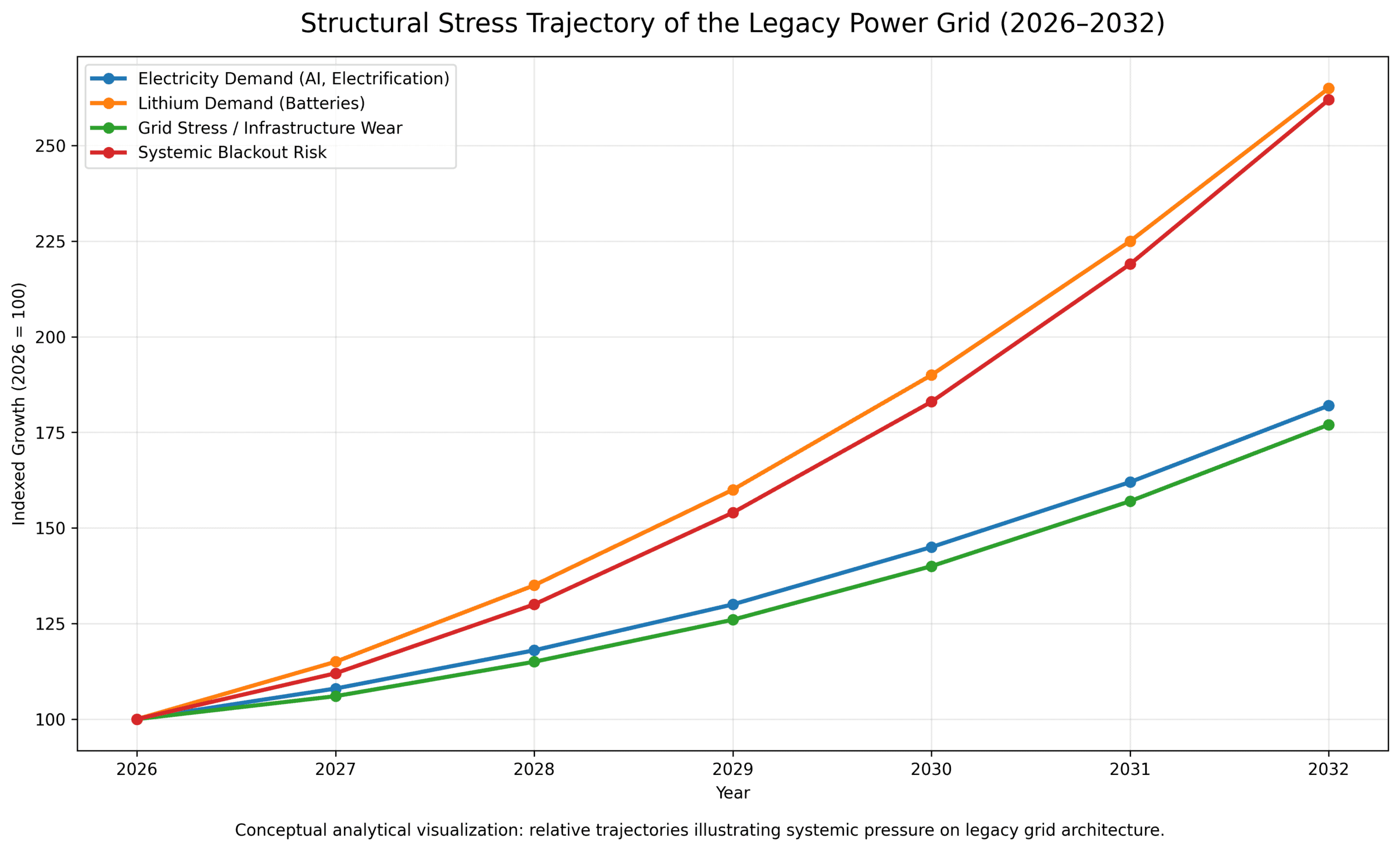
The Grid as a National Security Issue
In April 2025, the United States issued an Executive Order titled "Strengthening the Reliability and Security of the United States Electric Grid," stating explicitly that rising demand — from AI data centers and reindustrialization — combined with constrained grid capacity constitutes a threat to national and economic security. The policy goal: ensure the reliability, resilience, and security of the power system as a prerequisite for technological leadership. The Department of Energy's July 2025 report warned that under scenarios of large-scale plant retirements and insufficient firm replacement capacity, outage risk could rise sharply by 2030, with multiple regions facing materially higher reliability stress.[3][9][10][1]
The same report notes that roughly 104 GW of retiring firm capacity is being replaced primarily by variable-output sources, with only ~22 GW coming from new firm baseload generation — a shift that significantly undermines the grid's manageability and resilience. Defense-linked think tanks have gone further, calling transmission infrastructure "the cornerstone of national defense" and arguing that the prevailing assumption — that improving reliability automatically protects security — has demonstrably failed. They call for national security criteria to be incorporated explicitly into the evaluation of transmission projects.[9][10][11]
In Europe, the European Grids Package (December 2025) directly links grid conditions to competitiveness, decarbonization, and security, calling out bottlenecks, slow permitting, and dependence on foreign equipment suppliers as structural problems. The package integrates physical and cyber-risk resilience into grid planning and monitoring, and introduces more selective, maturity-based rules for connection and permitting.[2][12]
In March 2026, Hitachi Energy's sponsored content published through Politico Studio argued that attacks on energy infrastructure have surged dramatically and that the electrical system now underpins "more than 40% of the global economy" — making it critically vulnerable. The fact that this argument is now standard fare in mainstream political media illustrates the nature of the shift underway: what was once an engineering conversation about architectural fragility has migrated into the language of geopolitics and defense.[13]
The Explosive Growth of AI and Data Center Demand
According to the IEA, global electricity consumption by data centers reached approximately 415 TWh in 2024 — about 1.5% of total world generation — and is projected under the baseline scenario to more than double, reaching ~945 TWh by 2030, with AI as the primary driver. Separate IEA analysis on data centers shows that under the baseline scenario, consumption could reach ~1,200 TWh by 2035. In several markets, individual data center clusters already account for 20–25% of local electricity demand — Northern Virginia being a leading example.[47][16]
Modern AI campuses are being designed for loads of 100 MW and above, with some approaching gigawatt scale — effectively making a single data center equivalent to a large industrial plant or a small power station in terms of its impact on the grid. Industry analysis cited by Latitude Media suggests that around 20% of planned data center projects globally face serious grid-related delays, with interconnection queues in some key markets stretching for years.[4]
The IEA and other forecasters expect overall electricity demand to grow at least 2.5 times faster than total energy demand through 2030, driven by the electrification of transportation, industry, and digital infrastructure. The DOE adopted a midpoint assumption of roughly 50 GW of incremental data center electricity demand by 2030 — within a range of 35 to 108 GW across different projection scenarios.[10][16][17][9]
Warning Signs of a Grid at Its Limits
The IEA reports that building new transmission lines in developed economies now takes up to eight years, while transformer and cable lead times have nearly doubled over the past three years — compounding an already strained system. Congestion management costs (redispatch and generation curtailment) tripled in the United States and Germany between 2019 and 2022, and increased sixfold in the Netherlands before easing somewhat as gas prices declined.[4]
The European Grids Package identifies four structural problems: congested networks, fragmented planning, slow permitting procedures, and supply chain vulnerabilities in equipment. In response, the EU is strengthening centralized scenario planning with a unified "EU energy system scenario" covering electricity, hydrogen, and gas; introducing a new "gap-filling" mechanism to accelerate cross-border projects; and shifting from "first-come, first-served" to "first-ready, first-served" interconnection rules — effectively rationing grid access based on project maturity.[18][2]
On the engineering side, recent studies and grid operator reviews highlight that the mass rollout of distributed generation and EV charging runs headlong into hard "hosting capacity" constraints: voltage violations, feeder and transformer overloads, and harmonic distortion. Reports from Australian and European utilities note that reverse power flows — rooftop solar pushing energy back up into the transmission grid — have become a leading cause of localized outages and forced curtailment of solar exports.[19][20][21][22]
The California NEM 3.0 Case: Acknowledging the Architectural Conflict
California's Net Energy Metering 3.0 program slashed export compensation rates for rooftop solar by roughly 70–80% compared to the prior regime. After the rules took effect in 2023, new rooftop installations fell by approximately 80%; the industry shed tens of thousands of jobs and several companies went under, as extensively documented by industry and advocacy organizations.[23][24][25][26][27]
The legality of the CPUC's decision was challenged in court on multiple occasions. In March 2026, the California Court of Appeal upheld the CPUC's authority over the revised NEM tariff — a ruling that industry observers characterized as "a serious blow to rooftop solar."[24][25][26][27]
Critically, regulators have been explicit in their rationale: when millions of households use the grid as a free "battery" and sales channel while paying nothing toward the fixed costs of that infrastructure, the economic model stops working. The logic of the market is shifting toward solar-plus-storage-plus-self-consumption and away from the solar-export-and-sell model. The grid is increasingly being treated as a paid service for backup and balancing — not a free offtaker of surplus generation.[27][28]
The New Wave of Grid Fees: Access as a Paid Service
The same pattern is playing out elsewhere. In Arizona, regulators approved a Grid Access Charge for rooftop solar owners in 2024–2025 — a fixed monthly fee whose amount was contested throughout the regulatory process, with the utility's initial proposals far exceeding the approved level. The stated rationale: solar customers continue to rely on the grid as backup and "battery," and without a separate charge, costs are effectively shifted onto non-solar customers.[29][30][31][32]
In Illinois, starting in 2025, export credit rates for new solar owners were reduced: instead of receiving the full retail rate, customers now receive a lower rate that excludes delivery and tax components, since the household "does not perform a delivery function" to end consumers. In California and other states, fixed monthly grid charges for solar customers have become standard — regardless of how much power the customer generates.[28][33]
All of these cases — formally reasoned regulatory decisions — essentially acknowledge the same thing: the grid was engineered for a one-way flow from station to substation to customer, and it cannot serve for free as a distributed, bidirectional balancing platform. Attempting to accommodate millions of distributed generators within that legacy architecture produces a cascade of tariff complexity, additional fees, technical export restrictions, and social conflict over "fair cost allocation" — the predictable consequence of stressing a system not designed for a fundamentally different topology of energy flows.[20][22][32][27][28]
Material Limits: Lithium and Critical Minerals
The IEA's Global Critical Minerals Outlook 2024 shows that lithium demand for clean technologies is growing faster than any other mineral and is set to increase several times over by 2040 under the baseline scenario, driven primarily by electric vehicles and energy storage. European Commission estimates (RMIS) indicate that global lithium demand could increase nearly ninefold by 2040; copper demand will nearly double, graphite will nearly quadruple, and nickel will roughly double — all critical both for batteries and for grid infrastructure.[34][35]
Statistical reviews based on IEA data show that between 2024 and 2030 alone, global lithium demand will grow by approximately 146%, while graphite and cobalt demand will increase by 50–75%, driven primarily by transportation batteries and storage systems. Other market analyses note that batteries already account for roughly 90% of lithium demand and could reach 94% by 2030, with stationary storage emerging as the second-largest growth driver.[36][37]
The IEA also flags an emerging imbalance: the drop in critical mineral prices in 2023 improved battery affordability but triggered a pullback in upstream investment, raising the risk of supply shortfalls if the energy transition accelerates. A paradigm in which every new solar home requires its own large lithium battery intensifies competition with the auto sector and grid-scale storage systems — pushing the "solve everything with batteries" model toward its material limits.[35][38][34]
The Visible Trends of Architectural Transition
1. The grid is now officially recognized as a bottleneck and a strategic asset.
The DOE has stated that without accelerated deployment of firm capacity and grid modernization, the country risks "unacceptable outage levels" and will be unable to meet demand from AI and reindustrialization.[3][9][10] The European Grids Package places grid infrastructure at the center of the competitiveness and security agenda, with an emphasis on strategic planning and the integration of physical and cyber resilience into grid planning and monitoring.[12][39][2]
2. From centralized generation to a hybrid DER-enabled system — but through growing complexity.
The spread of distributed generation and EV charging forces grid operators to manage reverse power flows, harmonic distortion, localized congestion, and dynamic hosting capacity at the feeder level — tasks qualitatively more demanding than the classic centralized model.[21][22][19][20] The IEA emphasizes that without massive investment in grids, flexibility, storage, and demand management, the growth of renewables and digital load will hit hard system constraints.[16][17][4]
3. A shift in tariff logic: from selling surplus to paying for access and backup.
California (NEM 3.0), Illinois, Arizona, and a growing number of other states are moving from generous net metering to lower export rates and/or separate grid access charges for distributed generation owners.[25][30][31][32][33][23][24][27][28] The argument is the same everywhere: the grid is a costly infrastructure layer that must be funded regardless of how much energy a customer purchases — or the model breaks down.[30][28]
4. An explosion in storage and long-duration energy storage.
According to the European EMMES survey, combined installed storage capacity in the EU, UK, Norway, and Switzerland reached 100 GW by November 2025, with a further 115% growth expected by 2030.[8] Separate analytical work shows that deploying long-duration energy storage systems (LDES, 8+ hours) at scale could save up to €103 billion in grid expansion and curtailment costs across Europe by 2040.[5][40][41]
5. The formalization of Virtual Power Plants (VPPs) and aggregated DERs.
FERC Order 2222 in the US has opened wholesale markets to aggregated DER; 2024–2025 reports document intensive work by regional grid operators (PJM, MISO, and others) to implement this framework, despite delays.[6][42] DSIRE Insight and SEPA surveys for 2025 note a surge in state-level VPP initiatives. The DOE's updated "Commercial Liftoff" report for VPPs emphasizes their "critical role" in resource adequacy.[7][43][6]
Less Obvious, But Already Forming Trends
1. A shift from "build more hardware" to "make the grid smarter."
The European Grids Package prioritizes grid-enhancing technologies (dynamic line rating, FACTS devices, network reconfiguration), digitalization, and AI-assisted planning and operations over simply adding more transmission capacity.[2][18] This represents an institutional acknowledgment that endlessly widening wires is not feasible — what's needed are architectural and algorithmic solutions capable of managing a new class of multi-directional, multi-actor grid.
2. A move toward edge-of-grid architecture and autonomous nodes.
VPP legislation and regulation are effectively legitimizing a model in which many small resources — solar, batteries, controllable loads, EVs — are aggregated into managed clusters capable of providing system services and operating semi-autonomously from the bulk grid.[42][6][7] This hasn't been formally declared as a replacement for transmission-centric architecture, but in practice it creates "energy islands" and edge infrastructure that is far less vulnerable to single-point failures and targeted attacks on major nodes.
3. Long-duration storage as a substitute for grid CAPEX.
European LDES analyses show that deploying long-duration storage at the regional scale allows planners to forego a portion of transmission expansion and gas infrastructure investment, reducing overall system costs.[40][41][5] This is a paradigm shift: the grid is no longer treated as the sole balancing "reservoir" — part of that function is being transferred to local and regional storage with extended discharge windows.
4. Tightening the "entry filter" for new grid connections.
The EU has introduced project maturity criteria and a "first-ready, first-served" principle; in congested zones such as Ireland and the Netherlands, system operators have explicitly paused new large-load connections (data centers) until 2028 and beyond.[2][4] At the distribution level, dynamic export limits for PV and differentiated congestion-zone tariffs are becoming widespread — effectively making grid access a rationed and scarce resource.[22][20][28]
5. The quiet convergence of energy and defense agendas.
Reports such as Wired for Defense and the TREND Initiative describe transmission lines and substations as priority targets in modern conflicts — Ukraine and Gaza cited — and argue that only a more distributed, redundant, and intelligent grid can withstand deliberate attack.[11] Policy decisions such as the pause on certain US offshore wind projects on national security grounds demonstrate that energy infrastructure is increasingly being assessed through the lens of military vulnerability and intelligence risk — not just economics and climate.[44][45]
What This All Says About the Grid's Breaking Point
Taken together, the official signals support several key conclusions about the nature of the transition underway.
The limits of the legacy architecture are visible to regulators. The DOE, IEA, and EU officially acknowledge that over a 5–10 year horizon, the current approach — centralized generation plus slow grid expansion — will produce unacceptable outage risk and trillion-dollar investment shortfalls in the face of AI and electrification-driven demand growth.[17][9][10][16][3][2]
Forcing new realities into old architecture drives complexity and cost. The result is multi-year interconnection queues, increasingly complex tariff structures and grid fees, technical export restrictions, accelerated digitalization, and more sophisticated operating algorithms.[31][32][33][22][30][4]
Material and mineral constraints make "just add batteries" an unstable paradigm. Mass adoption of home battery storage competes for lithium, copper, graphite, and nickel with the transport sector and grid-scale infrastructure, while upstream investment in mining lags behind demand trajectories.[37][38][34][35][36]
A new logic is already surfacing: the grid as a resilience layer, not just a power conduit. Virtual power plants, long-duration storage, edge architectures, and the integration of physical and cyber resilience into grid planning are together shaping an architecture in which the centralized grid is one layer among several — not the sole skeleton of the system.[5][6][7][8][12][2]
Against this backdrop, the central question of the coming years will logically shift from "how much should we generate?" to "how is the architecture structured?" and "who owns and operates the new resilience layer?"
The Architectural Response: Why the Next Stage of the Energy System Will Require Autonomous Resilience Nodes
The global energy system is at a point of structural inflection. Load growth from AI, data centers, and transportation electrification is outpacing the expansion of the bulk transmission grid. Regulators are documenting bottlenecks, growing interconnection queues, distribution grid overloads, and a widening gap between the pace of firm capacity retirements and the pace of reliable replacements. Against that backdrop, a clear conclusion emerges: an additional layer of energy infrastructure — decentralized, autonomous, locally resilient — is no longer a future option. It is an engineering response to present-day constraints.
The Fragility of Centralized Grids
The existing grid architecture was designed for a one-way flow of energy: from large generating station through the transmission system to the end user. That model worked for decades, but it is running into hard limits when confronted with a new reality: reverse power flows from distributed generation, gigawatt-scale data center loads, mass EV charging, and an expanding role as a target for cyberattack and physical sabotage.
The IEA documents that building new transmission lines takes up to eight years in developed economies, transformer lead times have roughly doubled, and congestion management costs in several European countries have multiplied within just a few years. The DOE warns that the gap between retiring firm capacity and reliable replacement generation will leave multiple regions facing materially higher reliability stress by 2030. The European Grids Package identifies four structural problems: congested networks, fragmented planning, slow permitting, and equipment supply chain vulnerabilities.[3][4][9][10][2][12]
The Hidden Cost of Battery-Only Solutions
The default response to grid constraints — the "PV + inverter + battery" model — carries a set of hidden costs that become increasingly significant at scale. First, the capital expenditure on stationary battery systems remains high, and battery degradation creates a recurring replacement and disposal cycle. Second, batteries address short-duration storage but struggle to provide sustained autonomy through multi-day grid stress events or extended outages. Third, the underlying architecture remains grid-dependent: a battery is a buffer, not a replacement for the primary energy channel. And finally, the mass replication of this model creates collective dependence on the same mineral supply chains, amplifying systemic supply chain vulnerability.[34][35][36][37][38]
Lithium Dependency and Supply Chain Risk
The IEA identifies lithium as the fastest-growing mineral by demand across the energy transition. European Commission estimates (RMIS) project that global lithium demand could increase nearly ninefold by 2040, while copper demand will nearly double and graphite will nearly quadruple. The battery industry already absorbs roughly 90% of lithium demand and remains acutely sensitive to mining investment cycles, the geography of processing, and the export policies of supplier countries.
Replacing a portion of stationary battery capacity reduces lithium and LCE requirements from hundreds of kilograms at the individual site level to tons and tens of tons as deployments scale across networks of dozens or hundreds of facilities — material that would otherwise need to be purchased, hedged against price volatility, maintained, and eventually recycled at end of life. An architecture that reduces the need for stationary batteries through a different generation principle cuts that dependency on two dimensions simultaneously: cost and materials.[34][35][38]
The Second Layer of Energy Infrastructure
Official documents from the past two years — from the US Executive Order to the European Grids Package to IEA reports — are in practice describing the formation of a second layer of the energy system, even if they don't always name it that directly. This layer encompasses virtual power plants (VPPs), aggregated distributed energy resources (DERs), long-duration energy storage systems (LDES), and edge-power infrastructure: local autonomous nodes capable of sustaining critical loads independently of bulk grid conditions.
According to the European EMMES survey, combined installed storage capacity across the EU, UK, Norway, and Switzerland reached 100 GW by November 2025, with a further 115% growth projected by 2030. FERC Order 2222 has opened US wholesale markets to aggregated DERs. European analysis shows that deploying long-duration storage at scale could save up to €103 billion in grid expansion costs by 2040. The second layer is not a hypothesis — it is an emerging reality.[5][6][7][8][16][40][41]
The TESSLA & VECSESS Architecture
TESSLA & VECSESS is a two-component architecture of autonomous resilience nodes, designed specifically to operate within this second layer of the energy system.
VENDOR.Max is a stationary autonomous energy node for critical infrastructure. It provides local generation, backup power, and continuity of supply at facilities where grid dependence creates unacceptable operational or commercial risk: telecom nodes, water treatment facilities, agricultural infrastructure, medical and logistics facilities, and elements of urban critical infrastructure.
VENDOR.Drive is a mobile energy node integrated into a vehicle or service platform. It turns a transport asset into a deployable power source for emergency response, rapid communications deployment, field engineering tasks, and temporary site support where building fixed infrastructure in advance doesn't make sense. It introduces a new asset category — energy-on-arrival — and provides the foundation for a B2B/B2G service layer.
The fundamental distinction from standard solutions: both systems are positioned not as "yet another power source," but as an architectural resilience layer embedded in infrastructure from the design stage — not retrofitted after the fact.
Economic Impact: Downtime, OPEX, CAPEX
The economics of autonomous resilience nodes are built not on the cost per kilowatt-hour, but on the cost of a prevented failure. This fundamentally changes the investment case.
For VENDOR.Max, value is generated through four channels: reduced diesel fuel and service logistics costs; lower direct losses from downtime (communication failures, pump shutdowns, SLA breaches, product spoilage, process disruptions); partial substitution or deferral of grid connection CAPEX at sites where interconnection queues stretch for years; and appreciation in the underlying asset's value through an improved resilience profile. The outcome is a changed risk profile for the facility and improved TCO and IRR — not through a 10% reduction in the electricity tariff, but through a reduced probability of operational stoppage.
For VENDOR.Drive, value is generated through: lower emergency response costs; reduced need to maintain a separate fleet of mobile diesel solutions; shorter incident recovery times; and the ability to build a new service layer on a subscription or energy-as-a-service model.
Security Impact
Defense-aligned analytical centers and official regulatory documents are documenting a convergent trend: energy infrastructure is increasingly evaluated not only through the lens of economics and climate, but through the lens of military vulnerability, cybersecurity, and physical survivability.
The Wired for Defense report and similar analyses describe transmission lines and substations as priority targets in modern conflicts and argue that only a more distributed, redundant, and intelligent grid can withstand deliberate attack. The European Grids Package integrates physical and cybersecurity into grid planning and monitoring. Hitachi Energy's sponsored content through Politico Studio underscores that the increasing frequency of attacks on energy infrastructure threatens a system that supports more than 40% of the global economy.
Autonomous resilience nodes structurally reduce this vulnerability: each facility with its own local energy supply stops depending on a single point of failure in the bulk grid. For operators of critical infrastructure — telecom, defense-adjacent facilities, water systems, healthcare, emergency response — this is a first-order argument, not a secondary consideration.[11][13][44][45]
FAQ
Why is electricity grid security becoming a national security issue?
Electricity infrastructure is the foundation of modern economies. Data centers, AI systems, telecommunications, transportation and industry all depend on continuous power supply.
As electricity demand grows rapidly while many transmission networks age, the risk of large-scale disruptions increases. For this reason, energy infrastructure is increasingly being treated as critical national security infrastructure by governments and regulators.
Why is blackout risk increasing in many countries?
Several structural factors are converging at the same time:
- rising electricity demand driven by AI, electrification and data centers
- aging transmission and distribution infrastructure
- increasing system complexity due to renewable integration
- growing dependence on battery-based storage systems
These combined pressures are placing stress on legacy centralized grid architectures.
What role does lithium play in the future energy system?
Lithium is a key material used in batteries for electric vehicles and large-scale energy storage systems.
As electrification accelerates, global lithium demand is expected to grow rapidly. This raises concerns about supply chains, mining capacity and long-term material dependency in energy infrastructure.
Reducing excessive dependence on large battery systems is becoming an important strategic objective for many energy planners.
Can decentralized energy systems reduce grid risk?
Distributed energy systems can reduce systemic vulnerability by creating multiple local energy nodes rather than relying on a few centralized power plants.
This approach allows parts of the energy system to continue operating even when sections of the grid are disrupted, improving resilience and energy security.
Technologies such as microgrids, distributed generation and autonomous energy modules are increasingly being explored as resilience layers.
What are autonomous energy nodes?
Autonomous energy nodes are decentralized power units capable of generating electricity locally and operating either connected to the grid or independently.
In distributed energy architectures, these nodes can supply power directly to infrastructure such as telecom towers, industrial facilities, transportation systems or remote locations.
They represent an emerging architectural layer designed to reduce dependency on long transmission chains.
How could future energy networks evolve?
Many energy analysts believe future infrastructure will combine several layers:
- traditional centralized power plants
- renewable generation
- distributed energy systems
- autonomous energy nodes
- intelligent grid management systems
This hybrid architecture aims to increase resilience, flexibility and security in energy supply.
3–5 Year Deployment Outlook
The combination of regulatory, technological, and market factors makes the 3–5 year horizon specifically the most relevant window for scaling architectures like TESSLA & VECSESS.
On the demand side: the IEA projects data center consumption to grow from ~415 TWh in 2024 to ~945 TWh by 2030; the DOE estimates 35–108 GW of incremental data center load by 2030; AI-driven and electrification-driven load growth is happening now, not sometime in the future.[16][10][9]
On the grid constraint side: interconnection queues in congested zones are stretching for years; several system operators have paused new large-load connections until 2028 or later; physical grid expansion cannot keep pace with demand growth.[4][2]
On the regulatory side: FERC Order 2222, state-level VPP programs, the European Grids Package, and DER support programs are creating the policy infrastructure for the distributed layer. The DOE's updated "Commercial Liftoff" report for VPPs underscores their "critical role" in resource adequacy.[6][7][43]
Against this backdrop, the question is no longer academic — it has become operational planning. Not "are autonomous nodes needed?" but "which facilities are too critical to remain dependent solely on the grid?"
Sources
- Strengthening the Reliability and Security of the United States Electric Grid — White House, April 2025
- The European Grids Package: towards secure and resilient grids — Secure Energy Europe
- Department of Energy Releases Report on Evaluating U.S. Grid Reliability and Security — U.S. DOE
- Report: Global grid congestion puts 20% of data center projects at risk — Latitude Media
- Europe Must Embrace Long Duration Energy Storage to Manage Costs and Meet Climate Goals — Hydrostor
- FERC Order 2222 & DER Policy and Implementation Tracker — Report January 2025
- Q1 2025 VPP and Supporting DER Policy and Regulatory Updates — DSIRE Insight
- The Role of Energy Storage in Providing Inertia — Energy Storage Europe (EMMES)
- US grid reliability and security at risk, warns DOE — GridBeyond
- DOE Report Says Generation Retirements Threaten Grid Reliability — American Public Power Association
- Wired for Defense: The National Security Imperative of Transmission — Secure Energy
- European Grids Package — European Commission official document
- Protecting the electricity grid is crucial for national security — Politico Studio / Hitachi Energy, March 2026
- Electricity Demand and Grid Impacts of AI Data Centers — arXiv (supplementary)
- AI Energy Crisis: Data Centres Double Power Demand — AI CERTs (supplementary)
- Electricity 2025 — IEA
- IEA urges grid and flexibility plan to meet electricity boom — Enlit World
- Grids as the missing link: will the new Grids Package fill the gaps in time? — CERRE
- Research on assessment method of maximum distributed generation capacity — PLOS ONE
- Grids and their Limits — Austrian Academy of Sciences symposium, November 2025
- EV Hosting Capacity Analysis on Distribution Grids — NREL Preprint
- Jemena DER Hosting Capacity Project Final Report — ARENA
- California Supreme Court orders solar net metering policy to be re-reviewed by appeals court — PV Magazine USA
- California rooftop solar receives setback as court upholds NEM 3.0 — PV Tech
- A Landmark Ruling For California Solar Homeowners — EnergySage
- California Supreme Court Decision Gives Rooftop Solar A Fighting Chance — Local Clean Energy Alliance
- California's Rooftop Solar Fight: What the Supreme Court's Decision Means for Homeowners — Climate Reality Bay Area
- Why Southern California Solar Homes Still Pay a Grid Fee — US Power
- Arizona Solar Users Face New Utility Fees: What You Need to Know — The Solar Team (supplementary)
- Arizona Rooftop Solar Customers to Face Mandatory Monthly APS Fees — Integrate Sun (supplementary)
- Arizona rooftop solar customers will have a monthly fee added to their bills in 2025 — PV Magazine USA
- Arizona Corporation Commission on track to keep Grid Access Charge — Solar Power World
- Electric bill savings will be lower for some new Illinois rooftop solar owners starting in 2025 — Chicago Tribune
- Global Critical Minerals Outlook 2024 — IEA
- RMIS — Future Demand for Raw Materials in Emerging Technologies — European Commission JRC
- Chart: Powering Tomorrow: The Growing Demand for Critical Minerals — Statista (supplementary)
- What's Driving Lithium Demand in 2025 and Beyond? — Metals Hub (supplementary)
- More critical minerals investment required to meet energy transition demand — S&P Global / IEA
- EU needs to take decisive actions on electricity grids for competitiveness and security — WindEurope
- Europe must embrace long duration energy storage — Envirotec Magazine
- Policy Options to Anticipate Europe's Long-Duration Energy Storage Deployment — Energy Storage Europe
- FERC Order 2222 & DER Policy and Implementation Tracker — Report November 2024
- 2025 Q1 VPP and Supporting DER Policy and Regulatory Updates — SEPA
- US critical networks are prime targets for cyberattacks — Politico
- Trump administration halts offshore wind projects, citing national security concerns — Politico
- Unleashing the Grid: Energy Dominance for National Defense — Converge Strategies
- Energy and AI — IEA
- World Energy Outlook 2025: Data Center Energy Drain — Data Center Knowledge
- Blackouts Could Increase 100x, DOE Reliability Report Finds — Energy Bad Boys (Substack) (supplementary)
- RGI Statement on the European Grids Package — Renewables Grid Initiative
- The Edge of the Grid: DER and VPP Deployment 2025–2030 (supplementary)
- Why long duration energy storage will be the heart of Europe's energy future — LDES Council