


Core Team
We don’t present personalities.
We present engineering responsibility.
In deep-tech energy systems, early exposure of individuals often equals early exposure of architecture.
VENDOR operates in domains involving high-voltage electronics, control logic, and system-level intellectual property.
Premature visibility increases technical and operational risk — not transparency.
We remain visually discreet not out of secrecy, but out of engineering responsibility.
What matters at this stage is not who we are publicly, but what has been built, validated, and is being carried forward.
Why The Team Is Presented This Way
VENDOR is built as an engineering system, not a narrative product.
The team operates close to:
intellectual property generation,
control logic and safety systems,
high-voltage and impulse regimes,
long-cycle validation and certification paths.
In such environments, the correct representation of a team is not biography — it is functional accountability.
Vitaly Peretyachenko
Co-Founder & CEO
Systems Architecture, Infrastructure Strategy, Applied Engineering
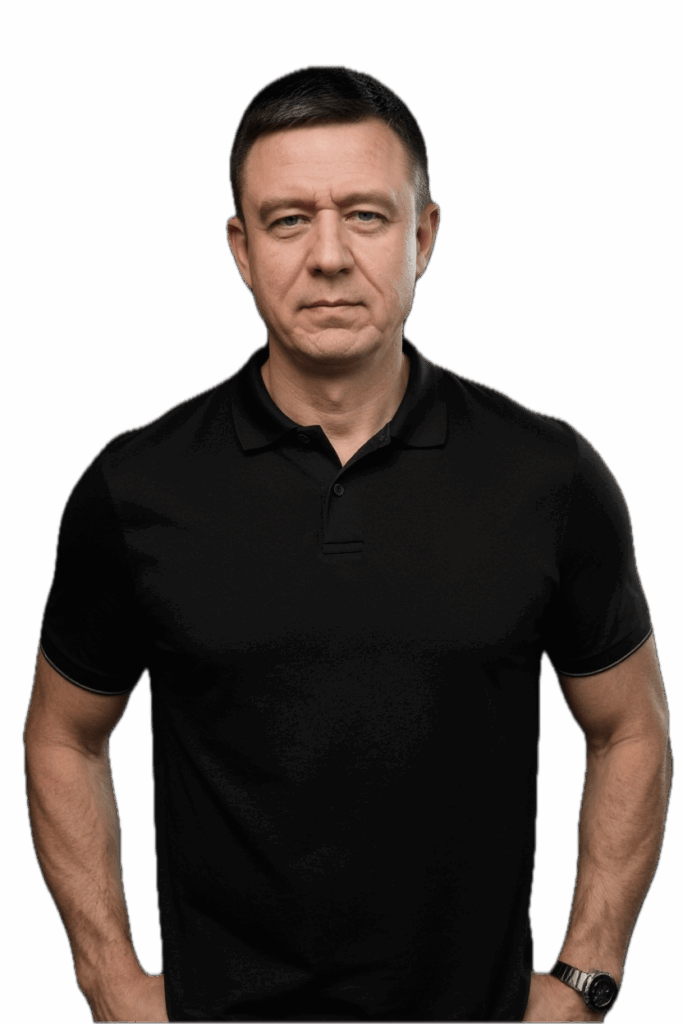
Vitaly’s professional background combines medicine, IT infrastructure, and large-scale system engineering.
Early work in intensive care and surgical environments shaped a core engineering principle that defines his approach today:
systems responsible for human safety must be deterministic, verifiable, and failure-aware.
Alongside clinical practice, he developed early telemedicine tools and digital health systems, later transitioning into infrastructure-scale engineering and system orchestration.
At VENDOR, Vitaly is responsible for:
- System-level architecture framing and decomposition
- Definition of validation logic and testability boundaries
- Risk modeling and failure-mode thinking
- Alignment of engineering work with TRL progression
- Long-term IP strategy and disclosure discipline
- Integration of engineering, regulatory, and economic constraints
His role is not operational micromanagement, but architectural coherence: ensuring that every subsystem evolves toward a verifiable, certifiable, and scalable whole.
Oleg Hartman
Co-Founder & CTO
Power Electronics, Control Systems, Industrial Architecture

Oleg is an engineer specializing in industrial power electronics and control systems for environments where failure tolerance is minimal and system behavior must remain predictable under load, stress, and long-term operation.
His professional background includes the design and deployment of power systems used in continuous-duty and mission-critical applications, where electrical stability, thermal margins, and control reliability are primary constraints.
Key technical competencies relevant to VENDOR include:
- Design of power conversion systems in the range from several kilowatts to megawatt-class installations
- Development of inverter and converter topologies for industrial loads
- Vector and scalar control methods for electric drives and power stages
- Soft-start, direct-start, and fault-tolerant operating modes
- Gate driver design for high-power switching elements (IGBT and thyristor-class devices)
- Integration of measurement, telemetry, and protection subsystems
- Thermal management and lifetime-oriented component selection
Before VENDOR, Oleg worked on systems where:
- power-stage instability directly translated into equipment loss,
- control errors could not be masked by software abstraction,
- maintenance windows were limited and costly.
At VENDOR, Oleg is responsible for:
- Overall power-system architecture and electrical topology
- Control logic governing pulse generation and operating regimes
- Safety interlocks and protection strategies
- Scalability of multi-module configurations
- Alignment between physical behavior and control-layer assumptions
His role anchors the system in engineering realism: every operating mode must be controllable, repeatable, and defensible under independent technical review.
Oleg Shnaider
System Architect
High-Speed Electronics, FPGA, Power Circuit Design
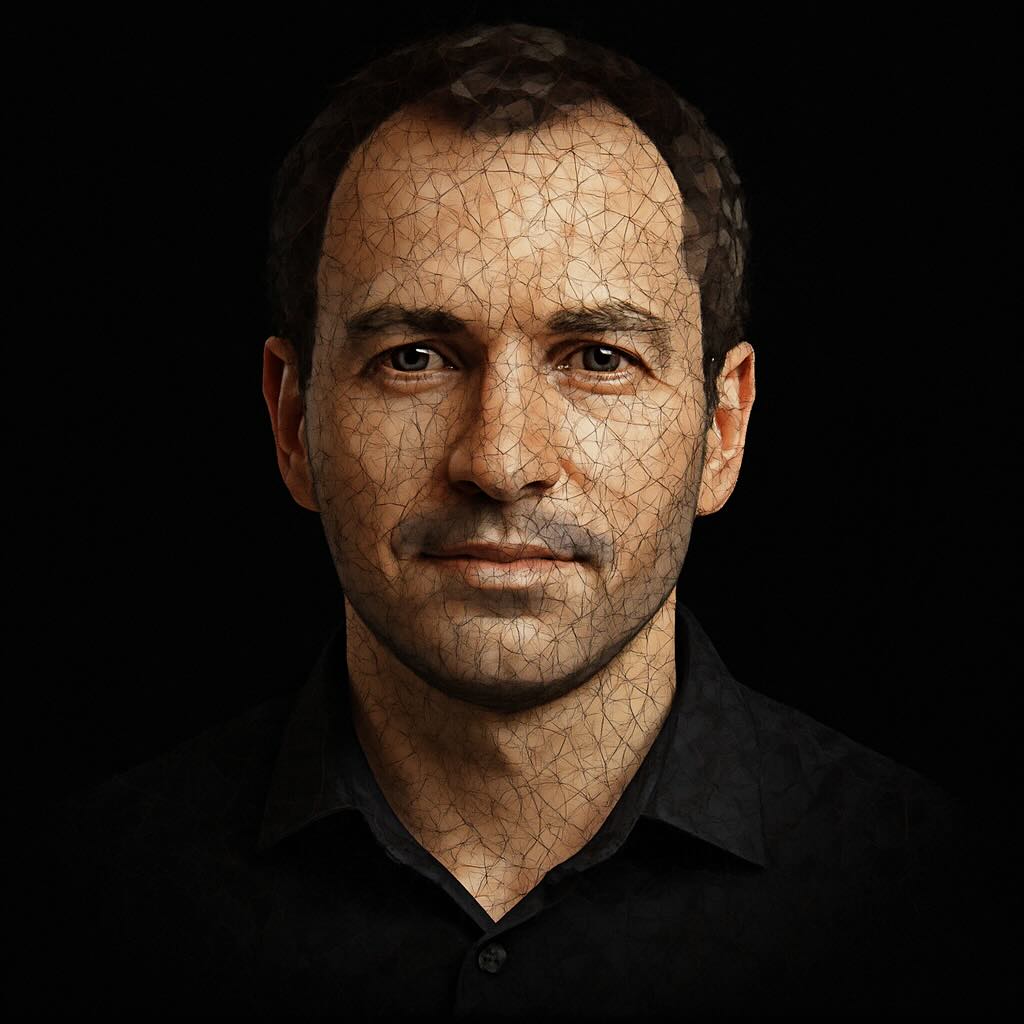
Oleg is a system-level hardware architect specializing in high-speed electronics, FPGA-based control, and precision power circuitry.
His engineering background is centered on systems operating near physical and electrical limits, where timing accuracy, signal integrity, and deterministic behavior are critical.
Relevant competencies for VENDOR include:
- Design of high-speed digital and mixed-signal circuits
- FPGA-based control logic and real-time signal processing
- Precise timing coordination across multiple hardware domains
- Development of protection logic for fast transient events
- Power electronics circuit optimization for efficiency and stability
- Noise immunity, grounding strategies, and EMC-aware design
- Debugging and validation of complex multi-board systems
Before joining VENDOR, Oleg worked on industrial modules where:
- component tolerances directly affected system survival,
- latency and jitter could not be abstracted away,
- hardware behavior had to match theoretical models under stress.
At VENDOR, he is responsible for:
- Low-level hardware architecture of control and synchronization blocks
- FPGA logic governing multi-module coordination
- Precision timing and threshold handling in pulse-resonant regimes
- Ensuring electrical behavior remains deterministic across operating envelopes
His contribution is critical where physics, electronics, and control theory intersect.
A Team Built for Hard Problems
This team was not assembled for presentation. It emerged around a technical problem that resists shortcuts.
What unites us is not titles, but engineering posture:
- We design systems that must remain stable under uncertainty
- We assume failure modes before they appear
- We validate behavior, not narratives
- We treat safety and repeatability as first-class requirements
The team works across:
- High-voltage hardware
- Nonlinear operating regimes
- Control systems with tight timing constraints
- Architectures that must pass independent validation
People joined VENDOR not through recruitment campaigns, but through recognition of the challenge.
If the question is whether this team can carry the technology forward:
the system already reflects the answer.