


How VENDOR.Energy™ Works
An Open Electrodynamic System — Explained Simply
What Class of System This Is
VENDOR is an open electrodynamic system operating entirely within classical physical laws.
It does not rely on fuel or chemical energy storage as a primary source of output power.
Instead, it operates by establishing and sustaining a controlled operating regime.
Within this regime, electrical energy circulates internally and becomes available for extraction through standard, well-understood electrical methods —without consuming fuel. A buffer may be present for startup, protection, and transients, but it is not the sustaining energy source in steady operation.
The surrounding environment participates only as a coupling medium that shapes boundary conditions.
Think: boundary-condition participation like antennas, resonators, and controlled-discharge systems — not an energy source term.
It is not treated as an energy source.
The Core Idea — In One Sentence
Three statements that define the operating logic of the system.
Energy is not created.
Energy is maintained within a controlled operating regime.
External input enforces the device-boundary balance: it covers unavoidable losses and any net energy delivered to the load, except during brief intervals where stored energy is being discharged.
Result: Everything that follows on this page is a consequence of regime formation + internal routing, while conservation is enforced at the complete device boundary.
Why This Is Not a Linear System
Most familiar power systems operate in a linear way:
- energy enters the system once
- energy exits the system once
- higher output requires proportionally higher input
This logic applies to engines, batteries, and most conventional generators.
VENDOR does not operate under this model.
Inside the system, energy does not pass through a single time.
It circulates repeatedly within an electrodynamic structure governed by a controlled operating regime.
As a result, the decisive factor is not how much energy is injected at the boundary, but how long and how densely energy is retained and circulated inside the system.
This distinction — between single-pass transfer and sustained internal circulation — is the fundamental reason VENDOR cannot be analyzed as a linear system.
The Three Functional Parts of the System
The system is intentionally divided into three functional roles, each with a distinct physical responsibility.
This separation is fundamental to stability, controllability, and correct energy balance.
Terminology note: On this page, regime (operating regime / mode) means a stable nonlinear operating state maintained by boundary conditions and control.
Active Core
Establishes and sustains a stable electrodynamic operating regime.
- energy oscillates between electric and magnetic fields
- the system operates in a nonlinear, impulse-driven mode
- internal energy circulation becomes significantly higher than the external energy required to compensate losses
Linear Extraction
Extracts usable electrical power through a separate linear path once the regime is stable.
- electromagnetic induction
- classical electrical conversion
- conventional power conditioning
Control & Buffer Layer
Ensures reliable operation under real-world conditions through control, protection, and short-term buffering.
- system start-up and shutdown
- transient load behavior
- protection limits and fault boundaries
- short-term buffering during transitions
Why This Architecture Matters
By separating mode generation, energy extraction, and control, the system avoids the fundamental instabilities that affect single-loop or single-function designs.
- stably
- predictably
- and in full compliance with classical electrodynamics
The Energy Balance — Explained Correctly
To avoid common misunderstandings, the system is described using three distinct energy quantities.
Each plays a different physical role and must not be conflated.
Energy that repeatedly circulates inside the electrodynamic operating regime.
This is not stored energy and not a one-pass transfer.
It is a sustained internal circulation enabled by the operating mode of the system.
Unavoidable dissipations associated with real physical systems, including:
- thermal losses
- radiative losses
- dielectric and conductive losses
- control and conversion overhead
These losses are intrinsic to maintaining the regime.
Energy supplied only to compensate B.
External input does not scale with output power.
It exists solely to offset irreversible losses and keep the operating regime stable.
- The output is not compensated.
- Only the losses are.
This distinction is critical.
Device boundary (always): External input = delivered load power + irreversible losses + storage change.
In a stable regime, the maintenance share of external input primarily offsets irreversible losses and control overhead, while output is extracted from internal circulation.
Internal circulation can exceed the maintenance share as long as the regime remains stable — but the net boundary balance still holds.
- classical electrodynamics
- open-system energy accounting
- conservation laws
No energy is created.
No hidden source is assumed.
Only regime stability determines whether internal circulation — and therefore usable output — exists.
What the Air Actually Does
It functions as:
a coupling medium
a controllable electrodynamic participant
part of the boundary conditions that define the operating regime
The system interacts with its environment the same way antennas, plasma systems, and resonant structures do:
through field-mediated interaction and controlled boundary conditions — not through “extraction” of energy from air.
Simple View:
How the VENDOR.Energy™ System Works
A simplified explanation for everyone
Important: this comparison is provided strictly for simplified understanding and is not an engineering description of the device or its actual physical schematic.
Scope fence: This analogy is strictly about functional separation and control loops. It does not imply energy extraction from the environment. At the complete device boundary, net output is accounted for by measured external input plus any change in stored energy.
Analogy: a heat pump or an air conditioner
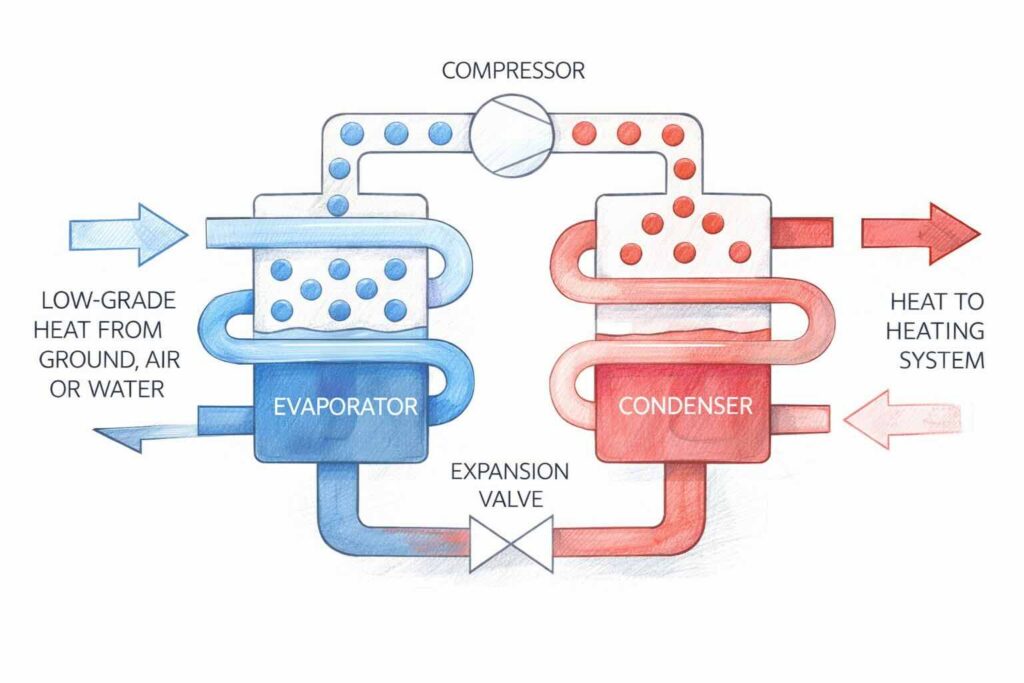
Many people are familiar with how a heat pump or an air conditioner works.
In such systems:
there are two loops, each with a different function
one loop interacts with the surrounding environment
the other loop delivers a useful effect (heat or cooling)
between them, there is an energy transfer,
governed by control and feedback
Because of this interaction, the system produces a stable effect that can look like an “amplified” result:
more heat indoors
or cooled air
At the same time:
heat is not created from nothing
the system works through process and mode control, not through fuel
Where the Analogy with VENDOR Applies
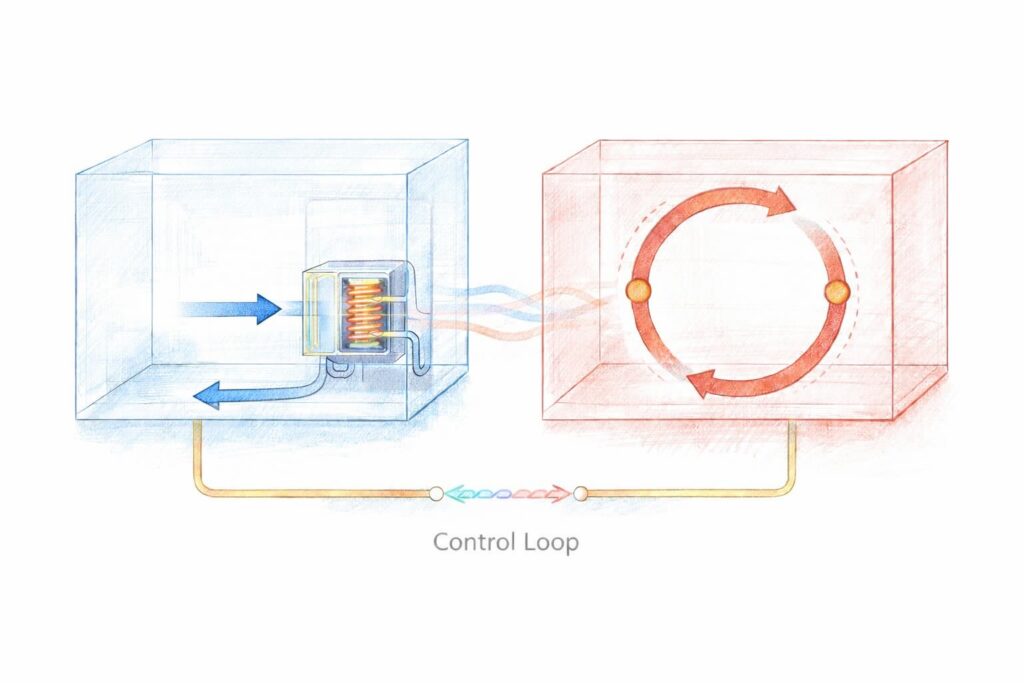
In a very general, intuitive sense, the VENDOR system works in a similar way:
the system also contains two functionally different loops
there is a controlled energy exchange between them
correct operation of these loops is impossible without:
a control loop
feedback
regime stabilization
It is mode control, not the energy source, that determines the outcome.
How to Read the Diagram (Simple View)
Where the Analogy Ends
It is important to draw a clear boundary here.
VENDOR is not a heat pump
VENDOR does not transfer heat
VENDOR does not use a refrigeration cycle
VENDOR does not replicate the physics of an air conditioner
The analogy is used only to explain the idea of two functional loops and the role of control,
not to describe the actual physical processes inside the system.
If all details are stripped away, one essential idea remains:
The result is determined not by an “energy source”,
but by how the system organizes and sustains its
operating regime
This is what makes stable, continuous, and predictable operation of the VENDOR system possible.
One Operating Mode — Two Functional Layers
The VENDOR system becomes much easier to understand when it is viewed through a familiar and well-established engineering analogy.
Think of it like a Faraday generator — but without mechanical rotation.
Active Core (right block) — the “rotor”, but not a mechanical one
In a classical generator, the rotor is the rotating part that establishes a time-varying electromagnetic state. It does not “create” energy by itself — it creates the operating mode that makes power generation possible.
In VENDOR, the role of the rotor is played by a controlled electrodynamic operating regime. Nothing physically rotates here. Instead, a stable, time-dependent regime of fields and processes is formed and maintained.
This regime behaves like a “non-mechanical rotor”: a dynamic state that enables energy to circulate, synchronize, and remain available for useful work.
Linear Extraction (left block) — the “stator” and power take-off
Just as in a conventional generator, power is not taken directly from the rotor itself. It is extracted inductively by a separate, linear structure — the equivalent of a stator winding.
In VENDOR, this left-hand block uses standard, well-known electrical methods (transformer action, induction, rectification) to convert the regime’s field dynamics into usable electrical power for external loads.
Why this can look like “gain” — and what actually happens
No energy is created, and nothing comes “from air.” What changes is how effectively the operating mode is established and sustained.
Once the regime is active, energy circulates inside the system for longer and in a more organized way. Only a portion of this circulating energy is extracted through the linear path.
External input energy is therefore used primarily to stabilize and control the operating mode — much like regulating a turbine in a hydroelectric generator — not to directly pay for the output power itself.
Engineering View:
Controlled Discharge & Resonant Coupling
Two-Contour Architecture
(Functional Separation at System Level)
The VENDOR system is built around a two-contour architecture, where each contour has a clearly defined functional role. This separation is intentional and fundamental to system stability, controllability, and predictable operation.
- establishing the electrodynamic operating regime
- sustaining internal regime conditions required for system operation
- operating independently of the output load
- no direct electrical output
- no power delivery to the consumer
- no standard input/output interfaces
- converting regime behavior into usable electrical power
- delivering power through standard electrical interfaces
- interacting directly with the load
- linear electrical behavior
- classical electromagnetic conversion
- predictable response to load conditions
- transfers regime conditions from the Active Core to the extraction path
- ensures functional separation between regime formation and power delivery
- prevents direct electrical coupling between the two contours
- start-up and shutdown sequences
- operating boundaries and protection limits
- transient load behavior
- short-term buffering and stabilization
- does not generate power
- does not define output capability
- exists exclusively for system robustness, safety, and repeatability
- Contour A defines the operating regime
- Contour B delivers usable power
- The linking chain connects them functionally, not electrically
- Control and buffering ensure stable operation under real conditions
Architecture Principles
Four Core Architecture Principles
Modular Scalability
The system is built from independent functional modules.
Deployment can begin with a single module and expand incrementally.
Scaling does not require architectural changes or redesign of the core system.
Distributed Energy Topology
Modules and nodes are designed to operate autonomously or as part of coordinated clusters.
This enables flexible deployment models and forms the basis for future distributed architectures
(e.g. cluster-based and networked configurations).
Failure-Tolerant Design
The system does not rely on a single critical module.
If one module becomes unavailable, remaining modules continue operation within defined limits.
Performance degrades predictably rather than through catastrophic failure.
Layered Safety & Control Logic
- Hardware-level protection (overvoltage, overcurrent, isolation)
- Software-level monitoring and diagnostics
- Defined fail-safe shutdown sequences
- Optional remote fault detection and isolation
Architectural Outcome
High operational availability, predictable maintenance behavior,
and long service life under real operating conditions.
Controlled Discharge & Resonant Coupling
(VENDOR.Max)
Controlled Discharge Regime (VENDOR.Max)
VENDOR.Max operates by forming and maintaining a controlled discharge regime, within which electrodynamic conditions remain stable and repeatable over time.
Engineering-Level Process Flow:
Atmospheric gas (working medium)
        ↓
High-voltage electrode system
        ↓
Controlled discharge initiation
        ↓
Nonlinear discharge transition regime
        ↓
Stabilized oscillatory discharge mode
        ↓
Resonant coupling to extraction circuits
Discharge Formation Stage
- High-voltage electrode geometry establishes controlled electric field gradients
- Localized microdischarge initiates ionization in the working medium
- Discharge behavior transitions into a stable, repeatable operating regime
- Regime stability is maintained through controlled boundary conditions
Resonant Coupling Stage
- Electrodynamic regime interacts with a dedicated resonant coupling network
- Energy transfer occurs through phase-consistent field interaction
- No direct electrical conduction between discharge region and output path
- Coupling remains passive with respect to regime formation
Regulation & Stabilization Stage
- Continuous monitoring of discharge behavior across modules
- Dynamic control of operating boundaries and timing
- Synchronization across parallel discharge elements
- Stabilized delivery to the DC bus through standard conditioning circuits
Engineering Boundary Note
This section describes system behavior and architecture at an engineering level. It does not provide a physical justification for regime formation. Specific parameters, control algorithms, and internal configurations are protected and intentionally abstracted.
Physical Consistency NoteVENDOR.Max operates within established principles of gas discharge physics, electrodynamics, and open-system energy accounting. No violation of conservation laws is claimed. System performance and energy balance remain subject to independent validation.
Engineering Process Flow
Working medium → controlled discharge regime → coupled extraction → stabilized output
Atmospheric Gas (as a Working Medium)
Ambient conditions act as a controllable boundary medium for the discharge regime (not a fuel, not an energy source).
High-Voltage Electrode System
Electrode geometry and insulation define controllable field boundaries for repeatable regime initiation.
Controlled Micro-Discharge Onset
Localized discharge onset establishes the initial conductivity state required for a controlled operating regime.
Avalanche-to-Streamer Boundary (Controlled)
The regime is maintained within defined operating boundaries so behavior remains stable and controllable.
Sustained Discharge Regime (Stabilized)
A controlled electrodynamic regime is sustained by feedback and protection limits, independent of output load behavior.
Resonant Coupling & Power Conditioning
Regime dynamics are coupled into a linear extraction path and conditioned into a stabilized DC interface for downstream systems.
Boundary Control
Ionization is treated as a controllable boundary element.
Regime Stability
Operation is defined by maintaining a stable regime, not by “feeding” it.
Coupled Extraction
Power is delivered via a separate linear path with standard conditioning.
Important: This flow is an engineering abstraction. It describes functional stages and control intent, not a reproducible implementation.
Language boundaries: No claims of thermodynamic violation. At the complete device boundary: P_{in,ext} = P_{load} + B_{total} + dE/dt. External input includes loss compensation and control overhead, and it also closes the net balance of delivered output.
Architecture (Multi-Module Cascade)
Parallel Multi-Module Architecture
VENDOR.Max is implemented as a distributed, parallel architecture composed of multiple coordinated functional modules.
This approach is chosen to ensure stability, scalability, and predictable operation under real-world conditions.
System Structure
Input & Initialization Module
- Provides controlled low-voltage initialization of the system
- Manages start-up sequencing and controlled activation of operating modes
- Implements current limiting and basic electrical protection
- Does not function as a primary power source
Active Discharge Core (Multi-Module)
- Composed of multiple discharge modules operating in parallel
- Modules are coordinated to operate in a synchronized regime
- Architecture is designed to maintain stable operating conditions across modules
- Parallelization reduces localized electrical and thermal stress
Energy Coupling & Conditioning Layer
- Interfaces the operating regime with standard electrical conversion stages
- Provides rectification and conditioning for stabilized DC output
- Supports downstream AC conversion via conventional inverters
- Includes standard electrical protection mechanisms
- Exposes industry-standard electrical and communication interfaces
Control & Supervision System
- Monitors system state and operating boundaries in real time
- Coordinates module behavior to maintain stable operation
- Detects fault conditions and performs isolation when required
- Supports diagnostics and supervisory functions
Rationale for Parallel Architecture
- Improves system reliability through functional redundancy
- Enables graceful degradation instead of abrupt failure
- Allows modular scaling without architectural redesign
- Reduces single-point-of-failure risks
This section describes system architecture and functional roles only.
Detailed implementation, coordination mechanisms, and internal control logic are intentionally abstracted at this level.
Multi-Module Parallel Architecture
Distributed functional modules coordinated through a common DC interface
VENDOR.Zero Architecture
Solid-State Micro-Conversion
VENDOR.Zero is engineered for low-voltage, continuous output in embedded and micro-IoT use cases. It is a solid-state architecture — not atmospheric ionization.
Mechanism (Disclosure Boundary): VENDOR.Zero operates through a solid-state micro-conversion architecture. Implementation details remain protected as trade secrets pending additional IP filings. What can be confirmed: it does not rely on piezoelectric, triboelectric, thermal, or speculative effects. It functions as a regulated converter with very low internal losses.
Where It Fits
IoT sensors and edge devices
Smart building automation
Distributed monitoring networks
Wireless sensor power
Key advantage: designed to eliminate battery replacement cycles in supported use cases — with a predictable, install-and-maintain-minimal approach.
Operating Conditions & Limitations
Environmental requirements (targets): the parameters below reflect prototype testing at TRL 5. Full validation across all conditions remains ongoing and subject to independent verification.
Temperature Range
- Operating: −20°C to +50°C (representative, subject to validation)
- Storage: −40°C to +60°C
Humidity
- Functional across a wide humidity range (under characterization)
- Specific performance characteristics may vary with humidity
Altitude
- Target operational envelope up to 2000 m (under characterization)
- Higher-altitude configurations possible with system adjustment
Environmental Sealing
- Designed for IP54 (baseline protection)
- IP65-class and higher available in hardened enclosures (subject to validation)
Known Limitations
- Output characteristics depend on ambient conditions (under characterization)
- Startup requires a low-voltage DC input (9–24V typical) for initialization
- Not suitable for explosive atmospheres without additional certification
- Electromagnetic compatibility under validation (CE / UL pathway)
Deep Tech View:
TRL 5 Validation & Mathematical Framework
For Researchers & Validators
This section addresses the question that inevitably arises for researchers, physicists, and technical validators:
“If this is not fuel — then how does the system sustain internal circulation and the operating regime?”
There are no simplified analogies here, and no engineering instructions.
And no references to “energy from air”.
We explain, step by step:
what an operating regime means in the context of open electrodynamic systems,
why sustaining a regime is not equivalent to “feeding” energy,
how loss compensation fundamentally differs from a power source.
The explanation is provided:
without schematics,
without frequencies,
without numbers,
without reproducible parameters.
Only principles consistent with classical electrodynamics and open-system physics.
The goal of this section is to provide sufficient understanding for correct evaluation,
but insufficient detail for reproduction.
Why This Can Look Counterintuitive
If you expect every energy system to behave like a fuel engine or a battery, the VENDOR architecture can feel unfamiliar. That intuition comes from a linear mental model — but many established technologies work by holding a regime, not by “pushing energy through” once.
The default assumption is straightforward: energy is supplied, immediately consumed, and the result scales proportionally with the input.
VENDOR does not rely on this “single-pass” intuition. It belongs to a class of systems where the decisive factor is the ability to organize, retain, and stabilize a working regime.
Lasers
The laser medium does not “produce” energy. Energy is accumulated and held inside an optical cavity until the operating regime becomes stable. The key factor is not raw source power, but the conditions that maintain the regime.
Resonators & High-Q Systems
In resonant structures, internal fields can become much stronger than the external excitation. This is not because the source is amplified, but because losses are low, phases are coherent, and energy remains organized inside the regime.
Power Grids & Reactive Circulation
Large-scale grids rely on circulating reactive energy. It is not consumed by the load directly, yet it is essential for stability, synchronization, and reliable operation of the whole system.
In all these cases, the key factor is not energy input “by itself,” but the system’s ability to
hold, organize, and stabilize the operating regime.
VENDOR applies the same physical logic — in a different regime and a different medium.
Physics of Regime Maintenance
Physics of Regime Maintenance
In the VENDOR system, the operating regime is not an energy flow and not a continuous power input process. It is a stable state of an electrodynamic system that exists as long as specific conditions are preserved.
The system does not “feed” the regime with energy. Instead, it organizes and maintains the conditions under which the regime can exist autonomously.
Ionization in VENDOR is not a source of energy, not fuel, and not generation. It is used strictly as a tool for managing system boundary conditions.
- medium conductivity
- phase relationships between processes
- admissible states in which internal circulation is possible
Ionization does not add energy to the system. It defines which regimes are physically allowed to exist.
Energy inside the regime is not injected, created, or extracted from the environment. It is redistributed, retained, and circulates within an established system state.
The regime exists not because energy is constantly supplied, but because internal losses are sufficiently low and system structure supports stability.
Linear Thinking
To keep rotation or process running, energy must be continuously supplied.
Regime Thinking (VENDOR)
Rotation is not fed. It exists as long as regime conditions are preserved.
External energy is used only for one purpose: compensation of irreversible losses.
- thermal
- dielectric
- radiative
- control-related
It does not pay for output power and is not the source of circulation.
- ❌ Feeding rotation — no
- ✅ Maintaining the regime — yes
- ❌ Energy “from air” — no
- ✅ Controlled boundary conditions — yes
Mathematical Framework
Theoretical Foundations
This block lists the core theoretical elements used to interpret VENDOR’s operating regime in established terms.
It is provided for scientific context only and does not disclose implementation details.
Core Physics:
- Paschen’s Law (Context):
- Breakdown behavior as a function of pressure–distance relationships
- Used to define admissible operating windows for stable discharge regimes
- Supports regime classification (no fixed operating points disclosed)
- Townsend Avalanche Dynamics:
- Electron multiplication described with classical Townsend mechanisms
- Secondary emission treated as part of stability analysis
- Streamer transition considered a regime boundary under critical conditions
- Resonant Circuit Theory:
- Interpretation of coupling and extraction via established resonant models
- Phase coherence and impedance alignment as stability factors
- No frequencies, tuning methods, or quantitative parameters are disclosed
- Soliton Analogy (Analytical Framework):
- References to electrostatic solitary structures used strictly as an academic analogy
- Helps describe localized, self-consistent regime structures
- Analogy only — not a literal implementation
Important Disclaimer:
This framework is based on established plasma physics and electromagnetic theory.
Soliton-related references are analytical analogies only. Specific implementation details are patent-protected.
Validation Status & Technology Readiness
Technology Readiness Level Timeline
From Laboratory Concept To Commercial Deployment
- System-level prototype validated in a relevant (but not operational) environment
- Multi-module architecture tested
- 1000+ hours of continuous operational data collected
- Performance characteristics documented
- Failure modes identified and mitigated
- Not yet fully operational environment (TRL 6)
- Not yet pilot-scale deployment (TRL 7)
- Not yet commercial production (TRL 8–9)