
EV Range Extenders: Onboard Generators and New Power Architectures
How range-extended EVs turn fuel into electricity, which models are on sale, which are announced or delayed, and what non-fuel options exist.
An EV range extender is an onboard energy converter, usually a small petrol engine driving a generator, that produces electricity for the battery and the traction bus while only electric motors turn the wheels. A car built this way is a range-extended electric vehicle (EREV or REEV), a form of series hybrid. The architecture is mainstream in China, where EREVs reached 1.17 million retail sales in 2025, about 9% of new-energy car retail sales [1]. In Europe and North America, most announced EREVs are still ahead of production as of October 2026. Below: how the energy chain works, which systems are in series production, which are announced, and which are still in research.
What is an EV range extender (EREV)?
An electric vehicle range extender is a power source that adds electrical energy to an electric vehicle without any mechanical connection to the wheels. Technically, an EREV is a series hybrid. In a conventional EREV, the combustion engine drives an electric generator that feeds the high-voltage DC traction bus and/or charges the battery; the battery and the traction inverter sit on the same bus. A fuel cell can supply electricity to the same bus without a mechanically driven generator. In both cases, the wheels are driven by electric motors only.
- EREV vs BEV. A battery electric vehicle has no onboard converter. An EREV often carries a smaller battery, such as 17.8 kWh in the Mazda MX-30 e-Skyactiv R-EV [3] or 28.4 kWh in the Leapmotor C10 REEV [4], although Chinese SUVs and MPVs now pair the range extender with mid-size packs, for example 63.3 kWh in the Xpeng X9 EREV [5].
- EREV vs PHEV. In a parallel plug-in hybrid the engine can drive the wheels; in an EREV it cannot. Subsidy and tax rules still often treat both alike: Germany’s 2026 EV subsidy applies one rule to plug-in hybrids and EVs with range extender (at most 60 g CO2/km or at least 80 km electric range) [6], and China’s purchase-tax rules cover “plug-in (including extended-range)” cars, requiring at least 100 km of equivalent electric range from 1 January 2026 [7].
- Plug or no plug. An EREV can be charged from the grid. Series hybrids without a socket share the layout but take all their energy from fuel, so they are not range extenders in the sense used here.
How does a range extender work?
A range extender converts the chemical energy of fuel into electricity on board, so every kilometre driven on the generator passes through an engine, a generator, power electronics and the electric drive. In charge-depleting mode the car runs as a BEV until the battery reaches a set threshold; in charge-sustaining mode the engine starts and holds the battery around that level while power peaks come from the battery. Some models also let the driver start the range extender generator early: the Mazda MX-30 R-EV offers Normal, EV and Charge modes, and its generator also starts on kickdown [3].
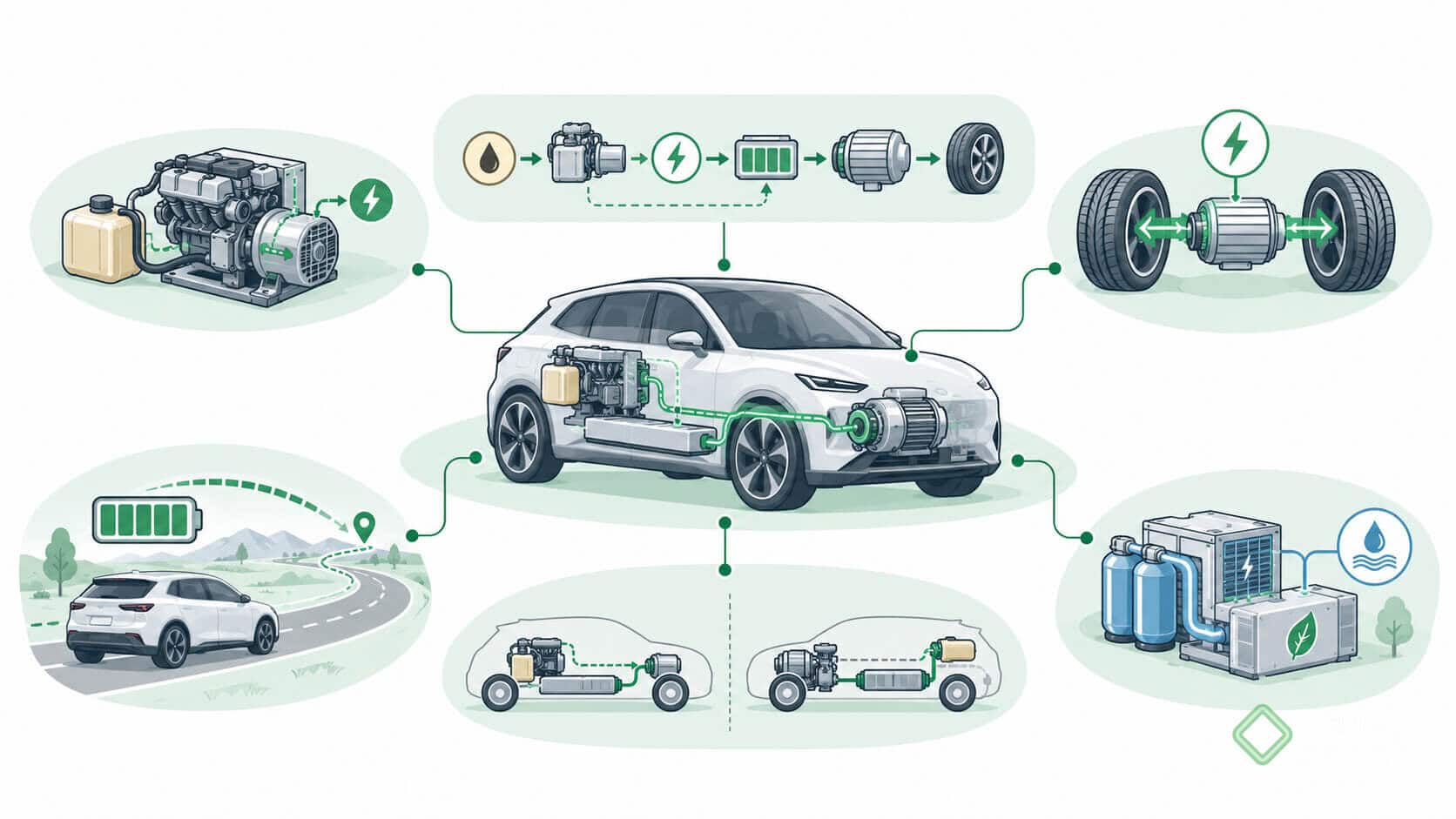
Because the engine is decoupled from the wheels, it can stay in a narrow speed and load window. Changan’s Deepal quotes an average thermal efficiency of 44.39% for the 1.5-litre unit in the S07 and 3.7 kWh of electricity per litre of petrol [8]; this is a manufacturer figure for the engine in its operating window, not a journey average for the car. For comparison, the U.S. Department of Energy estimates that a conventional petrol car loses 64% to 75% of its fuel energy in the engine [9]. The losses downstream of the engine still apply:
| Stage | Assumed efficiency | Cumulative share of fuel energy |
|---|---|---|
| Engine, fuel to shaft (best operating window) | 40% | 40.0% |
| Generator and rectifier, shaft to DC bus | 93% | 37.2% |
| Battery buffering (only if energy is stored first) | 95% | 35.3% |
| Inverter, motor and gearbox, DC bus to wheel | 88% | 31.1% |
In litres: with Deepal’s stated 3.7 kWh per litre [8], a vehicle drawing 20 kWh/100 km from its DC bus needs about 5.4 L/100 km in charge-sustaining mode (20 ÷ 3.7), and about 6.5 L/100 km at 24 kWh/100 km. ADAC lists the Mazda MX-30 R-EV at 18.3 kWh/100 km on electricity and 8.3 L/100 km with an empty battery (WLTP) [10].
The structural consequence is that a range extender brings back what the battery-electric car removed: a fuel tank (50 L in the MX-30 R-EV [3], 60 L in the Xpeng X9 EREV [5]), an exhaust with aftertreatment, oil and coolant circuits, engine service, exposure to fuel prices and tailpipe CO2 for every litre burned. The real-world result depends on charging habits: Deutsche Umwelthilfe, citing a T&E analysis of Chinese market data, puts average EREV consumption with an empty battery at about 6.7 L/100 km [11].
Which cars have a range extender? Series production, past and present
Range extenders reached European series production with the BMW i3, but the centre of the market has moved to China.
- BMW i3 REx (until 2018 in Europe). A water-cooled two-cylinder petrol engine rated at 25 kilowatts with a 9-litre tank added up to 150 km [12]. In October 2018 BMW announced it would drop the REx in Europe, citing gains in electric range and more rapid charging, although the option had made up 60% of i3 sales; it remained available in North America and Japan [13]. The i3, launched in 2013, ended production in June 2022 after about 250,000 units [14].
- Mazda MX-30 e-Skyactiv R-EV (2023 to 2026 in Europe). A rotary engine used purely as a generator, a 17.8 kWh battery, 85 km WLTP electric range and a 50 L tank [3]; ADAC lists the engine at 830 cc [10]. In January 2026 Mazda confirmed it was phasing the model out in Europe, where it had sold relatively poorly [15].
- Leapmotor C10 REEV (since 2025). Presented for Europe at the Brussels Motor Show in January 2025: 28.4 kWh battery, 145 km WLTP electric range and a 1.5-litre engine as generator [4]. Deliveries began in mid-April 2025, with a combined WLTP range of over 970 km [29].
In China, the China Passenger Car Association (CPCA) counted 1.17 million EREV retail sales in 2025 (+6.0%), against 7.88 million BEVs and 3.40 million conventional PHEVs, out of 12.81 million new-energy vehicles [1]. Momentum has slowed: in August 2026 EREV retail fell 22.2% year on year to 81,000 units, while BEVs were the only type still growing [2].
| Model | Launch | Battery (manufacturer, kWh) | Range (CLTC) | Source |
|---|---|---|---|---|
| AITO M8 EREV (Seres/Huawei) | 16.04.2025 | not stated | 1,526 km combined | [16] |
| Deepal S07 EREV (Changan) | updated 19.09.2025 | 31.7 or 39.1 kWh | 230 or 300 km electric | [8] |
| Xpeng X9 EREV | 20.11.2025 | 63.3 kWh | 452 km electric; 1,602 km combined | [5] |
Li Auto, the brand most associated with the EREV vehicle in China, delivered 406,343 vehicles in 2025, 18.81% fewer than in 2024, and according to a LatePost report cited by CnEVPost is preparing a realignment of its EREV line-up [17]. The AITO M8 passed 170,000 deliveries in its first year, with EREV and BEV versions on sale [16].
Which range extenders are announced for Europe and North America?
Announced EREVs for the US and Europe are mostly pickups and large SUVs, and several timelines have already moved. Status as of October 2026:
- Ram 1500 REV (formerly Ramcharger). In September 2025 Stellantis stopped developing a full-size battery-electric pickup and moved the REV name to the range-extended Ramcharger [18]. A supplier memo reported by Automotive News in September 2026 moved the launch from a mid-2026 target to mid-April; Stellantis said “Ram for 2027” [19].
- Jeep Grand Wagoneer EREV. Per the same memo, production moved from May to November 2026; Stellantis said “Jeep for this year” [19].
- Ford F-150 Lightning EREV. In December 2025 Ford said production of the current Lightning would end that year and announced the next generation as an EREV with an estimated range of more than 700 miles, to be built at the Rouge Electric Vehicle Center; launch timing is still to be announced [20].
- Hyundai Santa Fe EREV. Hyundai’s first EREV, for the US, expected in the first half of 2027, US-built, with a projected range of 600 miles [21].
- Scout Traveler and Terra “Harvester”. Scout targets production in 2027 and deliveries in 2028; more than 87% of reservation holders chose the range extender. An AutoForecast Solutions report of April 2026 put Traveler production in September 2028; Scout declined to comment [22].
- Volkswagen ID. Era 9X. Developed with SAIC for China, the group’s first range-extender model (1.5-litre turbo petrol engine as range extender, 51.1 or 65.2 kWh battery). In July 2026 VW was reported to be evaluating it for Europe; the plans were at an early stage [23].
- Toyota. Nikkei reports a plan to build EREVs in China from April 2027; this is a report, not an announcement [24].
Trade rules add a European question for China-built EREVs. The EU’s definitive countervailing duty on Chinese battery-electric cars, adopted on 29 October 2024, covers cars propelled solely by electric motors “including those with an internal combustion range extender” under customs code 8703 80 10; plug-in hybrids, whose engine can also drive the wheels, fall outside that definition [30]. After talks on 8–9 October 2026, the EU and China announced an “understanding on trade in hybrid vehicles”; the joint statement gives no volumes or product scope [31]. Which customs code, and therefore which duty, applies to an individual range-extender model is a question of customs classification.
Beyond fuel: hydrogen, trailers and solar
Range extenders that do not burn petrol have so far stayed in pilots or failed commercially.
- Hydrogen fuel cell. Hyvia, the Renault and Plug Power joint venture founded in 2021, built the Renault Master H2-Tech with a 30 kW fuel cell, a 33 kWh battery and 6 kg of hydrogen for about 500 km [25]. Hyvia entered administration on 10 December 2024 [25] and announced its liquidation in February 2025, for lack of a credible takeover offer [26].
- Range-extender trailers. The EV range extender trailer reached a pilot with EP Tender: trailers booked in advance and picked up before joining the motorway, powered by battery, gasoline or hydrogen; the concept stayed in a pilot phase until EVs are approved for towing light trailers [27].
- Vehicle-integrated solar. For the Aptera three-wheeler, TÜV Rheinland measured up to 4.75 kilowatt-hours per day from the solar body in sunny conditions, which Electrek estimates at about 40 miles of daily driving. As of 1 October 2026, deliveries are planned for early 2027, subject to financing [28].
| Architecture | Energy source onboard | Status (October 2026) | Example (year) |
|---|---|---|---|
| Petrol range extender, small battery | Petrol | Ended | BMW i3 REx (until 2018 in Europe) |
| Rotary-engine range extender | Petrol | Withdrawn from Europe | Mazda MX-30 R-EV (2023–2026) |
| Petrol EREV, mid-size battery | Petrol | Series production, mainly China | AITO M8, Xpeng X9 EREV (2025) |
| Petrol EREV sold in Europe | Petrol | Series production | Leapmotor C10 REEV (2025) |
| Petrol EREV pickup or SUV, North America | Petrol | Announced, 2026–2028 | Ram 1500 REV (2027 target) |
| Hydrogen fuel-cell range extender | Hydrogen | Supplier liquidated | Renault Master H2-Tech, Hyvia (2025) |
| Range-extender trailer | Battery or fuel in trailer | Pilot only | EP Tender |
| Vehicle-integrated solar | Sunlight | Pre-production | Aptera (deliveries targeted 2027) |
| Onboard architecture supplying traction power without a stored reserve | No stored reserve drawn down | Research and development | None in series production |
New power architectures: can the traction bus be supplied without fuel?
As of October 2026, no onboard architecture in series production independently supplies the traction power a journey needs without drawing down a stored energy reserve (fuel, hydrogen or battery charge); the approaches in this class are research and development projects. Other non-fuel routes answer different questions. Vehicle-integrated solar is the closest to market, but it delivers a daily amount of energy, not traction power on demand: even on a purpose-built lightweight three-wheeler it yields up to 4.75 kilowatt-hours a day in sunny conditions [28]. Fuel cells burn no fuel in an engine, but they consume hydrogen stored on board and need a refuelling network, and the van programme in this article ended in liquidation [25][26]. Engineers can screen any proposal in this class with the questions that apply to a petrol range extender: what continuous power reaches the DC bus and at what voltage; how the net energy balance is measured, by whom and with what uncertainty; what evidence exists on a verified integration on a target platform rather than on a bench; and what service life, safety case and homologation route apply. Announced range figures are not evidence here; independent measurement on a defined configuration is.
Our direction: VENDOR.Drive
Every fuel range extender in this article, in production or announced, works inside the same energy logic: the energy for the journey is carried as a stored reserve, in a battery, a fuel tank or both, and refilled at a station. We are developing VENDOR.Drive as a different answer to that constraint. Project stage: TRL 2 — Technology concept formulated. We are engineering it as an onboard energy architecture for vehicle manufacturers and engineering partners to integrate into their electric transport platforms: built for integration, not as a VENDOR vehicle. VENDOR.Drive is not a fuel range extender, and it is not a stationary VENDOR.Max placed in a vehicle: it is a dedicated propulsion-energy implementation of the VENDOR architecture.
From energy reservoir to power buffer: our goal is to change the job of the traction battery, from the reservoir that has to hold the whole journey to a battery layer that starts the architecture and covers short traction peaks such as acceleration. Our design objective is driving without planning the next charging stop and, after arrival, power for compatible external loads from the same system; reaching it on a given vehicle depends on the verified energy balance of that integration and the requirements of its platform.
We engineer it platform by platform. DC-bus coupling voltage, the transient current envelope, the thermal envelope and the control interfaces are set with each partner. For each target platform, power delivery, operating limits and the contribution to vehicle range are to be established by measurement and validation of that integration, the evidence standard this article applies to every architecture above. Where the energy comes from, and how it is to be measured independently, is set out on Where does the energy come from and Technology Validation.
Frequently asked questions
Is an EREV better than a PHEV?
Neither is better in general. An EREV always drives electrically, so it feels like a BEV and its engine can run at efficient points, but on long motorway trips all energy passes through the generator chain. A parallel PHEV can drive the wheels directly from the engine at speed, avoiding conversion losses. Subsidy rules often treat the two alike, for example in Germany’s 2026 scheme, while the EU’s duty on Chinese battery-electric cars separates them. The buyer comparison is in EREV vs BEV vs PHEV.
Can a range extender be retrofitted to an existing EV?
Not as a series-production product. Retrofitting would mean adding a fuel system, an exhaust and a high-voltage connection to an approved vehicle, which changes its type approval. The approach that reached a pilot was the towed unit: EP Tender proposed trailers booked in advance for motorway trips, but its pilot depended on EVs being approved for towing light trailers. Portable generators for emergency charging are a different, much slower use case.
Can an EREV be driven without fuel?
Yes, within its battery range. In charge-depleting mode an EREV runs purely on grid electricity: 85 km WLTP for the Mazda MX-30 R-EV or 145 km WLTP for the Leapmotor C10 REEV. Once the battery reaches its threshold the generator must run, so long trips still need fuel. For owners who charge daily, trips within that electric range need no fuel.
Why are range extenders common in China but rare in Europe?
China combines EREV-focused brands, demand for large SUVs and MPVs, and tax rules that count EREVs as new-energy vehicles when they meet range and consumption thresholds; EREVs reached 1.17 million retail sales in 2025. In Europe, BMW and Mazda withdrew their range-extender models in 2018 and 2026, and new entries come mostly from Chinese brands such as Leapmotor or from China-developed models.
- CnEVPost (CPCA data) — China Dec NEV retail sales hit record high, with full-year 2025 by powertrain (09.01.2026). cnevpost.com
- CnEVPost (CPCA data) — China’s August NEV retail sales fall 10%, but penetration hits record 65.2% (08.09.2026). cnevpost.com
- Mazda Motor Corporation — Mazda reveals Mazda MX-30 e-Skyactiv R-EV in Europe (13.01.2023). newsroom.mazda.com
- Stellantis / Leapmotor International — Leapmotor unveils the C10 REEV at the 2025 Brussels Motor Show (20.12.2024). media.stellantis.com
- CnEVPost — Xpeng launches X9 EREV with 1,602-km range (20.11.2025). cnevpost.com
- German Federal Environment Ministry (BMUKN) — FAQ: Welche Plug-In-Hybride und Elektrofahrzeuge mit Range-Extender sind förderfähig? (as of 19.01.2026). bundesumweltministerium.de
- MIIT, Ministry of Finance, State Taxation Administration — Announcement 2025 No. 24 on technical requirements for NEV purchase-tax relief 2026–2027 (22.09.2025). fgk.chinatax.gov.cn
- CnEVPost — Changan Deepal launches updated S07 SUV equipped with Huawei driver assist system (19.09.2025). cnevpost.com
- U.S. Department of Energy / EPA, fueleconomy.gov — Where the Energy Goes: Electric Cars (accessed 20.10.2026). fueleconomy.gov
- ADAC Autokatalog — Mazda MX-30 e-SKYACTIV R-EV Makoto (01/25–01/26), technical data (accessed 20.10.2026). adac.de
- Deutsche Umwelthilfe — Hintergrundpapier: Plug-In-Hybride und Reichweitenverlängerer im Kontext der Flottengrenzwerte (16.12.2025). duh.de
- Elring — Engine flyer: BMW i3 Range Extender (accessed 20.10.2026). elring.de
- electrive — Europe: BMW to discontinue range extender option for i3 (07.10.2018). electrive.com
- electrive — It’s over: BMW delivers last i3 electric cars (07.08.2022). electrive.com
- electrive — Mazda discontinues the MX-30 R-EV (14.01.2026). electrive.com
- Gasgoo — AITO M8 Deliveries Surpass 170,000 Units (16.04.2026). autonews.gasgoo.com
- CnEVPost — Li Auto delivers 44,246 cars in Dec, down 24% year-on-year (01.01.2026). cnevpost.com
- TechCrunch — Ram ends EV pickup truck plans (12.09.2025). techcrunch.com
- GM Authority (citing Automotive News) — Ram 1500 REV, Jeep Grand Wagoneer EREV Launches Delayed (04.09.2026). gmauthority.com
- Ford Motor Company — Next-Gen F-150 Lightning EREV Delivers Electric Torque, 700+ Mile Range, and Powerful Towing (15.12.2025). fromtheroad.ford.com
- Jalopnik — Hyundai Santa Fe Will Offer The Brand’s First EREV Powertrain And 600-Mile Range (26.08.2026). jalopnik.com
- Jalopnik — Scout Terra Pickup Reportedly Won’t Go Into Production Until March 2030, And The Traveler SUV Is Delayed Until September 2028 (08.04.2026). jalopnik.com
- electrive — Volkswagen considers bringing China-developed EVs to Europe (01.07.2026). electrive.com
- CnEVPost (citing Nikkei Asia) — Toyota plans China-made extended-range EVs in 2027 to broaden lineup, report says (20.09.2026). cnevpost.com
- NewMobility News — Renault’s hydrogen subsidiary Hyvia still gasps for air (17.02.2025). newmobility.news
- Auto Infos — Hyvia nous dit officiellement adieu, Hyvia topic page (20.02.2025). auto-infos.fr
- Mission Innovation — Electric tenders for extending electric vehicle range (EP Tender) (updated 28.06.2019). mission-innovation.net
- Electrek — Aptera (SEV) now says it needs $25M to start production, stock drops 15% (01.10.2026). electrek.co
- Stellantis / Leapmotor International — Experience the Leapmotor C10 Range Extended EV. Arriving at European Dealerships in April (08.04.2025). media.stellantis.com
- EUR-Lex — Commission Implementing Regulation (EU) 2024/2754 of 29 October 2024 imposing a definitive countervailing duty on imports of new battery electric vehicles designed for the transport of persons originating in the People’s Republic of China, consolidated text of 11.02.2026, Article 1(1) (accessed 20.10.2026). eur-lex.europa.eu
- European Commission — Joint Statement at the second meeting of the EU-China Trade and Investment Consultations, Beijing, 8–9 October 2026 (STATEMENT/26/2122, accessed 20.10.2026). ec.europa.eu
Further reading
VENDOR.Drive
the onboard energy architecture we are developing for electric transport platforms, its application classes and integration principles.
Explore 02Where does the energy come from
where the energy in the VENDOR architecture comes from and how it is to be measured independently.
Explore 03Technology Validation
the published protocol for independent verification: device boundary, criteria and what counts as evidence.
Explore


