
How to Increase EV Range Without a Bigger Battery
Speed, heating, tyres and load decide most of your range. What helps, by how much, and where the energy balance sets the limit.
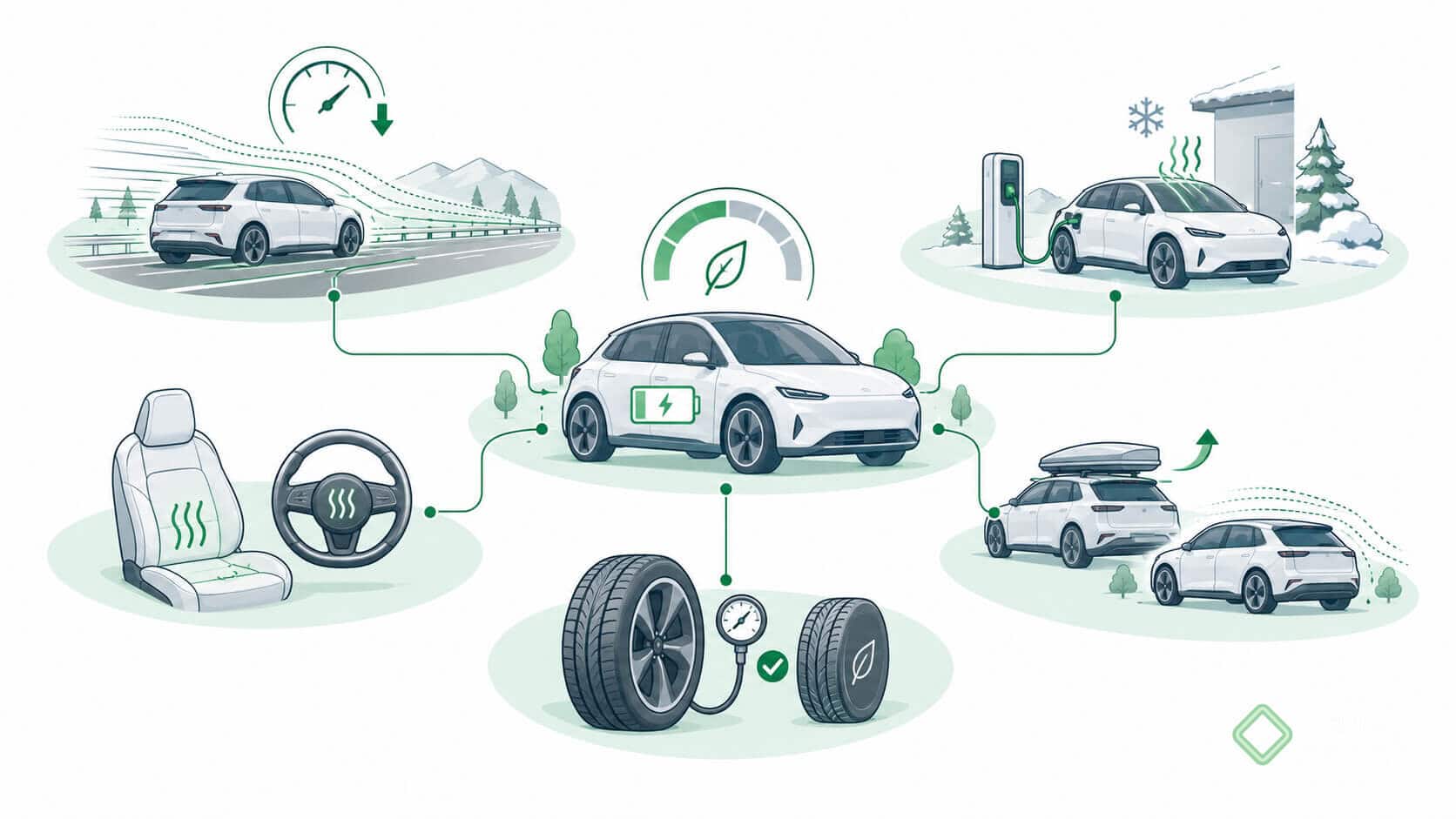
If you want to know how to increase EV range, the biggest levers are the ones you control: drive 10–20 km/h slower on the motorway, heat the seats rather than the cabin air, pre-condition the car while it is still plugged in, keep tyres at the correct pressure and take the roof box off. Range is usable battery energy divided by consumption. Most driving measures work by lowering consumption; increasing usable energy or adding an onboard energy source changes the other side of the range equation.
What determines EV range?
EV range is usable battery energy divided by energy consumption per distance. A car with 60 kWh of usable energy that consumes 16 kWh/100 km covers about 375 km; at 22 kWh/100 km the same battery gives about 273 km. Nothing about the battery changed — only consumption did.
| Usable energy | 16 kWh/100 km | 18 kWh/100 km | 22 kWh/100 km | 26 kWh/100 km |
|---|---|---|---|---|
| 60 kWh | 375 km | 333 km | 273 km | 231 km |
| 80 kWh | 500 km | 444 km | 364 km | 308 km |
Consumption itself is the sum of a few physical losses: aerodynamic drag, tyre rolling resistance, the energy needed to accelerate the car (partly recovered by regenerative braking), drivetrain losses, and auxiliary loads such as heating and air-conditioning. Electric drivetrains are already efficient: the US Department of Energy estimates that EVs convert over 77 % of the electrical energy from the grid into power at the wheels [11]. For a given starting charge, route and weather, with no charging on the way, that leaves three ways to extend EV range:
- Store more usable energy — a bigger or denser battery.
- Consume less per kilometre — speed, aerodynamics, tyres, mass, heating, drivetrain efficiency.
- Add an energy source on board — a fuel range extender, solar cells, or another onboard architecture.
This is the energy-balance boundary. Regenerative braking belongs to the second column: it lowers net consumption by returning part of the energy already spent. Charging on the way does not add range per charge; it starts the next leg with a new store of energy. Every tip in this article belongs to one of the three columns.
How can I increase my EV range today?
The most effective ways to increase EV range are speed, climate control and tyres; together they usually matter more than any accessory or setting.
Drive slower on the motorway
Aerodynamic drag grows with the square of speed, so the power needed to overcome it grows with the cube. At motorway speeds drag dominates consumption. In a back-to-back test, Automobile Propre drove two identical MG4s at 110 and 130 km/h: consumption averaged 17.0 and 20.4 kWh/100 km, about 20 % more at the higher speed [10].
| Constant speed | Model consumption | Range from 60 kWh | Consumption vs 90 km/h |
|---|---|---|---|
| 90 km/h | 14.3 kWh/100 km | 418 km | — |
| 100 km/h | 16.2 kWh/100 km | 370 km | +13 % |
| 110 km/h | 18.3 kWh/100 km | 327 km | +28 % |
| 120 km/h | 20.7 kWh/100 km | 290 km | +44 % |
| 130 km/h | 23.2 kWh/100 km | 259 km | +62 % |
Check tyre pressure, tyre type and wheel size
Rolling resistance is the second large loss and the dominant one at town speeds. For combustion cars the DOE estimates that under-inflation costs about 0.2 % of fuel economy per 1 psi drop [8]; an EV is affected by the same physics. In the model above, 10 % more rolling resistance raises consumption by about 3 % at 110 km/h and about 6 % at 50 km/h. Check pressures monthly and when temperatures fall, use the load-dependent pressure from the door placard, and look at the rolling-resistance class on the EU tyre label when replacing tyres. Larger, wider wheels add rolling resistance and drag; manufacturers often homologate a lower official range for the same model on bigger wheels, so the wheel option is a range decision.
Heat people, not air
Cabin heating is the largest auxiliary load. Seat, steering-wheel and screen heating work more efficiently than air heating, according to ADAC [1]. The DOE recommends pre-heating the cabin while the car is plugged in and using seat warmers instead of the cabin heater [6]; ADAC notes that pre-conditioning for about 15 minutes from the grid costs no range [1]. A heat pump helps further: Recurrent’s fleet data show about 10 % more range at 0 °C for cars equipped with one [4].
Use regenerative braking and anticipation
Regenerative braking turns kinetic energy back into electricity, but every conversion loses some of it. The most efficient braking is the braking you avoid: look ahead, lift off early and let the car coast or regenerate gently instead of braking hard late. Regeneration is limited when the battery is cold or nearly full.
Remove weight and drag you do not need
Roof boxes and roof racks cost range at speed. In an ADAC test with a Kia EV6 at an average of 120 km/h, a rear bike carrier increased consumption by about 8 %; carrying the same two bicycles on the roof instead of at the rear raised it by a further 25 % [9]. For conventional cars, the DOE estimates that a roof-top cargo box reduces fuel economy by 10–25 % at 65–75 mph [7]. Mass matters less than drag at constant motorway speed but more in stop-and-go traffic, where every acceleration costs energy.
Use the efficiency settings the car already has
Eco or range modes typically soften acceleration and limit climate output; navigation-based battery pre-conditioning warms the battery before a fast-charging stop so it charges faster; in most cars it starts automatically only when route guidance to a fast charger is active [14]. The gain differs by model, so check the owner’s manual.
Charge with the trip in mind
Charging strategy changes two different things, and only one of them is range. Range per charge grows only with the energy on board at departure: charging to full right before a long trip and starting with a warm battery, ideally still plugged in, gives you more usable energy, especially in winter. Journey time is a separate matter. Charging power falls off much faster above about 80 % state of charge, so for long motorway trips ADAC advises unplugging at 80 % [14]; several short stops in the fast part of the charging curve usually get you there sooner than waiting for 100 %, but they do not add a kilometre of range per charge.
Why does EV range drop in winter, and how much?
Winter range drops mainly because cabin and battery heating consume energy and because cold batteries deliver and accept energy less readily. Typical losses are 20–40 %, worst on short trips from a cold start.
| Source | Conditions | What is measured | Result |
|---|---|---|---|
| Recurrent, 2025/2026 [4] | Over 30,000 US cars, 34 models, real-world data | Range retained | Average 78 % at 0 °C, 70 % at −7 °C |
| AAA, 2019 [5] | Five EVs, −7 °C (20 °F), heater on | Range change | −41 % |
| DOE/EPA [6] | −7 °C (20 °F) vs 24 °C (75 °F), heater not used | Range change | About −12 % |
| ADAC/Green NCAP [1] | 23 km short trip, −7 °C vs +23 °C | Consumption change | +38 % to +107 % (average range about 40 % lower) |
| ADAC real driving [1] | 100 km at 0 °C vs +20 °C | Consumption change | +21 % to just over +30 % |
| ADAC winter motorway test, 2025 [2] | 582 km Munich–Berlin, 0 °C, up to 130 km/h, 25 models | Consumption vs official figure | About +50 % for 18 of 25 models |
| NAF El Prix, 28 January 2026 [3] [20] | 24 cars, Norwegian roads, extreme cold: −6 to −32 °C along the route | Range vs WLTP figure | −28.9 % to −45.9 %, average −37.8 % |
Results vary by model, trip and heating, so they show the size of the effect, not a forecast for one car.
Two practical conclusions follow. First, the short trip is the worst case: on a 23 km cold-start trip, heating the cabin and battery is a large share of total energy, which is why ADAC’s short-trip losses exceed its 100 km results [1]. Second, the heater is the main driver: the DOE’s analysis attributes about two-thirds of the extra winter consumption to cabin heating [6]. To increase EV range in winter, start with heating: pre-condition on the grid, use seat heating and, when buying, choose a car with a heat pump. ADAC’s motorway tests show the combined effect of cold and speed. In 2025 a Cupra Born rated at 594 km WLTP covered 325 km, while the Mercedes EQS was the only car to complete the 582 km without stopping, at 20.4 kWh/100 km [2]. In the January 2026 round with 14 family cars on the same route, no car finished without a stop; the Audi A6 Avant e-tron went furthest, 441 km at 23.2 kWh/100 km, and the Tesla Model Y was the most efficient at 22.2 kWh/100 km [19].
What can the vehicle itself change?
Beyond driver behaviour, the vehicle can improve EV range only through more efficient hardware or an additional energy source on board.
Drivetrain efficiency. Silicon-carbide (SiC) inverters can cut switching and conduction losses compared with silicon parts; how much depends on the components, the voltage class, the switching frequency and the operating point. Efficient motors, low-loss gearboxes and smart thermal management add further gains. Because the drivetrain already converts most of the energy [11], the larger gains come from aerodynamics and mass. Mercedes-Benz’s Vision EQXX, a research car built around minimum drag and mass, drove 1,008 km from Stuttgart to Cassis at 8.7 kWh/100 km and, in June 2022, 1,202 km from Stuttgart to Silverstone at 8.3 kWh/100 km [15] — a demonstration of how far efficiency can go, not a production model.
Fuel range extenders. An extended-range electric vehicle (EREV) is an EV with a small combustion engine that drives a generator to recharge the battery; the engine has no mechanical connection to the wheels. EREVs answer EV range anxiety by carrying fuel, with the emissions, maintenance and refuelling that come with it. See our explainer EV range extenders explained.
Vehicle-integrated solar. Solar cells on the body add a small amount of energy. Lightyear claimed its Lightyear 0 could add up to 70 km of range per day under clear skies and about 20 km in cloudier Dutch conditions; it suspended production in January 2023, weeks after it began, and its operating company was declared insolvent [16]. Sono Motors stated up to 245 km a week, 112 km on average, for its Sion [18] — about 16 km a day — and terminated the programme in February 2023 to focus on solar technology for buses and other manufacturers’ vehicles [17]. These are manufacturer claims, not independent measurements. Illustrative calculation: 350 W of roof cells × 5 full-sun hours on a summer day ≈ 1.8 kWh ≈ 11 km at 16 kWh/100 km; on a winter day with about 1 full-sun hour, about 2 km. Useful as a trickle, not as a solution.
Why not just fit a bigger battery?
A bigger battery adds range, but each extra kilowatt-hour also adds mass, cost and charging time. The average new battery-electric car sold in 2025 carried close to 70 kWh in the EU, below 60 kWh in China and around 90 kWh in the United States [13]. At the latest-generation cell energy densities the IEA reports, up to 205 Wh/kg for LFP and 265 Wh/kg for NMC [13], the cells alone of a 70 kWh battery weigh about 264–341 kg; housing, cooling and structure add more.
| Item | 60 kWh battery | 80 kWh battery |
|---|---|---|
| Extra mass of the cells only, 265–205 Wh/kg (complete pack heavier) | — | about +75 to +98 kg |
| Extra cost of the complete pack at US$ 99/kWh (BEV pack price 2025) | — | about US$ 1,980 |
| Model consumption at 110 km/h (+98 kg) | 18.3 kWh/100 km | 18.6 kWh/100 km |
| Model range at 110 km/h | 327 km | 429 km |
| Extra time for the added 20 kWh at an average 100 kW | — | about 12 min |
In this model a third more energy buys slightly less than a third more range, because the battery also has to carry itself. The larger penalties are outside the energy balance: the extra pack costs money and raw materials, makes the car heavier for everything else it does, and takes longer to refill. Battery prices have fallen — BloombergNEF reported a record-low average of US$ 108/kWh across all segments in 2025 [12] — but the trade-off remains: a bigger battery stores more, it does not consume less.
Where VENDOR.Drive comes in
Every measure above works inside the same boundary: stored energy divided by consumption. We are developing VENDOR.Drive for the third column, an energy source on board. Project stage: TRL 2 — Technology concept formulated. We are engineering it as an onboard energy architecture for vehicle manufacturers and engineering partners to integrate into their electric transport platforms: built for integration, not as a VENDOR vehicle. From energy reservoir to power buffer: our goal is to change the job of the traction battery, from the reservoir that has to hold the whole journey to a battery layer that starts the architecture and covers short traction peaks. Our design objective is driving without planning the next charging stop and, after arrival, power for compatible external loads from the same system; reaching it on a given vehicle depends on the verified energy balance of that integration and the requirements of its platform. VENDOR.Drive is not a fuel range extender. For each target platform, power delivery, operating limits and the contribution to vehicle range are to be established by measurement and validation of that integration. Where the energy comes from, and how it is to be measured independently, is set out on Where does the energy come from and Technology Validation.
Frequently asked questions
How can I increase my EV range?
Reduce consumption. Drive 10–20 km/h slower on motorways, where drag grows with the square of speed; keep tyres at the recommended pressure; remove roof boxes and racks; pre-condition the car while it is plugged in; and use seat and steering-wheel heating instead of warming the cabin air. Eco modes and smooth, anticipatory driving with regenerative braking help further. Together, these measures typically make a larger difference than any single accessory.
Do smaller wheels increase EV range?
Usually yes. Larger and wider wheels and tyres increase rolling resistance and aerodynamic drag, and many manufacturers state a lower official range for the same model with bigger wheels. The effect depends on the tyre as much as the rim: a narrow tyre with a good rolling-resistance class on the EU tyre label helps most. If you are choosing a new EV, compare the official range for the exact wheel option you are buying.
Can you increase EV range without a bigger battery?
Yes, by lowering consumption: slower motorway speeds, correct tyre pressure, less drag from roof loads, efficient heating and smart use of pre-conditioning. In a published test, driving at 110 instead of 130 km/h cut consumption by about 17 %. Beyond consumption, only an additional energy source on board — a fuel range extender, solar cells or another onboard architecture — can add range without a larger battery.
Why does EV range drop in winter?
Cold weather increases consumption mainly through cabin and battery heating, and cold batteries are less willing to deliver and accept energy. Recurrent’s data on over 30,000 cars show average range retention of 78 % at 0 °C and 70 % at −7 °C. Short trips from a cold start are hit hardest. Pre-conditioning on the grid, seat heating and a heat pump reduce the loss.
What affects EV range the most?
Speed and temperature. At motorway speeds aerodynamic drag dominates, so a 20 km/h difference can change consumption by a fifth or more. In winter, heating can add a large share to consumption, especially on short trips. After those come tyres and wheel size, roof loads, mass in stop-and-go traffic, and driving style. Battery ageing also reduces usable energy, but usually more slowly than people fear.
- ADAC — Elektroauto im Winter: So sinken die Reichweiten bei Eis und Schnee (20.11.2024, accessed 20.10.2026). adac.de
- ADAC — Großer ADAC E-Auto-Winter-Test: Wie gut klappt die Langstrecke? (31.01.2025). adac.de
- NAF (Norwegian Automobile Federation) — Disse bilene er med i El Prix vinteren 2026, results table (21.01.2026, updated 02.10.2026). naf.no
- Recurrent — Best EV for Winter & Cold Weather Range (19.11.2025). recurrentauto.com
- AAA — Icy Temperatures Cut Electric Vehicle Range Nearly in Half (07.02.2019). newsroom.aaa.com
- US DOE / EPA, fueleconomy.gov — Fuel Economy in Cold Weather (accessed 20.10.2026). fueleconomy.gov
- US DOE / EPA, fueleconomy.gov — Driving More Efficiently (accessed 20.10.2026). fueleconomy.gov
- US DOE / EPA, fueleconomy.gov — Keeping Your Vehicle in Shape (accessed 20.10.2026). fueleconomy.gov
- ADAC — ADAC Test zur Reichweite: Elektroauto mit Fahrradträger oder Anhänger (09.08.2022). adac.de
- Automobile Propre — Voiture électrique : rouler à 110 km/h au lieu de 130 km/h permet-il vraiment d’aller plus vite ? (11.10.2023). automobile-propre.com
- US DOE / EPA, fueleconomy.gov — All-Electric Vehicles (accessed 20.10.2026). fueleconomy.gov
- BloombergNEF — Lithium-Ion Battery Pack Prices Fall to $108 Per Kilowatt-Hour, Despite Rising Metal Prices: BloombergNEF, press release (09.12.2025). about.bnef.com
- International Energy Agency — Global EV Outlook 2026: Electric vehicle batteries (20.05.2026). iea.org
- ADAC — E-Auto schnellladen leicht gemacht: So laden Sie richtig (07.08.2025). adac.de
- Mercedes-Benz Group — VISION EQXX: efficiency record on the road trip to England (23.06.2022). group.mercedes-benz.com
- WhichCar — Solar-powered EV maker Lightyear files for bankruptcy, future unclear (31.01.2023). whichcar.com.au
- Sono Motors — Sono Motors Commits to Focus Exclusively on Solar Tech Company, and Has Terminated the Sion Program, press release (24.02.2023). ir.sonomotors.com
- auto motor und sport — Sono Motors Sion (2023): Marktstart, Preis, Reichweite (accessed 20.10.2026). auto-motor-und-sport.de
- ADAC — Winter-Stresstest: Wie reisetauglich sind E-Autos für Familien? (22.01.2026). adac.de
- NAF (Norwegian Automobile Federation) — El Prix 2026, main test report: test day 28 January 2026 and route temperatures (updated 02.10.2026). naf.no
Further reading
VENDOR.Drive
the onboard energy architecture we are developing for electric transport platforms, its application classes and integration principles.
Explore 02Where does the energy come from
where the energy in the VENDOR architecture comes from and how it is to be measured independently.
Explore


